Your CEO Didn’t Send That Email. Here’s How to Tell.
An email lands in your inbox. It looks exactly right.
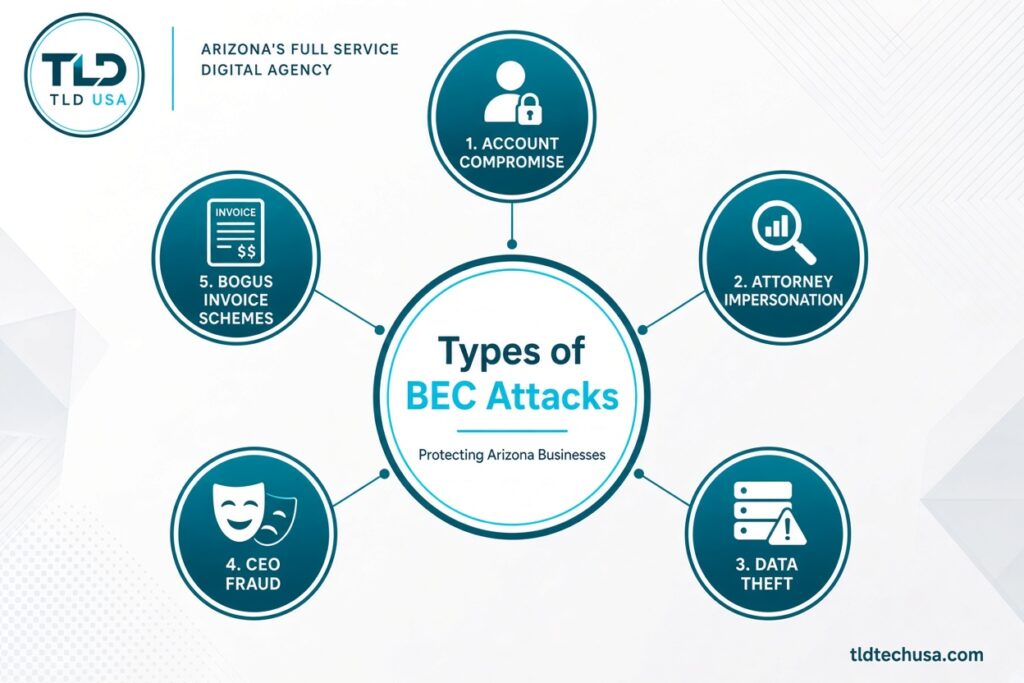
It comes from your boss, or maybe a vendor you’ve worked with for years. Asking for an urgent wire transfer or a quick payment on an overdue invoice. Nothing about it looks off. That’s the problem. This is a business email compromise scam, and AI has made it dramatically harder to spot than it was even two years ago.
Quick answer: A business email compromise scam uses a convincing fake email, often generated or refined with AI, to trick an employee into wiring money or paying a fraudulent invoice. Unlike typical phishing, these emails usually contain no malicious links or malware, so they slip past traditional spam filters. The best defense is a verification process that requires confirming any financial request by phone before acting, regardless of how legitimate the email looks.
Table of Contents
Why This Scam Is Getting So Much Worse
How It Actually Works
Why Small Businesses Get Targeted
Building a Verification Process That Actually Works
What to Do If You Already Sent the Money
A Simple Next Step
Frequently Asked Questions
Why This Scam Is Getting So Much Worse
AI changed everything about this scam almost overnight.
Attackers used to rely on generic, poorly written emails full of obvious red flags. Now they use AI tools to write flawless, personalized messages that mimic a specific person’s tone and writing style. On top of that, reported losses from these attacks have climbed sharply year over year, with the average loss per incident now well into six figures.
Because these emails rarely include a malicious link or attachment, traditional spam filters often let them through without a second look. So the burden shifts almost entirely to the human reading the email.
How It Actually Works
Most attacks follow one of two patterns.
In the first, scammers impersonate a company executive, requesting an urgent wire transfer while framing the situation as time-sensitive and confidential. In the second, scammers compromise or spoof a trusted vendor’s email, sending a fake invoice that looks identical to a real one, sometimes even updating banking details on a legitimate-looking follow-up.
Either way, the scam depends entirely on urgency and trust. It works because the request feels routine, and questioning it feels awkward or insubordinate in the moment.
Why Small Businesses Get Targeted
Larger companies typically have layered approval processes that naturally slow down financial requests.
Small businesses often don’t, since speed is part of what makes a small team functional. That same efficiency becomes the exact vulnerability this scam exploits.
Attackers also know that small businesses frequently lack dedicated IT security staff. Because of that, a smaller team is often seen as an easier, faster target than a large enterprise with a security operations center watching every transaction.
Building a Verification Process That Actually Works
Require a callback for any financial request over a set threshold.
Use a phone number you already have on file, never one provided in the email itself.
Treat urgency as a warning sign, not a reason to skip verification.
A genuine request can wait the extra few minutes it takes to confirm.
Watch closely for last-minute banking detail changes.
A vendor suddenly updating their payment information, especially via email alone, deserves a direct phone call before anything gets paid.
Train your entire team, not just finance staff.
Office managers, administrative assistants, and anyone with payment access are common targets, even when the email impersonates someone above them.
Use email authentication protocols.
Setting up SPF, DKIM, and DMARC on your domain helps prevent attackers from successfully spoofing your own company’s email address.
What to Do If You Already Sent the Money
Contact your bank immediately. Time matters enormously here, since funds are often moved out of the receiving account within hours.
File a report with the FBI’s Internet Crime Complaint Center. This creates an official record and, in some cases, assists with fund recovery efforts.
Notify anyone else who might be targeted next. If one vendor relationship was compromised, others connected to it may be at risk too.
If your CRM and lead tracking already centralize your vendor and customer communications, that visibility can help you spot unusual account activity faster. Our guide on CRM for small business covers building that kind of centralized system.
A Simple Next Step
Business email compromise scams keep getting more convincing, not less. A simple verification process, set up before you need it, closes most of this risk for very little effort or cost.
How can I tell if an email is a business email compromise scam?
Look for urgency, requests to bypass normal approval steps, and any change to payment or banking details. Since AI-written emails often contain no obvious grammar errors anymore, verification by phone matters more than spotting red flags in the writing itself.
Do spam filters catch these emails?
Not reliably. Many of these emails contain no malicious links or attachments, which lets them bypass traditional filters designed to catch malware-based phishing.
Is a small business really a likely target?
Yes, often more so than larger companies. Small businesses are frequently targeted specifically because they tend to have fewer internal approval layers and less dedicated security staff.
What’s the single most effective defense?
A mandatory callback verification process for any financial request, using a phone number you already have on file rather than one included in the email.
Final Thoughts
Business email compromise scams have quietly become one of the most financially damaging cyber threats facing small businesses today, and AI is only making them more convincing. A straightforward verification habit, built into how your team already handles payments, closes most of this risk without requiring expensive new software.
TLD USA helps Scottsdale and Phoenix businesses set up practical email security and verification processes to protect against modern scams like this one.
Your Google Ads budget disappears every day, right on schedule, but the phone isn’t ringing to match it.
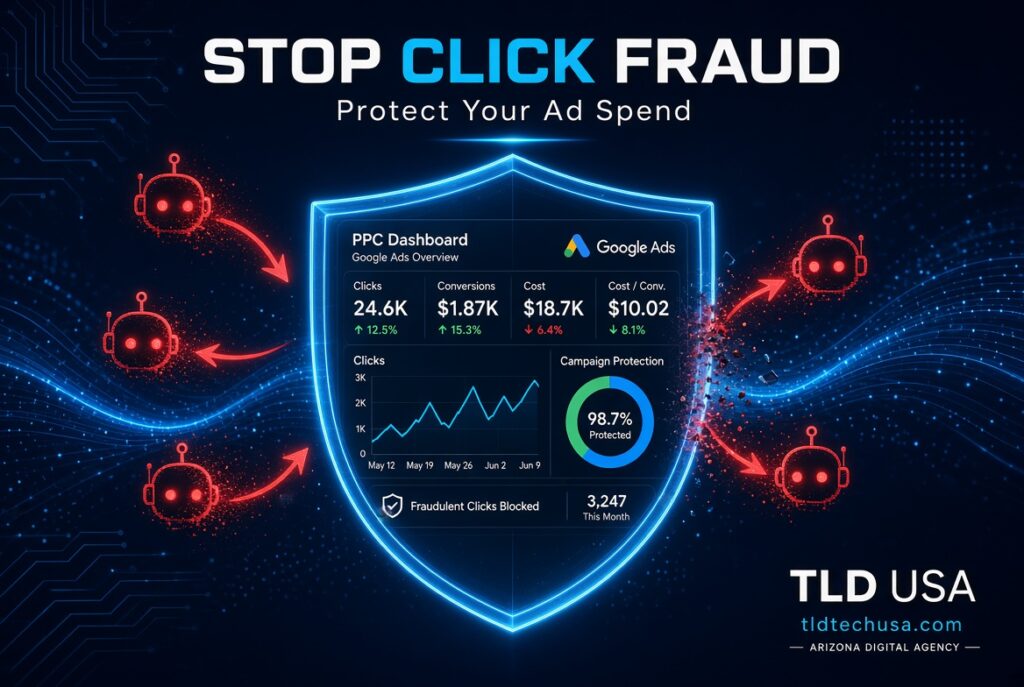
Before assuming your ads just aren’t working, consider a less obvious possibility: click fraud Google Ads campaigns quietly drain real budget every single day, and it happens far more often than most business owners realize.
Quick answer: Click fraud on Google Ads happens when bots, competitors, or click farms repeatedly click your ads with no real intent to buy, wasting your budget and corrupting your performance data. Industry data consistently shows double-digit invalid click rates across Google Ads, with local service industries like plumbing, HVAC, and legal services hit especially hard. Monitoring your click patterns and setting up IP exclusions are the most effective first steps to fight back.
Table of Contents
Why This Costs More Than Just Wasted Spend
Who’s Actually Doing This
How to Spot Click Fraud in Your Own Account
What to Do About It
Why Local Service Businesses Get Hit Hardest
A Simple Next Step
Frequently Asked Questions
Why This Costs More Than Just Wasted Spend
The direct financial hit is obvious.
Every fraudulent click burns real budget on someone who was never going to become a customer.
Still, the bigger problem often runs deeper than that. Google’s Smart Bidding and other automated bidding tools learn from your conversion data. So if fraudulent clicks or fake conversions slip through, the algorithm can start optimizing toward more of that same low-quality traffic, quietly making your entire account worse over time.
Because of that second-order effect, click fraud doesn’t just cost you today’s budget. It can actively steer your campaigns in the wrong direction going forward.
Who’s Actually Doing This
Competitors trying to exhaust your daily budget.
By repeatedly clicking your ads early in the day, a competitor can push your budget to zero fast, then enjoy cheaper, less competitive placement for the rest of the day.
Automated bot networks.
Large-scale bot traffic, sometimes running through infected devices, generates clicks that look like real human traffic to most basic fraud detection.
Low-quality ad placements.
Certain Display Network placements attract disproportionate amounts of accidental or fraudulent clicks, particularly on mobile apps designed to generate accidental taps.
How to Spot Click Fraud in Your Own Account
Watch for unusual click patterns from the same location.
Repeated clicks from a single IP address, especially at the same time of day on the same keywords, is a strong signal.
Compare your click-through rate to your conversion rate over time.
A sudden spike in clicks with no corresponding increase in leads or conversions deserves a closer look.
Check your Display Network placements regularly.
A small number of placements are often responsible for a disproportionate share of low-quality clicks.
Review your geographic and device performance data.
Fraud often concentrates in specific locations or device types that don’t match your typical customer base.
What to Do About It
Set up IP exclusions for repeat offenders. Once you identify a suspicious IP address, excluding it prevents further wasted spend from that specific source.
Use Google’s own invalid click reporting. Google does track and sometimes refund invalid clicks, though its detection generally catches less than independent, dedicated fraud monitoring tools.
Consider a dedicated click fraud protection service for high-spend accounts. For businesses spending significant monthly budget, a real-time monitoring tool can catch and block fraud far faster than manual review.
Keep your conversion tracking clean and accurate. This matters for more than just fraud detection. Our guide on local marketing tracking for Phoenix and Scottsdale businesses covers why accurate tracking is foundational to every marketing decision you make.
Why Local Service Businesses Get Hit Hardest
Industries with high cost-per-click, including plumbing, HVAC, legal services, and other local service categories, are disproportionately targeted. That’s because each fraudulent click costs more in these industries, making them a more attractive target for competitors trying to drain a rival’s budget quickly and cheaply.
If your business operates in one of these categories, click fraud monitoring isn’t an optional add-on. It’s a meaningful part of protecting your actual marketing return.
A Simple Next Step
Wasted ad spend from click fraud is one of the more invisible drains on a marketing budget, precisely because it looks like normal traffic on the surface. A closer look at your account’s click patterns often reveals more waste than expected.
How much of my ad budget is typically lost to click fraud?
Industry data commonly shows double-digit invalid click rates on Google Ads, though this varies significantly by industry and how aggressively you monitor for it.
Does Google Ads automatically filter out fraudulent clicks?
Google does some filtering, but independent research consistently shows its detection catches meaningfully less than dedicated third-party fraud monitoring tools.
Can I get a refund for fraudulent clicks?
Yes, in some cases, if you can provide clear evidence. Google does offer refunds for confirmed invalid clicks when properly documented.
Is click fraud protection worth it for a smaller ad budget?
It depends on your spend level and industry, but even a modest monthly budget in a high-CPC category can justify basic monitoring, since the wasted spend adds up quickly.
Final Thoughts
Click fraud is a quiet, ongoing drain on Google Ads budgets, and it’s easy to mistake for simply “ads that aren’t working.” For Scottsdale and Phoenix businesses running paid search campaigns, a closer look at click patterns often uncovers real, recoverable waste hiding in plain sight.
TLD USA helps local business owners audit and protect their Google Ads campaigns so budget actually reaches real, qualified customers.
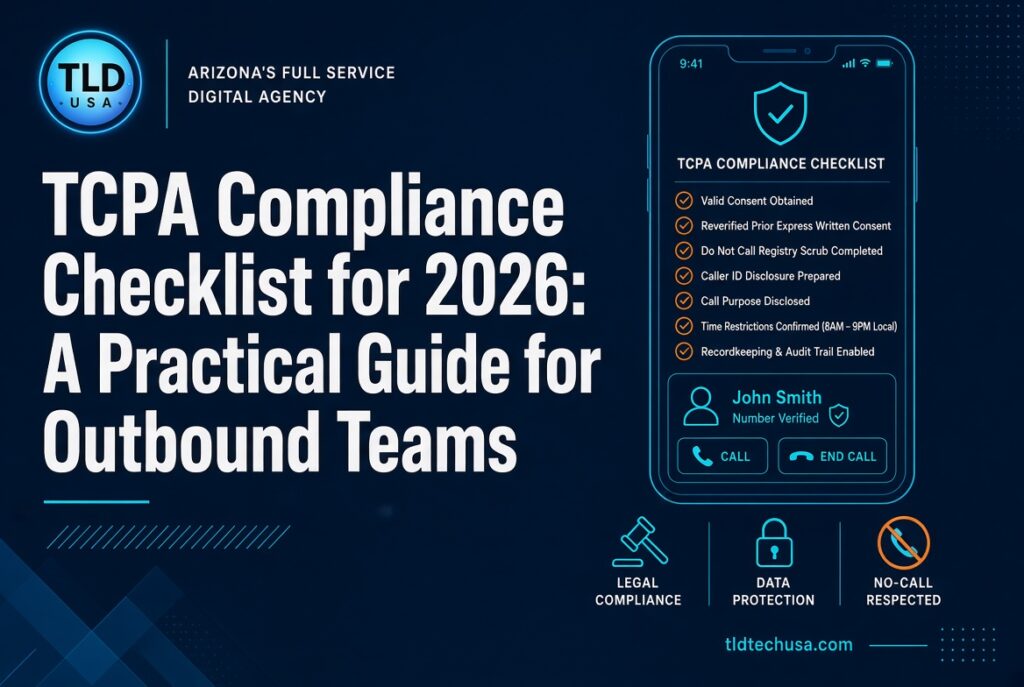
A TCPA text message lawsuit can cost $500 to $1,500 per message sent. Learn what triggers these claims and how to keep your SMS marketing compliant.
Text message marketing works. Open rates crush email, and customers respond fast. Unfortunately, that same effectiveness has turned SMS marketing into one of the fastest-growing sources of legal exposure for small businesses. A single improperly sent promotional text can trigger a TCPA text message lawsuit, and the penalties add up per message, not per campaign.
Quick answer: A TCPA text message lawsuit arises when a business sends marketing texts without proper prior written consent, continues texting after someone opts out, or sends messages outside allowed hours. Penalties run from $500 to $1,500 per violation, and since each individual text can count as a separate violation, a single flawed campaign to a modest list can create six or seven figures of potential liability.
TCPA lawsuit filings have climbed sharply so far this year compared to last. A few factors are driving this. First, SMS marketing has exploded in popularity, giving plaintiffs’ attorneys far more potential violations to pursue. Second, the statutory damages are large enough per message that even a modest list creates meaningful financial exposure. Finally, courts have shown a willingness to certify class actions in these cases, which multiplies the potential payout dramatically.
Because of all this, what used to feel like a low-risk marketing channel has become one that genuinely requires careful compliance.
What Actually Triggers a Violation
Sending marketing texts without proper prior written consent.
Simply having someone’s phone number from a purchase or appointment is not consent to send them promotional messages.
Continuing to text after someone opts out.
Once a customer replies STOP, every message sent afterward is a separate violation, even if it happens by accident through an automated system.
Texting outside allowed hours.
Marketing texts generally cannot be sent before 8 a.m. or after 9 p.m. in the recipient’s local time zone.
Using a purchased or scraped contact list.
Lists acquired from a third party rarely come with valid, documented consent, which makes them a common and serious source of liability.
The Consent Mistake Almost Everyone Makes
Here’s where most businesses get tripped up. A customer gives their phone number for an appointment reminder or a receipt. The business assumes that’s enough to also send promotional offers later. It isn’t. Courts require clear, documented consent specifically for marketing messages, separate from transactional or account-related texts. Without that specific documentation, even a well-intentioned promotional campaign can create real legal exposure.
Building Compliant SMS Marketing
Get explicit, documented consent for marketing texts specifically.
A simple checkbox or opt-in confirmation, separate from transactional consent, closes most of this gap.
Include clear opt-out instructions in every message.
A simple “Reply STOP to unsubscribe” line needs to actually work, immediately and completely.
Keep detailed records of every opt-in and opt-out.
Timestamps, consent language shown at the time, and the method of consent all matter if a claim is ever made.
Respect quiet hours without exception.
Automate your sending schedule so messages simply cannot go out before 8 a.m. or after 9 p.m. local time.
Review your CRM or marketing platform’s compliance features.
A properly configured system can automate consent tracking and opt-out enforcement so compliance doesn’t depend on manual diligence every time. This connects directly to the setup we cover in our guide on CRM for small business.
What to Do If You Receive a Demand Letter
Don’t respond directly without legal counsel.
Anything you say can affect your position, so involve an attorney familiar with TCPA claims before replying.
Pull your consent records immediately.
Documentation showing proper consent and opt-out handling is your strongest defense.
Audit your current SMS practices right away.
Even if the specific claim gets resolved, fixing the underlying process prevents a repeat issue.
A Simple Next Step
SMS marketing remains genuinely effective when it’s done correctly. The businesses running into trouble aren’t the ones using text marketing. They’re the ones running it without proper consent tracking and compliance safeguards in place.
Can I text customers who gave me their phone number for an appointment?
Not for marketing purposes, unless they separately consented to promotional messages. Transactional consent and marketing consent are treated differently under the law.
How much can a TCPA violation actually cost?
Penalties range from $500 to $1,500 per message. Since each text can count separately, even a modest campaign without proper consent can create significant liability quickly.
What counts as proper consent for marketing texts?
Generally, prior express written consent that clearly explains the type of messages a customer will receive and confirms consent isn’t a condition of purchase.
Is it too late to fix compliance if I’ve already been sending marketing texts?
Auditing your current list, confirming proper consent, and correcting any gaps now significantly reduces ongoing risk, even if past practices weren’t fully compliant.
Final Thoughts
TCPA text message lawsuits are a real and growing risk for any business using SMS marketing, but the fix isn’t abandoning a channel that works. It’s building proper consent tracking and compliance into how that marketing already runs. For Scottsdale and Phoenix business owners relying on text marketing to drive bookings, getting this right protects both revenue and the business itself.
TLD USA helps local business owners set up compliant, properly documented SMS marketing as part of a broader CRM and automation strategy.
Introducing Digital Growth and Managed Technology, All in One Place
Most growing businesses juggle a web designer, an SEO agency, a CRM consultant, an IT technician, and a cybersecurity vendor.
Each one works in its own silo.
Nobody sees the full picture.
That fragmentation creates blind spots, duplicated costs, and constant finger-pointing whenever something breaks.
TLD USA is changing that. We built a new partnership around digital growth and managed technology working as one connected system, not five disconnected ones.
Quick answer:TLD USA has partnered with USTech.Ninja to combine digital marketing, website development, and CRM automation with managed IT, cybersecurity, and cloud infrastructure into a single coordinated ecosystem. Instead of hiring separate vendors for growth and technology, businesses get one aligned team. A $495 complete business review kicks off the process, covering your current marketing, systems, and security in one session.
Table of Contents
Why This Partnership Exists
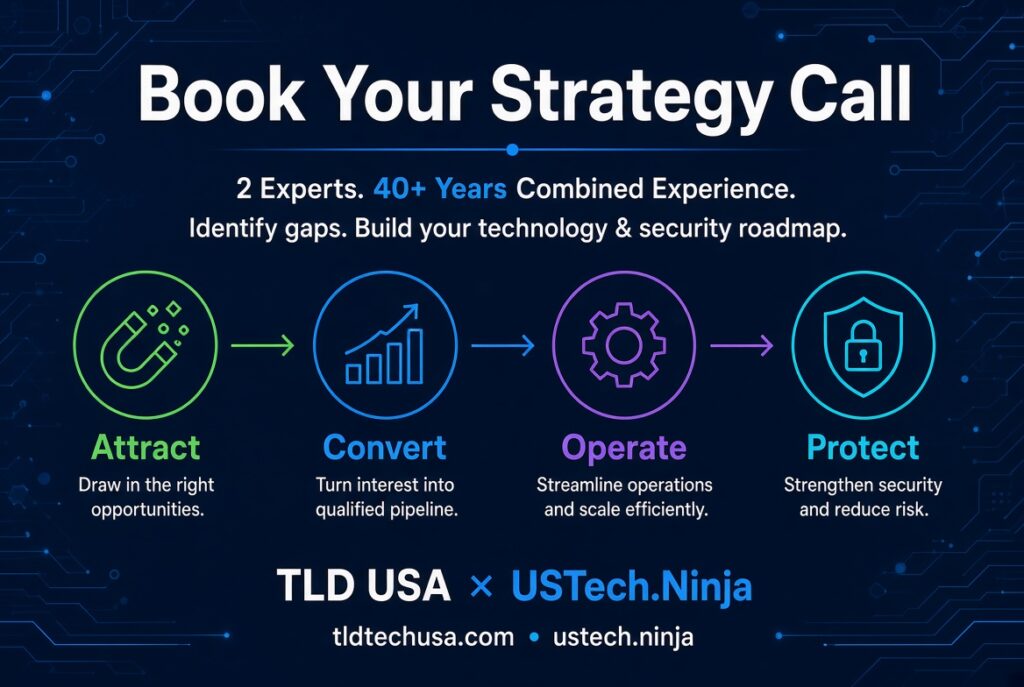
The Four-Stage Ecosystem: Attract, Convert, Operate, Protect
What Each Team Brings to the Table
Why Fewer Vendors Means Fewer Headaches
The $495 Complete Business Review
A Simple Next Step
Frequently Asked Questions
Why This Partnership Exists
Business owners usually treat growth and technology as two separate problems. Each one gets its own set of vendors.
In reality, the two are deeply connected.
A great website means little if leads fall through the cracks in a disconnected CRM. Strong SEO means little if a security breach takes the site down entirely. TLD USA and USTech.Ninja built this partnership to close that gap. Growth and technology finally move in the same direction instead of working against each other.
The Four-Stage Ecosystem: Attract, Convert, Operate, Protect
Attract. Custom websites, local SEO, Google Business Profile management, and targeted digital marketing bring in qualified inbound demand.
Convert. CRM setup, automated follow-up workflows, practical AI integration, and frictionless booking systems turn that demand into booked business instead of lost inquiries.
Operate. Reliable cloud platforms, responsive help desk support, and streamlined onboarding keep your team productive every day.
Protect. Managed IT, endpoint monitoring, email security, firewalls, and immutable backups run quietly behind the scenes, keeping everything secure and resilient.
Each stage builds on the one before it. That’s the whole point. A strong marketing engine only pays off when the systems behind it can actually support and protect that growth.
What Each Team Brings to the Table
TLD USA focuses on digital growth and business systems. We handle website design and engineering, local SEO, digital marketing campaigns, CRM implementation, and practical workflow automation.
USTech.Ninja focuses on managed IT and infrastructure. Their team handles proactive monitoring, endpoint detection, secure networks, email protection, immutable backups, and cyber insurance readiness.
Together, both teams stay aligned around the same business goals. Neither one operates as a separate vendor who’s never spoken to the other.
Why Fewer Vendors Means Fewer Headaches
Anyone who’s managed multiple vendors knows the drill.
One vendor blames another when something breaks.
Tools don’t talk to each other. Nobody has the full picture of how your marketing, systems, and security actually connect. A single coordinated partnership removes that friction entirely. You get one point of accountability instead of a blame game every time something goes wrong.
The $495 Complete Business Review
Every engagement starts with a $495 complete business review. This session takes a full look at your current marketing, website performance, CRM setup, and technology infrastructure together, rather than reviewing each piece separately with a different vendor.
You’ll walk away with a clear picture of where your business stands across all four stages: attract, convert, operate, and protect. From there, our team recommends specific next steps based on what will actually move the needle for your business, not a generic checklist.
A Simple Next Step
Whether you need more qualified leads, better internal systems, or stronger cybersecurity, the $495 complete business review covers all of it in a single session. It reviews your digital growth goals and technology operations together, rather than treating them as separate conversations with separate vendors.
What’s the difference between TLD USA and USTech.Ninja?
TLD USA handles digital growth: websites, SEO, marketing, and CRM. USTech.Ninja handles managed IT, cybersecurity, and infrastructure. Together, they coordinate as one team instead of operating separately.
What does the $495 complete business review include?
It covers a full assessment of your marketing, website, CRM, and technology infrastructure in one session, giving you a clear picture of where your business stands and what to prioritize next.
Do I need to hire both companies to work with either one?
You can work with either team individually. The connected approach fits businesses that want growth and technology handled together for maximum coordination.
Is this partnership only for larger businesses?
The connected model works well for growing small and mid-sized businesses. These businesses often juggle the most vendor fragmentation without the internal staff to manage it.
Final Thoughts
Growth and technology were never meant to sit with five disconnected vendors pointing fingers at each other.
The TLD USA and USTech.Ninja partnership brings both under one coordinated team. It covers everything from your first customer impression to the infrastructure protecting your business behind the scenes, starting with a $495 complete business review.
Most growing businesses end up juggling a web designer, an SEO agency, a CRM consultant, an IT technician, and a cybersecurity vendor, all working in separate silos with no visibility into what the others are doing. That fragmentation creates blind spots, duplicated costs, and a lot of finger-pointing whenever something breaks. TLD USA is changing that with a new partnership built around digital growth and managed technology working as one connected system, not five disconnected ones.
Quick answer: TLD USA has partnered with USTech.Ninja to combine digital marketing, website development, and CRM automation with managed IT, cybersecurity, and cloud infrastructure into a single coordinated ecosystem. Instead of hiring separate vendors for growth and technology, businesses get one aligned team covering everything from attracting customers to protecting the systems behind that growth.
Why This Partnership Exists
Growth and technology are usually treated as two separate problems handled by two separate sets of vendors. In reality, they’re deeply connected. A great website means little if leads fall through the cracks in a disconnected CRM. Strong SEO means little if the site behind it isn’t protected against downtime or a security breach. TLD USA and USTech.Ninja built this partnership specifically to close that gap, so growth and technology finally move in the same direction instead of working against each other.
The Four-Stage Ecosystem: Attract, Convert, Operate, Protect
Attract.
Custom websites, local SEO, Google Business Profile management, and targeted digital marketing bring in qualified inbound demand.
Convert.
CRM setup, automated follow-up workflows, practical AI integration, and frictionless booking systems turn that demand into actual booked business instead of lost inquiries.
Operate.
Reliable cloud platforms, responsive help desk support, and streamlined onboarding keep your team productive day to day.
Protect.
Managed IT, endpoint monitoring, email security, firewalls, and immutable backups keep everything running behind the scenes, secure and resilient.
Each stage builds on the one before it, which is exactly the point. A strong marketing engine only pays off if the systems behind it can actually support and protect that growth.
What Each Team Brings to the Table
TLD USA focuses on digital growth and business systems: website design and engineering, local SEO, digital marketing campaigns, CRM implementation, and practical workflow automation.
USTech.Ninja focuses on managed IT and infrastructure: proactive monitoring, endpoint detection, secure networks, email protection, immutable backups, and cyber insurance readiness.
Together, both teams stay aligned around the same business goals instead of operating as separate vendors who’ve never spoken to each other.
Why Fewer Vendors Means Fewer Headaches
Anyone who’s managed multiple vendors knows the drill. One vendor blames another when something breaks. Tools don’t talk to each other. Nobody has the full picture of how your marketing, systems, and security actually connect. Consolidating digital growth and managed technology under one coordinated partnership removes that friction, giving you a single point of accountability instead of a blame game every time something goes wrong.
A Simple Next Step
Whether you need more qualified leads, better internal systems, or stronger cybersecurity, a single 30-minute strategy call covers all of it. This session reviews your current digital growth goals and technology operations together, rather than treating them as separate conversations.
Schedule your strategy call: scheduling.yourpersonal.ninja/intro-ustechninja-tld
Frequently Asked Questions
What’s the difference between TLD USA and USTech.Ninja? TLD USA handles digital growth: websites, SEO, marketing, and CRM. USTech.Ninja handles managed IT, cybersecurity, and infrastructure. Together, they coordinate as one team instead of operating separately.
Do I need to hire both companies to work with either one? No. You can work with either team individually, though the connected approach is designed for businesses that want growth and technology handled together for maximum coordination.
What happens during the strategy call? The call reviews your current digital growth goals and technology setup, identifying where a connected approach would have the most impact for your specific business.
Is this partnership only for larger businesses? No. The connected model works for growing small and mid-sized businesses specifically, since they’re often the ones juggling the most vendor fragmentation without the internal staff to manage it.
Final Thoughts
Growth and technology were never meant to be handled by five disconnected vendors pointing fingers at each other. The TLD USA and USTech.Ninja partnership brings both under one coordinated team, covering everything from your first customer impression to the infrastructure protecting your business behind the scenes.
ADA website compliance helps Scottsdale and Phoenix businesses create more accessible websites, improve the user experience, and reduce potential legal risk.
ADA Website Compliance: The Lawsuit Risk Most Business Owners Don’t See Coming
You’ve got insurance. Got your business license. You’ve probably never once thought about whether your website itself could get you sued. Yet ADA website compliance has quietly become one of the fastest-growing legal risks for small businesses nationwide, and Arizona is not exempt.
Quick answer: ADA website compliance means your website works for people with disabilities, generally measured against the WCAG 2.1 Level AA standard. Courts consistently treat websites as places of public accommodation, so any business serving the public online is potentially exposed. Small and mid-sized businesses are frequently targeted, often through demand letters rather than a lawsuit outright, and settlement costs typically run from several thousand to tens of thousands of dollars.
Table of Contents
Why ADA Website Lawsuits Are Surging
Does This Actually Apply to Your Business?
The Overlay Widget Myth
What Actually Makes a Website Compliant
What to Do If You Get a Demand Letter
A Simple Next Step
Frequently Asked Questions
Why ADA Website Lawsuits Are Surging
The numbers tell the story clearly. Website accessibility lawsuits have climbed sharply year over year, and 2026 is on pace to set another record. A small group of law firms files the overwhelming majority of these cases. Because of that, this isn’t scattered, random litigation. It’s a volume-based legal strategy, and it specifically targets businesses that haven’t addressed accessibility yet.
E-commerce and retail sites get hit most often. Still, restaurants, service businesses, and plenty of other industries show up regularly too. So the pattern is broad, not narrow.
Does This Actually Apply to Your Business?
Here’s the uncomfortable truth. There’s no small-business exemption written into the law. Courts have repeatedly ruled that the ADA extends to websites, treating them the same way as a physical storefront. If your business has a physical location, or if it serves customers online in any capacity, you’re covered.
A lot of owners assume they’re simply too small to be a target. Unfortunately, the data says otherwise. Plaintiffs’ attorneys often prefer small businesses specifically, since smaller sites tend to have more accessibility gaps, and settling is usually faster and cheaper than fighting a lawsuit. That combination makes small businesses an efficient, repeatable target rather than an unlikely one.
The Overlay Widget Myth
Many business owners respond to this risk by installing an accessibility overlay widget, the small icon that promises instant compliance with one click. Here’s the problem: it doesn’t actually work that way. Overlays sit on top of your existing code without fixing what’s actually broken underneath.
A meaningful share of businesses that got sued already had one of these widgets installed at the time. On top of that, regulators have taken action against overlay vendors for misleading compliance claims. So an overlay might feel like a safety net, but in practice, it often isn’t one.
What Actually Makes a Website Compliant
Real compliance means your website genuinely works for people using screen readers, keyboard navigation, or other assistive technology. A few core areas matter most.
Proper heading structure and alt text. Screen readers rely on clean, logical heading hierarchy and descriptive alt text on images to convey meaning, not just visual layout.
Keyboard navigability. Every interactive element, including forms, menus, and buttons, needs to function without requiring a mouse.
Sufficient color contrast. Text needs enough contrast against its background to remain readable for users with low vision.
Properly labeled forms. Contact forms, booking tools, and checkout fields all need clear, programmatically associated labels, not just placeholder text that disappears once someone starts typing.
A real audit, not just an automated scan. Automated tools catch some issues, but a genuine audit combines automated scanning with manual testing to catch what scanners miss.
Don’t ignore it, and don’t panic either. A demand letter isn’t the same as a filed lawsuit, and how you respond in the first few weeks matters quite a bit.
Get a real accessibility audit immediately. Understanding the actual scope of the issues on your site is the first genuine step toward a resolution.
Loop in legal counsel before responding. An attorney familiar with ADA website claims can help you navigate the specific demands and avoid saying something that hurts your position later.
Fix the underlying issues, not just the specific complaint. A meaningful share of businesses that get sued once get sued again, usually because the root problem never actually got fixed the first time.
A Simple Next Step
Waiting until a demand letter shows up is the most expensive way to handle ADA website compliance. A proactive audit now costs far less than a lawsuit later, and it protects real customers who need an accessible website to use your business at all.
Is my small business really at risk for an ADA website lawsuit? Yes. There’s no small-business exemption, and small businesses are frequently targeted specifically because they’re less likely to already be compliant.
Does installing an accessibility overlay widget protect my business? Not reliably. Overlays don’t fix underlying code issues, and a notable share of businesses sued already had one installed at the time.
What standard does my website need to meet? Courts commonly reference WCAG 2.1 Level AA as the practical benchmark, even though the ADA itself doesn’t name a specific technical standard.
How much does it typically cost to fix an inaccessible website? It depends heavily on your site’s size and current condition, but proactive remediation is consistently far less expensive than a lawsuit settlement plus legal fees.
Final Thoughts
ADA website compliance isn’t a niche legal issue anymore. It’s a real, growing risk that’s already reaching small businesses across every industry, Arizona included. The businesses protecting themselves aren’t the ones hoping they’re too small to notice. They’re the ones getting a real audit done before a demand letter ever shows up.
TLD USA builds and audits websites for accessibility as part of every project, helping Scottsdale and Phoenix business owners avoid this risk instead of reacting to it after the fact.
Fake Google Maps listings can steal local visibility and customers from legitimate Scottsdale and Phoenix businesses.
Fake Google Maps Listings Are Stealing Your Customers. Here’s How to Fight Back.
You verify your business. You keep your hours accurate and have been collecting real reviews from real customers. Then, out of nowhere, a new listing appears. It has a keyword-stuffed name, a virtual office address, and no real footprint in your city, yet it sits right above you in the local pack. This is the fake Google Maps business listings problem, and right now it’s one of the most talked-about frustrations among Scottsdale and Phoenix business owners trying to compete fairly.
Quick answer: Fake Google Maps business listings use keyword-stuffed names, virtual addresses, or fabricated locations to unfairly rank above real, verified businesses. To fight back, first identify the specific policy violation. Then report it through Google’s Business Redressal Complaint Form with clear evidence. Finally, strengthen your own profile so you’re positioned to capture the ranking once the fake listing is removed.
Table of Contents
Why This Problem Keeps Growing
How Fake Listings Steal Your Local Pack Position
How to Spot a Fake Competitor Listing
How to Report It the Right Way
Protecting Your Own Rankings in the Meantime
A Simple Next Step
Frequently Asked Questions
Why This Problem Keeps Growing
Google Maps has become one of the most valuable pieces of digital real estate for local businesses. Because of that, it’s also become one of the most heavily targeted for manipulation. Industry reporting throughout 2026 has repeatedly flagged the scale of the issue. Millions of illegitimate listings stay active across Google Maps at any given time. On top of that, a steady stream of fake reviews works to boost fraudulent profiles or bury real ones.
Google has acknowledged the problem and continues rolling out stricter verification rules. Still, enforcement hasn’t caught up with the volume. As a result, that gap translates directly into lost calls, lost bookings, and lost revenue every day a fake listing outranks a real one.
How Fake Listings Steal Your Local Pack Position
Google Maps ranking largely works as a zero-sum game within the top three local pack positions. So when a fake listing occupies one of those spots, it isn’t just an annoying inaccuracy. Instead, it actively displaces a real business that would otherwise earn that visibility, and by extension, those customers.
A few common tactics show up again and again. Keyword-stuffed business names are designed to match exactly what someone searches. Virtual office addresses fake a local presence in a city the business doesn’t actually serve. Duplicate profiles get created just to monopolize multiple map pack slots for the same business.
How to Spot a Fake Competitor Listing
A few consistent red flags show up across most fake or manipulated listings.
The business name includes keywords that don’t belong in a name. For example, a listing titled “Best Emergency Plumber Scottsdale AZ 24/7” instead of an actual business name is a clear policy violation.
The address doesn’t match a real, accessible location. Virtual offices, UPS store mailboxes, and addresses with no real storefront or service base are common red flags here.
Multiple listings share the same phone number, website, or building. Often, a cluster of unrelated business names tied to one small address points to a lead-generation operation rather than real businesses.
The reviews feel generic, repetitive, or oddly timed. A sudden burst of five-star reviews within a short window, especially with vague, interchangeable language, usually signals fabricated review activity.
How to Report It the Right Way
Gather specific evidence before reporting. Save the Maps URL, screenshots, the business name, address, phone number, and website, along with anything that demonstrates impersonation or false information.
Use Google’s Business Redressal Complaint Form for clear fraud cases. This is the right channel specifically for fraudulent activity or misleading business information, not the general edit-suggestion tool.
Only report violations you can reasonably support with evidence. Google’s system exists to catch genuine policy violations, not to settle disputes with legitimate competitors. Misusing it can undermine your own credibility down the line.
Track shared identifiers across repeated attacks. If the same address, phone number, or naming pattern keeps generating fake listings, monitoring those identifiers usually works better than searching one exact business name at a time.
Be patient, and follow up if needed. A report is a request for review, not an automatic removal, so resolution can take time depending on Google’s current volume.
Protecting Your Own Rankings in the Meantime
Reporting fake listings addresses the immediate problem. Even so, a stronger, well-maintained profile of your own limits how much damage any single fake competitor can do.
Keep your Google Business Profile fully verified and complete. Accurate categories, real photos, and a genuine, verifiable location all strengthen your standing against manipulated competitors.
Build a steady, recent flow of real reviews. A strong, authentic review history is harder for a fake listing to overshadow, even temporarily.
Monitor your local pack position regularly. Catching a new fake competitor early, rather than months later, makes a real difference in how much revenue you actually lose.
For a broader look at the ranking factors behind all of this, our guide on outranking your competitors on Google covers the legitimate side of the same battle for local pack visibility.
A Simple Next Step
Fake Google Maps listings are a frustrating, ongoing part of local search right now. Waiting for Google to fully solve it on its own isn’t really a strategy. Instead, a combination of active reporting and a stronger profile of your own is the most reliable way to protect your local pack position.
How do I report a fake business listing on Google Maps? Use Google’s Business Redressal Complaint Form for clear fraud or impersonation cases. Include screenshots, the Maps URL, and specific evidence supporting the violation.
How long does it take Google to remove a fake listing after reporting? It varies quite a bit, from days to weeks, depending on how much volume Google is processing and how clear your evidence is.
Can I get in trouble for reporting a real competitor by mistake? Only report violations you reasonably believe are accurate. Using the system against legitimate competitors, rather than genuine violations, can undermine the credibility of your future reports.
Will my rankings improve automatically once a fake listing is removed? Not automatically, but removing an unfair competitor does reopen that position. A strong, well-maintained profile is better positioned to capture it.
Final Thoughts
Fake Google Maps listings are draining real revenue from real, verified businesses across Scottsdale, Phoenix, and beyond. Unfortunately, the scale of the problem isn’t shrinking on its own. Still, the businesses holding their ground are the ones actively reporting violations when they see them and building a profile strong enough that no single fake competitor can knock them out for long.
TLD USA helps Scottsdale and Phoenix business owners monitor their local search position, report fraudulent competitors, and strengthen their own Google Business Profile against exactly this kind of manipulation.
Verify your business. Keep your hours accurate, and collect real reviews from real customers.
Then a listing appears out of nowhere, with a keyword-stuffed business name, a virtual office address, and zero actual footprint in your city. Sitting right above you in the local pack. This is the fake Google Maps business listings problem. It’s currently one of the most talked-about frustrations among Scottsdale and Phoenix business owners trying to compete fairly in local search.
Quick answer: Fake Google Maps business listings use keyword-stuffed names, virtual addresses, or fabricated locations to unfairly rank above real, verified businesses in the local pack. Fight back by identifying the fake listing’s specific violation. Report itit through Google’s Business Redressal Complaint Form. Have clear evidence. And strengthen your own profile so it’s positioned to capture the ranking once the fake listing gets removed.
Table of Contents
Why This Problem Keeps Growing
How Fake Listings Steal Your Local Pack Position
How to Spot a Fake Competitor Listing
How to Report It the Right Way
Protecting Your Own Rankings in the Meantime
A Simple Next Step
Frequently Asked Questions
Why This Problem Keeps Growing
Google Maps has become one of the most valuable pieces of digital real estate for local businesses, which also makes it one of the most heavily targeted for manipulation. Industry reporting throughout 2026 has repeatedly flagged the scale of the issue: millions of illegitimate listings active across Google Maps at any given time, alongside a steady stream of fake reviews designed to boost fraudulent profiles or bury real ones.
Google has acknowledged the problem and continues rolling out stricter verification requirements, but enforcement hasn’t caught up with the volume. For business owners, that gap translates directly into lost calls, lost bookings, and lost revenue every single day a fake listing outranks a real one.
How Fake Listings Steal Your Local Pack Position
Google Maps ranking works largely as a zero-sum game within the top three local pack positions. A fake listing occupying one of those spots isn’t just an annoying inaccuracy. It’s actively displacing a real business that would otherwise be earning that visibility, and by extension, those customers.
Common tactics behind these fake listings include keyword-stuffed business names designed to match exactly what someone searches, virtual office addresses used to fake a local presence in a city the business doesn’t actually operate in, and duplicate profiles created to monopolize multiple map pack slots for the same business.
How to Spot a Fake Competitor Listing
A few consistent red flags show up across most fake or manipulated listings.
The business name includes keywords that don’t belong in a name. A listing titled something like “Best Emergency Plumber Scottsdale AZ 24/7” rather than an actual business name is a clear policy violation.
The address doesn’t match a real, accessible location. Virtual offices, UPS store mailboxes, or addresses that don’t correspond to a legitimate storefront or service base are common indicators.
Multiple listings share the same phone number, website, or physical building. A cluster of unrelated business names all tied to one small address or one phone number often points to a lead-generation operation rather than real businesses.
The reviews feel generic, repetitive, or oddly timed. A sudden burst of five-star reviews within a short window, especially with vague, interchangeable language, is a common sign of fabricated review activity supporting a fake listing.
How to Report It the Right Way
Gather specific evidence before reporting. Save the Maps URL, screenshots, the business name, address, phone number, website, and any details that demonstrate impersonation or false information.
Use Google’s Business Redressal Complaint Form for clear fraud cases. This is the appropriate channel specifically for fraudulent activity or misleading business information, rather than the general edit-suggestion tool.
Only report violations you can reasonably support with evidence. Google’s system exists to catch genuine policy violations, not to settle disputes with legitimate competitors, and misusing it can undermine your own credibility if patterns of abuse get flagged.
Track shared identifiers across repeated attacks. If the same address, phone number, or business pattern keeps generating fake listings, monitoring those identifiers is often more effective than searching for one exact business name at a time.
Be patient, and follow up if needed. Reports are a request for review, not an automatic removal, and resolution can take time depending on the volume Google’s team is working through.
Protecting Your Own Rankings in the Meantime
Reporting fake listings addresses the immediate problem, but a stronger, well-maintained profile of your own reduces how much damage any single fake competitor can do.
Keep your Google Business Profile fully verified and complete. Accurate categories, real photos, and a genuine, verifiable location all strengthen your standing against manipulated competitors.
Build a steady, recent flow of real reviews. A strong, authentic review history is harder for a fake listing to overshadow, even temporarily.
Monitor your local pack position regularly. Catching a new fake competitor early, rather than months after it starts costing you calls, makes a real difference in how much revenue you actually lose.
For a broader look at the ranking factors this connects to, our guide on outranking your competitors on Google covers the legitimate side of this same battle for local pack visibility.
A Simple Next Step
Fake Google Maps listings are a frustrating, ongoing reality of local search right now, and waiting for Google to fully solve it on its own isn’t a strategy. A combination of active reporting and a stronger profile of your own is the most reliable way to protect your local pack position.
How do I report a fake business listing on Google Maps? Use Google’s Business Redressal Complaint Form for clear fraud or impersonation cases, including screenshots, the Maps URL, and specific evidence supporting the violation.
How long does it take Google to remove a fake listing after reporting? It varies significantly, from days to weeks, depending on the volume of reports Google is processing and how clear the supporting evidence is.
Can I get in trouble for reporting a real competitor by mistake? Reports should only be made for violations you reasonably believe are accurate. Using the system against legitimate competitors rather than genuine violations can undermine the credibility of future reports.
Will my rankings improve automatically once a fake listing is removed? Not automatically, but removing an unfair competitor does reopen that ranking position, which a strong, well-maintained profile is better positioned to capture.
Final Thoughts
Fake Google Maps listings are draining real revenue from real, verified businesses across Scottsdale, Phoenix, and beyond, and the scale of the problem isn’t shrinking on its own. The businesses holding their ground are the ones actively reporting violations when they see them and building a profile strong enough that no single fake competitor can knock them out of contention for long.
TLD USA helps Scottsdale and Phoenix business owners monitor their local search position, report fraudulent competitors, and strengthen their own Google Business Profile against exactly this kind of manipulation.
You updated your address. Maybe you rebranded. Maybe you registered your out-of-state LLC in Arizona, which is a completely normal, legal thing businesses do constantly. And Google’s response? A Google Business Profilesuspended notice for “Deceptive Content,” delivered by an algorithm with all the warmth and context of a parking ticket.
Welcome to one of the more infuriating tech problems currently plaguing Scottsdale business owners.
Quick answer: A Google Business Profile suspended for deceptive content usually happens after edits like an address change, rebrand, or new business registration trigger an automated review. The fix involves filing a formal reinstatement appeal through Google’s Business Profile support, providing clear documentation, and being patient, since appeals can take weeks and automated denials are common on the first try.
Table of Contents
Why This Suspension Happens
The Frustrating Part About AI Moderation
How to Actually Appeal It
How to Reduce Your Risk Going Forward
A Simple Next Step
Frequently Asked Questions
Why This Suspension Happens
Google’s automated moderation flags accounts for a wide range of triggers, and legitimate business changes often look suspicious to a system trained to catch fraud. A new address, a rebrand, or registering a new LLC can all resemble patterns Google associates with fake listings, spam accounts, or businesses trying to game local rankings.
The irony is thick. The exact activities that show your business is real. A growing and legally operating business. But because of these you could be flagged.
The Frustrating Part About AI Moderation
The suspension happens instantly. The appeal does not. Business owners report waiting weeks, sometimes months, cycling through automated denials before finally reaching an actual human who can look at the situation and say, yes, obviously, this is a real business.
During that entire window, you disappear from local search and Google Maps completely. For a business that depends on local visibility, that’s not a minor inconvenience. That’s the phone going quiet.
How to Actually Appeal It
File the reinstatement request immediately. Don’t wait, since the appeal clock doesn’t start until you do.
Include clear supporting documentation. Business licenses, utility bills at the business address, and photos of a physical location or storefront all help establish legitimacy.
Keep your appeal factual and specific. Explain exactly what changed and why, rather than a general “please help” message.
Escalate through Google’s Business Profile community forums if the standard appeal stalls. Google employees do monitor these forums, and public visibility sometimes moves a stuck case faster than the standard support queue.
Be relentlessly patient, and follow up regularly. Appeals that go silent for too long. Sometimes they need a nudge to get looked at again.
How to Reduce Your Risk Going Forward
Make major changes gradually rather than all at once. A rebrand, address change, and new registration happening simultaneously reads as more suspicious to automated systems than the same changes spaced out.
Keep your business information consistent everywhere. Mismatched details across your website, directories, and your profile increase the odds of an automated flag.
Document everything as you make changes. Having your paperwork ready before an issue happens saves significant time if a suspension does occur.
A Simple Next Step
Getting suspended on Google is stressful.
Then comes figuring out Google’s appeal process.
For the first time, under pressure.
If your profile is currently suspended…or you are planning changes. Contact TLD USA first to avoid anything that might trigger a review.
How long does a Google Business Profile suspension appeal take? It varies significantly, from a few days to several weeks or longer, especially if the first appeal attempt is automatically denied.
Why did my profile get suspended right after I made changes? Automated systems. Like an address update or rebrand as suspicious activity resembling fake listing behavior.
Can I create a new Google Business Profile instead of appealing? No. It can violate Google’s policies. Potentially getting the new listing suspended.
Does hiring help speed up the appeal process? It won’t bypass Google’s process, but proper documentation and a correctly filed appeal reduce the chances of unnecessary denials that reset the clock.
Final Thoughts
Getting Google Business Profile suspended for legitimate business activity. It is one of the more absurd tech headaches for a local business. And it’s happening constantly across Scottsdale right now. The businesses that recover fastest are the ones who document everything, appeal correctly the first time, and don’t wait around hoping it resolves itself.
TLD USA helps Scottsdale and Phoenix businesses navigate Google Business Profile suspensions and appeals, and sets up profiles the right way to reduce this risk from the start.