Website Redesign Cost: What You’ll Actually Pay in 2026
Website Redesign Cost: What You’ll Actually Pay in 2026
Your website looks dated.
It loads slowly.
Maybe it doesn’t even work right on a phone anymore.
You know a redesign is coming, but every quote you’ve gotten so far lands in a wildly different range. Understanding website redesign cost, and exactly what drives that number up or down, makes it far easier to budget correctly and spot a fair quote when you see one.
Quick answer: A website redesign typically costs between $2,000 and $15,000 for a small to mid-sized business, depending on the number of pages, custom functionality, and whether content and photography need to be created from scratch. Simple redesigns on an existing content foundation land toward the lower end. Custom builds with e-commerce, booking systems, or advanced integrations push costs toward the higher end.
Table of Contents
Signs It’s Actually Time for a Redesign
Typical Website Redesign Pricing by Scope
What Actually Drives the Cost Up or Down
How to Evaluate a Redesign Quote
Red Flags in Redesign Pricing
Is a Redesign Worth the Investment?
How TLD USA’s Pricing Model Compares
A Simple Next Step
Frequently Asked Questions
Signs It’s Actually Time for a Redesign
Not every website needs a full redesign. Sometimes targeted fixes solve the real problem. A few clear signs point toward a genuine rebuild rather than a patch job.
Your site looks visibly outdated compared to competitors.
Design trends shift, and a site that looked current five years ago often reads as dated the moment a visitor compares it to a competitor’s site.
Mobile performance is genuinely broken, not just imperfect.
If pages don’t load correctly, buttons overlap text, or navigation doesn’t work on a phone, that’s a rebuild issue, not a minor tweak.
Your platform can’t support what your business needs now.
A site built years ago on an outdated platform often can’t handle a booking system, e-commerce, or other functionality your business has since grown into needing.
Page speed is consistently slow no matter what gets adjusted.
Sometimes underlying code or an outdated theme creates a speed ceiling that small fixes can’t break through.
You’re embarrassed to send people to your own website.
This one is subjective, but it matters. A website that doesn’t reflect how your business actually operates today creates a real mismatch with the experience customers expect.
Typical Website Redesign Pricing by Scope
Project Type
Typical Cost Range
What’s Usually Included
Simple Redesign
$2,000 – $4,500
Refreshed design on existing content, 5-8 pages
Standard Business Redesign
$4,500 – $8,000
New design, content updates, SEO foundation, 8-15 pages
These ranges reflect typical small business projects. Highly complex builds with extensive custom development can run higher depending on scope.
What Actually Drives the Cost Up or Down
Number of pages and content complexity.
A five-page site costs meaningfully less to design and build than a fifteen-page site with multiple service areas or locations.
Whether content and photography already exist.
Writing new copy and sourcing professional photography from scratch adds real cost. Reusing and refining existing content keeps the budget lower.
Custom functionality requirements.
Booking systems, membership portals, e-commerce, or custom integrations with a CRM all add development time and cost beyond a standard informational website.
SEO and technical setup depth.
A redesign that includes proper technical SEO, page speed optimization, and mobile testing costs more upfront but avoids expensive rework later.
Platform choice.
Building on an open, flexible platform like WordPress sometimes costs more initially than a page-builder tool, but it avoids long-term limitations and lock-in that often force a second redesign sooner than expected.
How to Evaluate a Redesign Quote
Ask for an itemized breakdown, not just one total number.
A fair quote separates design, development, content, and SEO setup so you can see exactly where your budget goes.
Confirm what happens after launch.
Ask whether basic support or a short adjustment period is included, or whether every post-launch change gets billed separately from day one.
Check whether the quote includes mobile optimization and speed testing.
These shouldn’t be treated as optional add-ons on a modern website redesign.
Ask how many rounds of revisions are included.
Unlimited revisions sound appealing but often signal a vague scope that leads to a longer, more expensive project than expected.
For a deeper look at evaluating who actually builds the site, our guide on how to choose a web design agency covers the full vetting process step by step.
Red Flags in Redesign Pricing
A quote given before any real discussion of your goals or current site
No breakdown between design, development, content, and SEO
Extremely low pricing with no explanation of what’s excluded
No clear answer about mobile optimization or page speed
Pressure to decide immediately with a limited-time discount
Is a Redesign Worth the Investment?
A redesign pays for itself when it directly improves what your website is supposed to do: convert visitors into calls, bookings, or sales. A faster, mobile-friendly, well-structured site typically sees meaningfully better conversion rates than an outdated one, even before accounting for the SEO benefits of a properly built foundation.
That said, a redesign only delivers real return when it’s paired with a plan for driving traffic to the new site. A beautiful redesign with no local SEO strategy behind it often underperforms compared to a simpler site backed by consistent visibility efforts. Our guide on building a complete local business online presence covers how a redesign fits into that bigger picture.
How TLD USA’s Pricing Model Compares
Most of the ranges above assume the traditional model: one big project, one big invoice, paid upfront or in two or three large chunks. That structure works fine if your budget can absorb it all at once. It works less well if you’re a growing business trying to redesign a site without draining cash flow in a single month.
TLD USA takes a different approach. Every project is billed at a transparent, published hourly rate of $125, broken down clearly so you see exactly what you’re paying for, rather than one opaque flat number. On top of that, redesign work doesn’t have to happen as one large, all-at-once expense. Through a fractional model starting at $250 a month, you can pace a redesign, and ongoing site improvements after it, across a schedule that actually fits your budget and your timeline, instead of committing to a lump sum before work even begins.
That flexibility matters most for businesses that know they need a redesign but don’t want to choose between doing it right and doing it all at once. Spacing the work out doesn’t mean spacing out the quality. It means the project moves at a pace your business can actually sustain.
A Simple Next Step
Understanding real website redesign costs upfront makes budgeting far easier and helps you recognize a fair quote versus one that’s underpriced, overpriced, or vague about scope.
A simple redesign on an existing content foundation typically costs between $2,000 and $4,500, depending on the number of pages and complexity.
Why do website redesign quotes vary so much between agencies?
Pricing differences usually come down to scope. Some quotes only cover design, while others include content creation, SEO setup, and post-launch support, which significantly affects the total cost.
Do I need to redesign my whole website, or can I just fix specific pages?
Not always. If your core structure and platform still work well, targeted updates to specific pages can address the problem without the cost of a full redesign.
How long does a website redesign take?
Most standard redesigns take a few weeks from kickoff to launch, depending on how quickly content, feedback, and approvals come back during the process.
Should I expect to pay more for SEO as part of a redesign?
A redesign that includes proper technical SEO and mobile optimization from the start typically costs more upfront but avoids expensive rework later to fix issues a rushed redesign often creates.
Final Thoughts
Website redesign cost varies for real, identifiable reasons, and understanding those reasons makes it far easier to budget accurately and evaluate whether a quote actually reflects the scope of work your business needs. A redesign done right pays for itself through better conversion, stronger SEO, and a site that finally matches how your business actually operates today.
TLD USA builds custom WordPress website redesigns for Phoenix and Scottsdale business owners with transparent, itemized pricing from the very first conversation.
Paid for the website. Worked on your Google Business Profile. You may be running SEO, advertising, social media or referrals.
Then a potential customer calls while you’re on a job, helping another customer, driving, in a meeting or simply away from your phone.
They leave a voicemail.
Or they don’t.
You plan to call them back.
Then the day gets away from you.
By the time you call, they’ve already contacted someone else.
For many small businesses, the problem isn’t generating another lead.
The problem is what happens after the lead arrives.
Quick answer: If your business regularly misses calls, takes hours to respond to website inquiries, or relies on memory to follow up with prospects, you may have a lead-management problem rather than a lead-generation problem. A properly connected website, phone system, CRM and automation workflow can help make sure legitimate inquiries are captured, acknowledged and followed up with.
Recent small-business discussions have repeatedly focused on this exact problem: missed calls, slow responses, after-hours inquiries, forgotten follow-ups and owners being too busy serving customers to manage every incoming lead.
For Phoenix and Scottsdale businesses, this matters because the customer who just searched for a service often has several options available to them.
You may only get one opportunity to respond.
Table of Contents
Why Small Businesses Miss Good Leads
The Problem With Relying on Voicemail
What Happens When a Website Lead Comes In
Why Speed Matters Without Chasing Every Lead
Missed-Call Text Back: A Simple First Step
What After-Hours Leads Should Trigger
How a CRM Prevents Leads From Disappearing
Where AI Can Actually Help
Why Your Website and CRM Need to Work Together
What Your Lead Process Should Look Like
When Fractional IT Makes Sense
A Simple Lead-Leak Test
A Simple Next Step
Frequently Asked Questions
Final Thoughts
Why Small Businesses Miss Good Leads
Most small businesses aren’t intentionally ignoring customers.
They’re busy.
A plumber is on a job.
A transmission shop is working on a vehicle.
A contractor is walking a property.
A salon owner is with a client.
A medical office is helping patients.
A law firm is dealing with an existing case.
A real estate professional is showing a property.
The business is doing exactly what it is supposed to do: serving customers.
The problem is that the phone doesn’t care what you’re doing.
Neither does the website.
Nor does the contact form.
Neither does the person who just searched Google for your service.
That creates a dangerous disconnect.
Your marketing can generate the opportunity, but your operational systems have to capture it.
The Problem With Relying on Voicemail
Voicemail isn’t useless.
It is simply not a complete lead-management system.
When someone calls a local business and gets voicemail, several things can happen.
They might leave a message.
Probably might hang up.
They might send a text instead.
Might visit another website.
They might call your competitor.
They might decide to deal with the problem later and forget about it entirely.
The business owner usually has no idea which outcome occurred.
That makes missed calls difficult to measure.
A better system treats an unanswered call as an event that requires action.
For example:
Incoming call → missed → automatic acknowledgment → lead captured → follow-up assigned → customer contacted → outcome recorded
That is very different from:
Incoming call → voicemail → remember to call back
One is a process.
The other depends on memory.
What Happens When a Website Lead Comes In?
The same problem happens with website forms.
A potential customer fills out your contact form.
What happens next?
Does the form go to one employee’s email?
Does someone receive a text?
Is the lead entered into your CRM?
Does the customer receive an immediate acknowledgment?
Does someone know who is responsible for the follow-up?
Can you tell whether that person ever contacted the prospect?
Does the lead remain visible until it is closed?
If the answer to several of those questions is “no,” your website may be generating opportunities that your business isn’t equipped to manage.
That’s an important distinction.
Your website may not need more traffic. It may need a better system behind it.
Why Speed Matters Without Chasing Every Lead
Not every phone call is a customer.
Just like not every form submission is legitimate.
Not every inquiry deserves an immediate sales response.
That doesn’t mean every legitimate lead should be treated casually.
A good lead-management system separates the two.
Instead of trying to personally respond to everything immediately, the system can help identify what needs attention.
For example:
New website inquiry
Missed customer call
Existing customer request
Spam inquiry
Quote request
Appointment request
Emergency service request
General question
Follow-up waiting on customer
The goal isn’t to automate your entire business.
The goal is to make sure important opportunities don’t disappear because everyone was busy.
Missed-Call Text Back: A Simple First Step
One of the simplest ways to improve a missed-call process is an automatic text response.
For example:
“Sorry we missed your call. We’re currently helping another customer. Reply here with what you need and we’ll get back to you.”
That message doesn’t replace your team.
It simply acknowledges the customer.
Tells them their call wasn’t ignored.
It gives them another way to communicate.
And, depending on the system, it can feed that conversation into the same lead-management process used for website inquiries.
However, businesses should not blindly turn on automated texting.
The messaging workflow, consent, opt-out handling and the type of message being sent matter. The FCC has specific rules concerning consent and revocation for certain automated calls and texts, including the ability for consumers to revoke consent through reasonable methods such as reply messages.
The technology should support your process—not create a compliance problem.
What Should Happen to After-Hours Leads?
Your business doesn’t have to be open 24 hours a day.
Your lead capture shouldn’t necessarily stop when you lock the door.
An after-hours system might:
Capture the customer’s name.
Capture their phone number.
Identify what service they need.
Provide basic information.
Offer a scheduling option when appropriate.
Notify your team.
Create a follow-up task for the next business day.
Record the interaction.
For some businesses, a simple form and automated acknowledgment are enough.
For others, an AI-assisted system or more advanced phone workflow may make sense.
The important part is matching the technology to the business.
You don’t need an expensive AI system just because AI exists.
How a CRM Prevents Leads From Disappearing
This is where a properly configured CRM becomes useful.
A CRM should not simply be a database containing hundreds of names.
It should show you what needs to happen next.
For example:
Lead
Source
Status
Next Action
John Smith
Website
New
Call
Sarah Jones
Google
Contacted
Send estimate
Mike Brown
Phone
Waiting
Follow up
Lisa Davis
Referral
Appointment
Confirm
Tom Wilson
Website
Closed
Request review
Now your team doesn’t have to remember everything.
The system tells them.
A properly configured CRM can also connect the website, email, phone system, scheduling tools and other business applications so information doesn’t have to be manually copied from one place to another.
That becomes particularly valuable as a business grows.
Where AI Can Actually Help
AI can be useful in the lead process, but it shouldn’t be added simply because it is fashionable.
Useful applications can include:
Summarizing incoming inquiries
Categorizing leads
Identifying the service requested
Drafting an initial response
Summarizing phone conversations
Extracting contact information
Routing inquiries
Helping answer routine questions
Creating internal follow-up tasks
Identifying leads that haven’t received a response
Organizing information before a salesperson or owner responds
The human still needs to control important customer decisions.
AI can reduce repetitive work.
It should not become an excuse to remove judgment from the process.
Why Your Website and CRM Need to Work Together
A website should not operate as an isolated marketing asset.
If someone fills out a form, that inquiry should have somewhere to go.
A strong setup might look like this:
Google Search
↓
Website
↓
Lead Form
↓
CRM
↓
Instant Acknowledgment
↓
Employee Notification
↓
Follow-Up Task
↓
Estimate / Appointment
↓
Customer
↓
Review / Repeat Business
That is a business system.
It also gives you something extremely valuable:
visibility.
Instead of wondering whether your marketing is working, you can start asking better questions.
How many leads came in?
Where did they come from?
In total how many were contacted?
How quickly?
How many booked?
What is the number that became customers?
How many are still waiting?
Where are leads getting stuck?
Those questions are far more useful than simply asking how many people visited your website.
What Your Lead Process Should Look Like
A practical small-business lead process doesn’t need to be complicated.
Step 1: Capture the lead
Every legitimate inquiry should enter a system.
That might be through:
Website forms
Phone calls
Text messages
Google Business Profile
Social media
Email
Online scheduling
Referral forms
Step 2: Acknowledge the inquiry
The customer should know their request was received.
This could be human or automated depending on the situation.
Step 3: Assign responsibility
Someone should own the lead.
Not “someone on the team.”
An actual person or clearly defined workflow.
Step 4: Follow up
The next action should be visible.
Call.
Email.
Text.
Schedule.
Send estimate.
Answer question.
Whatever the situation requires.
Step 5: Track the outcome
The lead should eventually have a status.
Booked.
Closed.
Lost.
Not qualified.
Waiting.
Follow-up required.
Without this step, your CRM eventually becomes another messy database.
When Fractional IT Makes Sense
This is where many small businesses run into a wall.
The problem isn’t necessarily that they need an IT department.
They need someone who understands how the pieces fit together.
The website needs to connect to the CRM.
The CRM needs to connect to email.
The phone system needs to work with the lead process.
The business needs secure accounts.
Employees need appropriate access.
Automations need to work.
Backups need to exist.
Someone needs to know what happens when something breaks.
That is where Fractional IT can make sense.
Instead of hiring a full-time IT employee to manage a relatively small technology environment, a business can bring in professional technology support as needed.
For a growing Phoenix or Scottsdale business, that can mean having someone who understands the technology underneath the marketing—not just someone who fixes a computer when it stops working.
A Simple Lead-Leak Test
You can test your own business in about 15 minutes.
Call your business from a number nobody recognizes.
Don’t leave a voicemail immediately.
See what happens.
Then submit your website contact form.
Watch your inbox.
Now ask:
How long did it take to receive a response?
Did anyone receive the lead?
Did the lead enter a CRM?
Did anyone know who was responsible?
Did you receive an acknowledgment?
What happens if the inquiry arrives after hours?
What happens if the person doesn’t respond?
Does anyone follow up again?
Can you tell where the lead came from?
Can you see whether the lead became a customer?
Now try it after business hours.
That’s where many businesses discover the gap.
The Real Cost Isn’t the Missed Call
A missed call isn’t automatically a lost customer.
That’s important.
Some calls are spam.
Other callers have the wrong number.
Some people will call back.
Some inquiries simply aren’t a fit.
The real problem is having no system for knowing which is which.
If you spend money on SEO, advertising, social media or other marketing to generate demand, then allow legitimate inquiries to disappear because nobody had time to handle them, you’re creating an expensive leak.
Fixing that leak may be more valuable than immediately increasing your advertising budget.
TLD USA Can Help Connect the Pieces
TLD USA works with Phoenix, Scottsdale and Arizona small businesses on the technology and digital systems behind customer acquisition.
That can include:
Website design and development
Website maintenance
Local SEO
Google Business Profile support
Lead tracking
CRM setup
CRM automation
Website-to-CRM integration
Email and business technology
AI and business automation
Marketing tracking
Fractional IT support
Technology planning
The objective isn’t to add more software.
It’s to determine what your business actually needs, connect the systems that should communicate, and eliminate unnecessary manual work.
A Simple Next Step
If you’re already getting calls, website inquiries or referrals but aren’t confident that every legitimate opportunity is being captured and followed up with, start there.
Don’t automatically buy more advertising.
Audit the path from first contact to customer.
TLD USA can review your website, lead process, CRM, technology and marketing systems and identify where opportunities are getting lost.
Start by identifying when and why calls are being missed. Then consider a business phone system, missed-call workflow, automated acknowledgment, call routing, scheduling system or CRM integration based on your actual needs.
What is a missed-call text-back?
A missed-call text-back is an automated message sent after an unanswered call. It can acknowledge the caller and provide another way to continue the conversation. Businesses should configure these systems with applicable messaging and consent requirements in mind.
Do small businesses need a CRM?
Not every business needs a complicated CRM. However, if leads are being tracked through memory, spreadsheets, scattered emails or text messages, a properly configured CRM can make follow-up much easier.
Should I use an AI receptionist?
It depends on the business. An AI receptionist may make sense when call volume, after-hours inquiries or repetitive questions are creating a real operational problem. It should be evaluated based on the customer experience and the actual workflow—not simply because it uses AI.
Can my website automatically send leads to my CRM?
Yes. Many websites and CRM platforms can be connected so that a form submission creates or updates a lead record, notifies the appropriate employee and triggers a defined follow-up process.
What if I already spend money on SEO?
SEO can help generate qualified traffic, but generating traffic is only part of the customer journey. If inquiries aren’t being captured, answered and followed up with consistently, improving the lead-management process may be necessary alongside SEO.
Can Fractional IT help with business automation?
Yes. Fractional IT can provide ongoing technical guidance and support for connected business systems, email, security, websites, automation, CRM infrastructure and other technology needs without requiring a full-time internal IT department.
Final Thoughts
Small businesses don’t lose customers only because competitors have better websites.
Sometimes they lose them because the owner was helping another customer when the phone rang.
Sometimes the form went to an inbox nobody checked.
Often times the quote was sent but never followed up.
Sometimes the customer called after hours and simply moved on.
Those aren’t necessarily marketing failures.
They’re system failures.
And systems can be fixed.
The goal isn’t to automate your business until it feels impersonal.
The goal is to make sure your team has the tools to respond when customers are ready to buy—even when you’re busy doing the work that makes your business successful.
How Much Does Local SEO Cost? A Real Pricing Guide
Every local SEO quote seems to land in a different range.
One agency may quote $300 a month. Another may quote $3,000.
Both companies may call their service “local SEO.” However, the work behind those prices can be very different.
So, how much does local SEO cost?
The answer depends on several factors.
Local SEO can include website optimization, keyword research, Google Business Profile work, content, citations, technical SEO, reporting, and ongoing strategy.
Therefore, two businesses can receive completely different services while both receive a quote labeled “local SEO.”
Understanding the pricing models gives you a better way to compare those offers.
Quick answer: Local SEO pricing commonly ranges from several hundred dollars per month to several thousand dollars. Your actual cost depends on competition, location, website condition, service area, and scope. One-time audits and setup projects can also cost hundreds or several thousand dollars. Most importantly, compare the work behind the price.
Table of Contents
Why Local SEO Pricing Varies
Typical Local SEO Pricing Models
Local SEO Pricing Chart
What Actually Affects Your Cost
What You Should Get for Your Money
Red Flags in Local SEO Pricing
What Makes TLD USA Different
TLD USA SEO Starts at $750 Per Month
What 12 Dedicated SEO Hours Can Cover
How to Know If Your SEO Is Working
A Simple Next Step
Frequently Asked Questions
Final Thoughts
Why Local SEO Pricing Varies So Much
Local SEO is not one single task.
Instead, it combines several different services.
Those services may include:
Website optimization
Keyword research
Google Business Profile optimization
Local citations
Content development
Internal linking
Technical SEO
Local landing pages
Review strategy
Competitor research
Reporting
Ongoing strategy
Because the scope can vary, pricing can vary as well.
Your starting point matters, too.
For example, a business with a fast website, strong content, accurate business information, and an established Google Business Profile may need less foundational work.
On the other hand, an older website with technical problems may need significant cleanup first.
The market also matters.
A personal injury law firm competing across Phoenix may face intense competition.
Meanwhile, a specialized home service business targeting one suburb may have a different SEO challenge.
Similarly, a company targeting Phoenix, Scottsdale, Tempe, Mesa, Chandler, and Gilbert needs a broader strategy than a company serving one community.
As a result, a simple price comparison does not tell the entire story.
You need to compare the scope of work behind the price.
Typical Local SEO Pricing Models
Here are common pricing models you may encounter when comparing SEO agencies, consultants, and service providers.
Pricing Model
Typical Cost
Monthly Support
Monthly SEO Retainer
$300 – $2,500/month
Yes
One-Time SEO Audit
$500 – $1,500
No
Project-Based SEO Setup
$1,000 – $5,000
No
Hourly SEO Consulting
$100 – $250/hour
No
These ranges are general market examples.
Actual pricing varies by provider, location, competition, experience, and scope.
Monthly SEO Retainer
A monthly retainer provides ongoing SEO work.
Depending on the provider, that work may include website optimization, local SEO, Google Business Profile management, content, reporting, technical improvements, and strategy.
However, the amount of actual work can differ significantly between providers.
That is why the monthly price alone does not tell you enough.
One-Time SEO Audit
An SEO audit examines your current website and local search presence.
For example, an audit may identify technical problems, keyword opportunities, content gaps, citation issues, Google Business Profile problems, and competitor opportunities.
The audit gives you information.
However, implementation may require a separate project or ongoing service.
Project-Based SEO Setup
A project-based service establishes the foundation for an SEO campaign.
That work may include technical fixes, keyword research, website optimization, Google Business Profile optimization, local landing pages, citations, schema, and other foundational improvements.
Once the project ends, ongoing SEO may require a separate agreement.
Hourly SEO Consulting
Hourly consulting can work well for specific questions, technical problems, strategy sessions, or individual SEO tasks.
For example, a business may need help fixing a technical issue or understanding a sudden ranking change.
However, hourly consulting does not automatically provide ongoing SEO management.
Local SEO Pricing Chart
The chart below gives you a simple visual comparison of common SEO pricing models.
LOCAL SEO PRICING SPECTRUM
$300 $750 $1,500 $2,500+
│---------------------│---------------------│----------------------│
Monthly SEO Monthly SEO Expanded SEO Extensive
Retainer Retainer Management SEO Campaign
│ │ │ │
Ongoing Support Ongoing Support Ongoing Support Ongoing Support
ONE-TIME SERVICES
$500 ───────────── $1,500
One-Time SEO Audit
Monthly Support: NO
$1,000 ───────────────────────────── $5,000
Project-Based SEO Setup
Monthly Support: NO
$100 ─────────────── $250/hour
Hourly SEO Consulting
Monthly Support: NO
The chart represents general pricing examples.
It does not mean every agency uses these exact numbers.
More importantly, price does not tell you how much professional work you receive.
That distinction becomes especially important when comparing monthly SEO services.
What Actually Affects Your Local SEO Cost?
1. Industry and City Competition
Competition plays a major role in local SEO pricing.
For example, a competitive legal market can require substantial ongoing work.
Likewise, popular service categories in Phoenix and Scottsdale can have many businesses competing for the same searches.
In contrast, a specialized business in a smaller market may face fewer competitors.
Therefore, your SEO plan should account for the actual search environment.
2. The Current State of Your Website
Your website provides the foundation for SEO.
If the site has technical problems, slow pages, weak content, broken links, or poor mobile performance, those issues may need attention first.
Once the foundation improves, ongoing SEO can focus more heavily on visibility and growth.
3. Number of Locations and Service Areas
One service area is very different from ten.
For example, a company targeting Scottsdale has a different local SEO scope than a company targeting multiple Phoenix Valley communities.
Each additional market can require more research, content, optimization, and competitive analysis.
As a result, a larger service area can increase the amount of SEO work required.
4. Content Requirements
Content can support local SEO in several ways.
It can target services, locations, customer questions, industry topics, and long-tail searches.
However, useful content takes time to research and produce.
A business with hundreds of strong pages has a different starting point than a business with five basic pages.
5. Citation and Directory Work
Your business information should remain accurate across relevant directories.
That includes your:
Business name
Address
Phone number
Website
Services
Business categories
If that information is inconsistent, additional cleanup may become necessary.
6. Reviews and Reputation
Reviews can also affect the overall local search strategy.
Some SEO providers include review strategy within their services.
Others treat reputation management as a separate service.
Therefore, ask what is included before comparing prices.
What You Should Get for Your Money
Before signing an SEO agreement, ask exactly what the provider will do, and remember we have no contracts here at TLD USA.
Depending on the plan, you may expect services such as:
Google Business Profile optimization
Google Business Profile posts and updates
Local keyword research
On-page website optimization
Technical SEO
Local landing page optimization
Internal linking
Citation and directory management
Competitor research
Content strategy
Schema markup
Local search monitoring
SEO reporting
Conversion tracking
Ongoing strategy
You should also know who performs the work.
Furthermore, you should understand how often that work happens.
A monthly SEO fee should never feel like a mystery charge.
Instead, you should know what work is being completed and why.
Red Flags in Local SEO Pricing
Guaranteed Number-One Rankings
No SEO provider controls the search results.
Search algorithms change.
Competitors also change their strategies.
For that reason, be cautious about anyone who guarantees a specific ranking position.
Extremely Cheap Full-Service Packages
A very low monthly price can sound attractive.
However, ask what actual work the price covers.
If the provider cannot explain the work, reporting, or strategy, you may not be comparing equivalent services.
No Reporting
You should know what is happening with your SEO.
Useful measurements can include:
Keyword visibility
Local search visibility
Organic traffic
Website leads
Phone calls
Google Business Profile activity
Direction requests
Conversion activity
Without meaningful reporting, it becomes difficult to understand your progress.
Long-Term Contracts With No Clear Explanation
Some businesses prefer month-to-month SEO.
Others choose longer engagements.
Either way, understand the commitment before signing.
Ask about cancellation terms, deliverables, reporting, and ongoing responsibilities.
One-Size-Fits-All SEO
Your business is different from your competitor.
Every website is different.
Your service area is different.
Your customers are different.
Consequently, your SEO strategy should account for those differences.
What Makes TLD USA Different?
This is where TLD USA takes a different approach.
Rather than forcing every business into a large SEO package, TLD USA uses a dedicated-work model.
The concept is straightforward.
You receive dedicated professional SEO time each month.
Then, that time can focus on the priorities your business actually needs.
Those priorities can include:
Technical SEO
On-page SEO
Keyword research
Local SEO
Google Business Profile optimization
Content strategy
Internal linking
Schema markup
Image SEO
Citation work
Competitor research
SEO reporting
Website improvements
Local landing pages
Search visibility strategy
As priorities change, the work can change with them.
For example, one month may require technical cleanup.
The next month may require more content optimization.
Later, the focus may shift toward local pages, Google Business Profile optimization, internal linking, or competitor research.
A common range for small and mid-sized businesses is several hundred to several thousand dollars per month.
However, your actual cost depends on competition, location, website condition, service area, and scope.
Therefore, compare the work behind each price.
How much does TLD USA SEO cost?
TLD USA SEO starts at $750 per month.
The starting plan includes 12 dedicated hours each month specifically for SEO work.
Those hours can support technical SEO, local SEO, Google Business Profile optimization, content, keyword research, competitor research, internal linking, schema, reporting, and other SEO priorities.
What makes TLD USA’s SEO model different?
TLD USA uses a dedicated-work approach.
Rather than relying only on a fixed checklist, the available SEO time can focus on the areas that need attention.
As your priorities change, the work can change as well.
Why do some SEO companies charge much less?
SEO pricing varies because the scope varies.
Some providers offer limited services.
Others automate portions of their work.
Meanwhile, some focus on one specific area instead of providing ongoing management.
Therefore, always ask what the monthly fee includes.
How long does local SEO take?
SEO usually takes time.
Some businesses see early movement within a few months.
However, competitive industries and larger service areas can take longer.
Your website’s starting condition also affects the timeline.
Can I do local SEO myself?
Yes.
Business owners can handle basic tasks such as keeping business information accurate and maintaining their Google Business Profile.
However, technical SEO, competitive keyword strategy, content optimization, structured data, and broader local SEO can require substantial time and experience.
Should I pay for a one-time SEO audit?
An audit can make sense when you want to understand your starting point.
For example, it can identify technical problems, content gaps, local SEO opportunities, and other priorities.
Afterward, you can decide which recommendations require implementation.
Do I need a long-term SEO contract?
Not necessarily.
Different providers use different arrangements.
Before signing, understand the contract terms, cancellation policy, deliverables, reporting, and ongoing responsibilities.
Is $750 per month expensive for SEO?
Price alone does not answer that question.
Instead, look at the amount and type of professional work included.
With TLD USA’s starting SEO plan, the $750 monthly price includes 12 dedicated SEO hours.
That gives you a clear way to understand the professional time allocated to your SEO.
Final Thoughts
So, how much does local SEO cost?
There is no single price.
Common pricing models can range from several hundred dollars per month to several thousand dollars.
One-time audits and SEO projects can also cost hundreds or thousands of dollars.
Ultimately, the difference comes down to scope.
You need to know what the provider is actually doing.
You should also know who performs the work.
Most importantly, understand how much dedicated professional time your business receives.
That is why TLD USA uses a different approach.
TLD USA SEO starts at $750 per month with 12 dedicated SEO hours each month.
The goal is straightforward.
Give Phoenix, Scottsdale, and Arizona businesses access to experienced SEO professionals without forcing them into an oversized agency package.
Your Google Reviews Just Vanished. Here’s What’s Actually Going On.
You open your Google Business Profile and check your review count.
Something looks wrong.
Your review count has dropped. In some cases, businesses have seen hundreds of reviews disappear almost overnight. Some owners have reported losing years of review history with little or no explanation.
If this happened to you, you’re not alone.
Google Business Profile owners reported multiple review problems during 2026. Some incidents affected what owners could see in their dashboards. Other reports involved major drops in public review counts.
Quick Answer
Google reviews can disappear for several reasons.
Sometimes, a technical problem affects how Google displays reviews. Other times, Google’s automated systems may remove reviews that they identify as spam or policy violations. Google also acknowledges that its automated systems can mistakenly remove legitimate reviews.
If your reviews suddenly disappear, don’t panic.
First, check your public profile. Then compare it with your previous records. Finally, document the change and contact Google Business Profile support if the reviews remain missing.
What’s Actually Happening in 2026?
Google Business Profile owners have reported several review-related problems throughout 2026.
Some incidents affected the owner dashboard while customers could still see the reviews publicly. Other reports described much larger drops in review counts.
For example, business owners reported sudden review-count changes in early July. One Google Business Profile Community thread described a profile dropping from more than 160 reviews to zero. The owner later reported that the written reviews also disappeared.
Another July thread reported businesses losing large numbers of reviews. Product Experts discussed the issue with affected business owners and escalated some cases to Google.
That distinction matters.
A missing review in your dashboard does not always mean Google permanently deleted it.
Is It a Bug or Real Enforcement?
This is where things get complicated.
Google uses automated systems to detect spam and policy violations. Those systems can remove reviews that violate Google’s policies. Google also says that its automated systems can sometimes remove legitimate reviews by mistake.
At the same time, technical problems can affect how reviews appear.
That means you need to determine what actually happened before changing your review strategy.
Look for these clues:
Did your public review count suddenly change?
Can customers still see the missing reviews?
Did only the owner dashboard lose access to the reviews?
Did Google send a policy notification?
Did the disappearance happen immediately after a suspicious review or spam attack?
Did several businesses report the same problem at the same time?
A sudden, widespread change can point toward a Google-side issue. A smaller group of missing reviews may require a closer look at Google’s review policies.
How to Check Whether Your Business Was Affected
Step 1: Check Your Previous Review Count
Look for a recent screenshot, report, marketing document, or other record showing your review count.
Don’t have one?
Start keeping monthly records now.
A simple screenshot can give you useful documentation if your review count changes later.
Step 2: Check Your Public Google Business Profile
Don’t rely only on the management dashboard.
Open your public Business Profile and check the reviews from the customer-facing side.
You may find that customers can still see reviews that don’t appear in your owner dashboard.
Google Business Profile owners reported this exact type of dashboard problem in July 2026. In one reported case, customers could see reviews while administrators could not access them through the dashboard. A Google Product Expert identified it as a known bug under investigation.
Step 3: Look for Policy Notifications
Check your Business Profile for notices about suspicious activity, review restrictions, or policy issues.
Google’s automated systems evaluate reviews for policy violations. Reviews that violate Google’s policies may disappear from Search and Maps.
Step 4: Check the Google Business Profile Community
Search the Google Business Profile Community for similar reports.
This step can provide useful context.
If dozens of business owners report the same problem during the same period, you may be dealing with a broader Google issue rather than an isolated problem with your profile.
What Should You Do If Your Reviews Disappeared?
Document Everything
Start with evidence.
Save screenshots of:
Your current review count
Your previous review count
Missing reviews
Your public Business Profile
Your owner dashboard
Any Google notices
Support case numbers
Relevant customer communications
Documentation gives Google more information to investigate.
Contact Google Business Profile Support
If legitimate reviews remain missing, contact Google Business Profile support.
Google specifically advises businesses to contact support when its automated systems mistakenly remove legitimate reviews.
Explain exactly what happened.
Include the approximate date, your previous review count, your current count, and any screenshots you have.
Don’t Ask Customers to Repost Everything Immediately
This is important.
Don’t immediately launch a campaign asking everyone to repost a missing review.
First determine why the reviews disappeared.
A sudden wave of similar review activity can create additional review-quality concerns. Google considers unusual review patterns and other signals when evaluating reviews.
Give Google time to investigate before creating another unusual spike.
Keep Running Your Business Normally
Don’t let a review-count problem derail your entire marketing strategy.
Continue providing good service.
Always be collecting legitimate customer feedback through normal processes.
Continue monitoring your Business Profile.
The goal is consistency, not panic.
How to Protect Your Review Base Going Forward
Google reviews matter. However, your entire reputation should not depend on one platform.
Diversify Your Online Reputation
Google remains an important source of local trust.
Still, consider building a broader review presence.
Depending on your industry, that could include:
Yelp
Facebook
BBB
Industry-specific review sites
Professional directories
Testimonials on your website
A broader reputation gives your business more than one source of customer trust.
Keep a Regular Record
Make review monitoring part of your normal marketing process.
Take a monthly screenshot.
Record your review count.
Track your average rating.
Monitor unusual changes.
This takes only a few minutes, but it gives you a historical record when something goes wrong.
Build Reviews Consistently
Don’t rely entirely on reviews you collected five years ago.
Create a consistent process for asking satisfied customers for honest feedback.
Don’t buy reviews.
Never offer incentives for positive reviews.
Don’t pressure customers to use specific wording.
Instead, create a simple process that makes it easy for genuine customers to share their experience.
Monitor Your Profile Regularly
Don’t wait until a customer tells you something looks wrong.
Monitor your profile.
Check your review count.
Watch for unusual changes.
Look at new reviews.
Respond appropriately.
That gives you a better chance of catching problems early.
A Simple Next Step
Google’s review system can create real headaches for local businesses.
Technical problems can affect what owners see. Automated systems can also remove reviews that Google identifies as policy violations. In some cases, legitimate reviews may disappear by mistake.
That’s why review monitoring should become part of your broader local SEO strategy.
TLD USA helps Phoenix and Scottsdale businesses monitor their online presence, Google Business Profile, local SEO, reviews, website performance, and overall digital reputation.
If your review count suddenly changed, don’t guess at the problem.
Let’s look at what happened and determine what you should do next.
Several things can cause missing reviews. Google may experience a technical issue, or its automated systems may remove reviews that trigger spam or policy filters. Google also acknowledges that legitimate reviews can sometimes disappear by mistake.
Will Google restore my reviews if they were removed by mistake?
Google says legitimate reviews that its systems remove incorrectly can require support assistance. Contact Google Business Profile support and provide evidence showing that the reviews existed.
Should I ask my customers to repost their reviews?
Not immediately.
First, determine why the reviews disappeared. A sudden surge of new reviews can create additional review-quality concerns, so avoid trying to replace hundreds of missing reviews at once.
How can I tell if my reviews are actually gone?
Check your public Business Profile and your owner dashboard separately.
If customers can still see the reviews but you cannot see them in the dashboard, you may be dealing with a display or management issue.
Recent 2026 reports documented this exact type of problem.
Could Google remove old reviews years after customers posted them?
Yes.
Google’s automated systems evaluate reviews for policy violations. A review that once appeared may later trigger a policy filter. Google also acknowledges that automated systems can make mistakes.
Is Google still having review problems in 2026?
Business owners reported multiple review-related problems during 2026, including missing review counts, missing dashboard reviews, and large-scale review disappearances. Some reports later showed reviews returning after support intervention.
Final Thoughts
If your Google reviews suddenly disappeared, don’t assume your business did something wrong.
First, investigate.
Check your public profile. Check your dashboard. Compare your current count with previous records. Look for policy notices. Then document everything.
Google’s automated review systems can catch legitimate problems, but they can also make mistakes. Technical issues can create another layer of confusion.
The best response combines monitoring, documentation, legitimate review practices, and a broader online reputation strategy.
TLD USA helps Phoenix and Scottsdale business owners protect the digital presence they’ve spent years building.
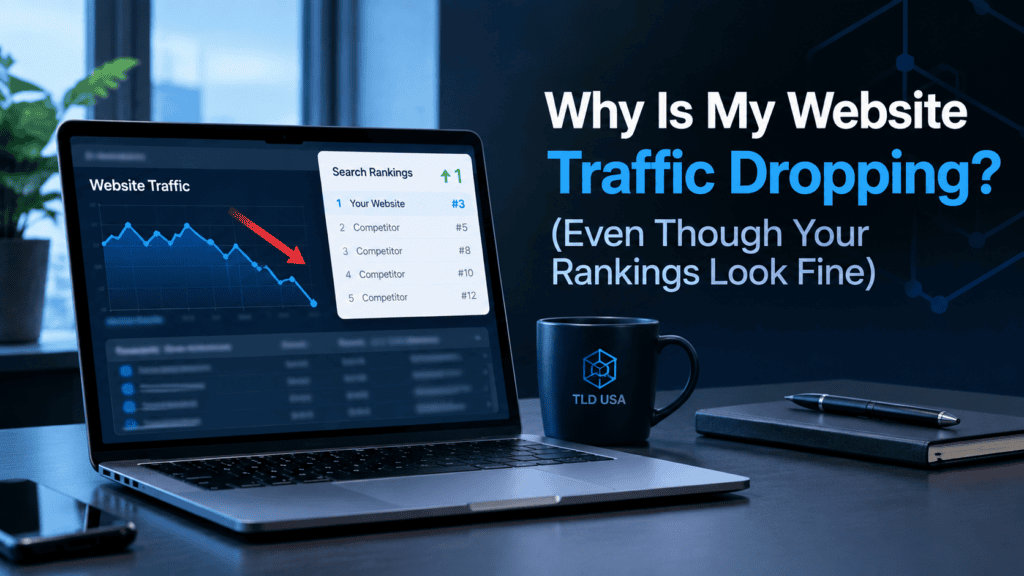
You haven’t changed anything. If that sounds familiar, you’re not imagining it, and you’re far from alone. Why is my website traffic dropping has become one of the most common questions business owners ask right now. The answer almost always traces back to the same thing: AI Overviews.
Quick answer: Website traffic is dropping for most businesses in 2026 because Google’s AI Overviews now answer many searches directly on the results page. Users never click through to a website at all. People call this zero-click search, and industry data shows well over half of all Google searches now end without a click. The fix isn’t abandoning SEO. It’s restructuring content so it gets cited inside those AI answers instead of losing visibility to them.
Table of Contents
Why This Is Happening to So Many Websites Right Now
How to Diagnose Your Specific Traffic Drop
The Silver Lining Most Business Owners Miss
What Actually Gets Your Content Cited
What This Means Specifically for Local Businesses
A Simple Next Step
Frequently Asked Questions
Why This Is Happening to So Many Websites Right Now
Google’s AI Overviews now appear on a large and growing share of search results. The feature pulls together a direct answer from multiple sources into one paragraph, shown right above the traditional results. When that happens, a meaningful share of searchers get what they need without clicking anywhere at all. Industry research consistently shows organic click-through rates drop sharply whenever an AI Overview appears.
Small and mid-sized business websites take the hardest hit. That’s largely because AI Overviews trigger most often on informational, comparison, and local queries. Small business content lives almost entirely in that territory. So this isn’t a penalty, and it isn’t a sign your content got worse. The rules changed underneath everyone at the same time.
How to Diagnose Your Specific Traffic Drop
Step 1: Check whether your rankings actually moved. Open Google Search Console and compare your average position for key pages over the last six months. If rankings held steady while clicks dropped, that points directly to AI Overviews or another zero-click feature, not a ranking problem.
Step 2: Identify which specific pages lost traffic. Pull organic traffic by landing page. Compare recent months to the same period last year. Pages that lost traffic despite stable rankings are your AI Overview casualties.
Step 3: Search your own target keywords manually. Check whether an AI Overview now appears for the exact questions your top pages answer. If it does, and your site isn’t cited as a source, that page is likely losing clicks directly to that summary.
Step 4: Rule out seasonality and other SERP features first. Compare like periods, not just recent months against older ones. Normal seasonal patterns can look similar to an AI Overview impact at first glance.
Step 5: Check whether a competitor is being cited instead of you. If a competitor’s content appears inside the AI Overview for your target keywords, that traffic and visibility go to them instead of you, even when your ranking position hasn’t changed at all.
The Silver Lining Most Business Owners Miss
Here’s the part most of the panic around this shift misses. AI Overviews don’t pull exclusively from major publications or high-authority domains with years of backlinks behind them. Any page structured clearly enough for the AI to extract a direct answer can earn a citation, regardless of how long the site has existed. A small, well-structured local business page can earn a spot right alongside a national brand for the same query.
That’s a genuine opportunity search hasn’t historically offered smaller sites. Businesses cited inside an AI Overview tend to see meaningfully more organic clicks than businesses ranking on the same page without a citation. Even the impression alone still carries brand value. When your business name appears inside an AI-generated answer, the searcher sees it, even without clicking through.
What Actually Gets Your Content Cited
Answer placement matters more than almost anything else. A direct, clearly written answer near the top of the page, before background information or extended explanation, earns citation far more often.
Structure beats length. Clear headings, short paragraphs, and content organized around specific questions outperform long, unstructured pages, even when the unstructured page contains more total information.
Specificity outperforms generic coverage. Content that answers a precise, specific question earns a citation more reliably than broad content covering a topic at a surface level.
Freshness and accuracy still matter. AI systems trust recent, accurate content more than outdated information or stale statistics.
This connects directly to the broader shift we cover in our guide on AI search visibility for local business, which goes deeper into the signals AI systems look for across Google, ChatGPT, and other platforms.
What This Means Specifically for Local Businesses
Google kept expanding AI Overviews into local, commercial, and comparison searches throughout 2026. That’s exactly the territory most local service business websites depend on. If you run a business relying on searches like “best plumber near me” or “how much does X cost in Phoenix,” this isn’t a future concern. It’s likely already showing up in your analytics right now.
The businesses adapting well aren’t the ones abandoning content and SEO altogether. They’re restructuring their existing content around clear, direct answers, positioning themselves to earn citations rather than get buried. For more on how this fits into the broader 2026 search landscape, our recap of Google’s 2026 algorithm updates covers the platform-wide changes driving this shift.
A Simple Next Step
A confusing traffic drop, with rankings intact but clicks disappearing, almost always has an identifiable cause once you know where to look. Diagnosing the specific affected pages and restructuring them for AI citation works far better than guessing or abandoning your content strategy altogether.
Why did my website traffic drop even though my rankings stayed the same? This almost always points to AI Overviews or another zero-click search feature answering the query directly on the results page. Your page still ranks well, but users never click through.
Is this a Google penalty? No. This is a structural shift in how search results work, not a penalty against your specific website. Google isn’t ranking your content lower; it’s simply answering more questions directly.
Can small businesses actually get cited inside AI Overviews? Yes. AI Overviews pull from any clearly structured, well-answered page, regardless of domain authority or site size. That creates a real opportunity for smaller, well-optimized local business sites.
Should I stop investing in SEO and content because of AI Overviews? No. Restructure your content for clear, citable answers instead of abandoning SEO altogether. Businesses that adapt their content structure keep seeing strong results despite the overall shift toward zero-click search.
How long does it take to see results after restructuring content for AI citation? Results vary, but content changes generally need a few weeks to a few months to show measurable impact, similar to other SEO and content-driven improvements.
Final Thoughts
If your website traffic is dropping in 2026, you’re dealing with a real, well-documented, industry-wide shift, not a mistake you made or a penalty you triggered. AI Overviews and zero-click search have changed how people find information. Still, the businesses restructuring their content around clear, specific, well-placed answers are finding a genuine opportunity inside a shift most competitors haven’t adapted to yet.
TLD USA helps Phoenix and Scottsdale business owners diagnose traffic loss, restructure content for AI citation, and rebuild visibility in a search landscape that keeps changing.
Why Phoenix Small Businesses Are Frustrated With Web Design, SEO and Marketing Agencies
If you own a small business in Phoenix or Scottsdale, there is a good chance you’ve heard the same promises before.
More traffic.
Better rankings.
A new website.
More leads.
Better marketing.
Then the invoices start arriving.
The monthly reports show charts and numbers you don’t fully understand. Your website looks newer, but the phone isn’t ringing. Your SEO company says the campaign is working, but you still cannot tell where the customers are coming from. You send an email and wait three days for an answer.
Eventually, you start wondering whether the problem is your business or the company you hired.
For many Phoenix small businesses, the frustration isn’t that digital marketing does not work. The bigger problem is that too many businesses are buying disconnected services from companies that never take responsibility for the bigger picture.
Quick answer: Phoenix small businesses should not choose a web design company, SEO agency or digital marketing provider based only on price, appearance or promises. The right provider should explain what needs to be fixed, show you what the work is accomplishing, keep your accounts accessible, communicate clearly, build for search and conversions, and provide ongoing support after the website launches.
That distinction matters because a website, SEO campaign, Google Business Profile, advertising account, CRM and IT environment are not separate islands.
They affect one another.
A beautiful website that nobody finds is a problem.
A highly ranked website that does not convert visitors is a problem.
A marketing campaign that generates leads but loses those leads because nobody follows up is a problem.
And an agency that cannot explain any of it clearly is another problem.
Table of Contents
Why Phoenix Business Owners Are Frustrated
The Website Looks Good — So Why Isn’t It Working?
The SEO Problem: Reports Are Not Customers
Why Cheap Web Design Can Become Expensive
What Phoenix Businesses Should Expect From an SEO Company
Communication Is Part of the Service
Who Owns Your Website and Accounts?
What About Monthly Website Maintenance?
When You Actually Need IT Support
Why Fractional IT Makes Sense for Small Business
The Phoenix Digital Marketing Checklist
Questions to Ask Before Hiring a Phoenix Agency
A Simple Next Step
Frequently Asked Questions
Final Thoughts
Why Phoenix Business Owners Are Frustrated
A recent Phoenix-area discussion from a business owner looking for web design and SEO help highlighted a concern that comes up repeatedly: owners want something between the cheapest freelancer and an expensive agency that charges for everything. The same conversation included warnings about overpromising, unclear SEO results and the importance of transparency.
That is the real issue.
Most small-business owners aren’t digital marketing experts.
They don’t want to become SEO experts.
Don’t want to learn every WordPress setting.
They don’t want to understand every Google Business Profile feature.
They simply want to know:
Is this working?
What are you doing?
Do I need to fix anything on my end?
What am I paying for?
Can I call someone when I have a problem?
Those are reasonable questions.
Unfortunately, some providers make digital marketing more confusing than it needs to be.
The Website Looks Good – So Why Isn’t It Working?
This is one of the biggest mistakes businesses make when evaluating a website.
They judge the website by how it looks.
Customers judge it by whether it helps them make a decision.
A professional Phoenix business website should answer basic questions quickly:
What does this business do?
Where does it operate?
Why should I trust it?
What services does it provide?
How do I contact it?
Can I call from my phone?
Can I request an appointment?
Can I find pricing or useful information?
Does the company appear legitimate and established?
A website can look fantastic and still fail at all of those things.
A recent small-business website discussion made the same point from another angle: owners often discover that the real problem isn’t development itself. It may be unclear contact information, weak service descriptions, poor mobile usability, no obvious inquiry path or nobody maintaining the website after launch.
That is why website design Phoenix should not simply mean making a website prettier.
It should mean building a website that helps the business accomplish something.
Your Website Should Be Built Around Customers
When someone searches for:
“Phoenix plumber”
or
“Scottsdale personal injury lawyer”
or
“website designer Phoenix AZ”
they are not looking for a pretty homepage.
They are looking for an answer.
That means your website needs to connect:
Search → Page → Information → Trust → Action
If one of those steps breaks, the customer can disappear.
For example, you might rank well for a service.
The visitor clicks.
The page takes six seconds to load.
They leave.
Or the page loads quickly, but the service information is buried.
They leave.
Or the information is good, but there is no clear way to call.
They leave.
That is a conversion problem.
The SEO Problem: Reports Are Not Customers
SEO is one of the biggest areas of frustration for small-business owners.
A business owner may receive a monthly report showing:
backlinks
impressions
clicks
keyword movement
domain authority
traffic
technical scores
All of those numbers can matter.
But there is another question that matters more:
Did this work help my business?
A Phoenix business owner recently described paying thousands of dollars to an SEO company while organic traffic declined and new Google leads failed to materialize. The owner also complained that the agency’s reports consisted largely of dashboard screenshots that were difficult to understand.
That doesn’t mean every SEO agency operates that way.
It does mean business owners should ask better questions before signing an SEO agreement.
Ask Your SEO Company:
What keywords are you targeting?
Why did you choose them?
What pages are you improving?
What local searches are we targeting?
What competitors are we trying to beat?
What technical problems did you find?
What changes did you actually make?
How are leads being tracked?
What should I realistically expect?
What happens if the strategy isn’t working?
If the answers are vague, keep asking.
SEO Should Connect to Business Intent
A ranking by itself is not the goal.
The goal is visibility in searches that matter to your business.
There is a huge difference between ranking for:
“what is SEO?”
and:
“SEO company Phoenix AZ”
The first search may come from someone researching.
The second comes from someone potentially looking for a provider.
That distinction is called search intent.
A strong Phoenix SEO company should build its strategy around the searches that can actually produce business.
That includes service keywords, location-based searches, comparison searches, problem-based searches and decision-stage searches.
Why Cheap Web Design Can Become Expensive
There is nothing wrong with having a small website budget.
The problem happens when the cheapest option creates problems that somebody else has to fix later.
A $500 website can become much more expensive if:
nobody knows how it was built
the business does not control the hosting
the domain is registered under someone else’s account
the website has no backup
the site is not maintained
the design is not mobile-friendly
SEO was never considered
the site has no conversion strategy
nobody can update it
security updates are ignored
The same issue applies to cheap SEO.
If someone promises immediate rankings for a tiny monthly fee, ask exactly what work they are doing.
Phoenix business owners searching for web design and SEO are increasingly comparing the middle ground: they want professional help without paying inflated agency prices or accepting bottom-of-the-barrel freelance work.
That is a reasonable expectation.
What Phoenix Businesses Should Expect From an SEO Company
A legitimate SEO strategy should begin with an understanding of the business.
Before changing anything, an agency should understand:
your services
your customers
your service area
your competitors
your current rankings
your website
your Google Business Profile
your reviews
your existing content
your technical SEO
your conversion process
Then it should establish priorities.
Not every business needs the same strategy.
A Phoenix transmission shop does not need the same SEO strategy as a Scottsdale law firm.
A medical practice does not need the same website as a home contractor.
A real estate company does not need the same content strategy as a restaurant.
One-size-fits-all SEO is usually a warning sign.
Communication Is Part of the Service
This sounds obvious.
It isn’t.
Small-business owners repeatedly complain about agencies that are difficult to reach, slow to respond or impossible to understand.
If you are paying someone to manage an important part of your business, communication should not feel like an additional service.
You should know:
Who is doing the work.
Who do I contact?
How often will we communicate?
What happens when something breaks?
How quickly do you respond?
Can you explain the work without hiding behind technical language?
A good digital marketing agency Phoenix should be able to explain what it is doing in language a business owner can understand.
You should never need a marketing degree to understand your own marketing.
Who Owns Your Website and Accounts?
This is one of the most important questions to ask before hiring anyone.
Your business should maintain control of its:
domain
website
hosting
Google Business Profile
Google Analytics
Search Console
advertising accounts
social media accounts
CRM
email systems
If an agency manages those systems, that is fine.
If the agency owns everything and you have no access, that is different.
Before signing anything, ask:
“If we stop working together tomorrow, what happens to my website and accounts?”
A professional provider should be able to answer that clearly.
What About Monthly Website Maintenance?
A website is not finished simply because it launched.
WordPress updates.
Plugin updates.
Security patches.
Backups.
Content changes.
Forms.
Integrations.
DNS.
Email.
Analytics.
Search engines.
Business information.
All of these can change.
That is why website maintenance Phoenix is an important service for small businesses.
The goal isn’t to constantly redesign the website.
The goal is to keep the website functioning, secure and useful.
When You Actually Need IT Support
Sometimes the problem isn’t marketing.
It is technology.
Your website may be fine, but your employees cannot access email.
Microsoft 365 account needs attention.
Google Workspace setup is causing problems.
Your domain records are wrong.
DNS is misconfigured.
Your computers need support.
Your business needs better backups.
CRM isn’t connected to your website.
Those are IT and technology problems.
This is where IT support Phoenix becomes important.
Instead of hiring a full internal IT department, many small businesses can use fractional support when they need experienced help without the overhead of a full-time technology employee.
Why Fractional IT Makes Sense for Small Business
Most small businesses don’t need someone sitting in the office waiting for a computer problem.
They need someone who understands the systems when something happens.
That might include:
website support
email
Microsoft 365
Google Workspace
DNS
domains
backups
security
CRM
automation
software
employee technology
vendor coordination
That is the basic idea behind Fractional IT Phoenix.
You get experienced technology support without building an entire internal department.
The Phoenix Digital Marketing Checklist
Before hiring a Phoenix web design company, SEO company or digital marketing agency, make sure you can answer these questions.
Website
Is the website mobile-friendly?
Does it load quickly?
Are services clearly explained?
Are phone numbers clickable?
Are calls to action obvious?
Can customers easily contact you?
Is the website secure?
Do you control the domain and hosting?
SEO
Are you targeting the right services?
Are you targeting the right locations?
Is your website technically sound?
Are your service pages optimized?
Is your content answering real customer questions?
Are you tracking meaningful searches?
Are competitors being monitored?
Local SEO
Is your Google Business Profile complete?
Are your categories accurate?
Are your services listed?
Are your hours correct?
Are your reviews current?
Is your business information consistent?
Are local citations accurate?
Marketing
Are leads being tracked?
Do you know which channels generate customers?
Are you measuring calls and forms?
Are advertising campaigns tied to actual business goals?
Are you building an audience you can reach directly?
Technology
Who handles your IT?
Are backups verified?
Is email secure?
Are employee accounts protected?
Are your systems connected?
Do you have someone to call when something breaks?
Questions to Ask Before Hiring a Phoenix Agency
Before you hire a Phoenix web design company, ask these questions.
1. Will I own my website?
You should know exactly what you own.
2. Will I have access to my accounts?
You should not be locked out of your own business systems.
3. Who actually does the work?
Ask whether the work stays local, gets outsourced or gets handed between departments.
4. What happens after the website launches?
A website without maintenance can quickly become outdated.
5. How does SEO fit into the website?
SEO should not be treated as an afterthought.
6. How will you measure results?
Ask for meaningful business metrics, not just impressive-looking charts.
7. Can I cancel?
Understand the agreement before you sign it.
8. How quickly can I get help?
This matters even more when the same company handles your website and technology.
9. Do you understand Phoenix and Scottsdale?
Local businesses compete in a specific market. Local knowledge matters.
10. Can you explain what you’re doing?
If the answer is buried under jargon, keep asking questions.
A Simple Next Step
You don’t have to fire your current agency tomorrow.
You don’t have to rebuild your entire website next week.
And you don’t need to spend thousands of dollars before you even understand what is wrong.
Start with an honest assessment.
Look at your website.
Search for your own services.
Check your Google Business Profile.
Look at your competitors.
Test your website from a phone.
Call your own business.
Submit your own contact form.
Ask yourself whether the experience is actually good.
Then ask:
“If I were looking for this business today, would I choose it?”
If the answer isn’t an immediate yes, something needs attention.
TLD USA helps Phoenix and Scottsdale businesses evaluate websites, SEO, local search, digital marketing and business technology as one connected system.
You don’t have to know exactly what is wrong before you call.
That’s what the conversation is for.
Call TLD USA at (623) 282-2114 or book a free 30-minute strategy session.
Frequently Asked Questions
How much does website design cost in Phoenix?
Website pricing varies based on the size of the site, functionality, platform, content requirements, SEO needs and ongoing support. A simple business website and a custom eCommerce or CRM-connected website should not cost the same.
What should I look for in a Phoenix web design company?
Look for experience, clear communication, transparent pricing, ownership of your website and accounts, mobile-friendly development, SEO knowledge and ongoing support.
Is SEO worth it for a small business in Phoenix?
SEO can be valuable when it targets searches that match your services, locations and customers. The important question isn’t simply whether an agency does SEO. It is whether the strategy targets the searches that can actually produce business.
Should my website and SEO company be the same company?
They do not have to be. However, having website development and SEO under one team can make communication easier because the people working on the website understand the search strategy from the beginning.
Do small businesses need IT support?
Not every small business needs a full-time IT employee. However, businesses that rely on email, cloud applications, websites, CRM systems and other technology need someone responsible for keeping those systems working.
What is Fractional IT?
Fractional IT provides ongoing access to professional technology support without requiring a business to hire a full-time internal IT department.
How do I know if my SEO company is doing enough?
Ask what work was completed, which pages changed, what technical problems were fixed, what searches are being targeted, how competitors are performing and how the work connects to leads or business outcomes.
Final Thoughts
Phoenix small businesses don’t need more confusing marketing.
They need clarity.
What is wrong?
They need to know what should be fixed first.
And someone who answers the phone.
Control of their own accounts.
A website that does more than look good.
They need SEO that targets real customers.
They need technology that supports the business instead of creating more work.
Most importantly, they need a partner who understands that websites, SEO, marketing and technology are connected.
That’s the approach TLD USA takes.
We help Arizona businesses with website design, website support, SEO, local SEO, digital marketing, CRM, automation, IT support and Fractional IT.
One team. One call. Complete support.
If your business has been dealing with a website that isn’t working, SEO that you don’t understand, marketing that isn’t producing enough leads or technology that has become a constant headache, call TLD USA.
How to Choose a Web Design Agency: The Complete Guide
Picking the wrong web design agency costs more than money. It costs months of your time, a website that undersells your business, and often a second, more expensive project to fix what the first one got wrong. Learning how to choose a web design agency the right way, before signing anything, is the single best way to avoid that outcome entirely.
Quick answer: To choose a web design agency, evaluate their portfolio for real, live client sites rather than mockups, confirm they build on a platform you can actually control (like WordPress), ask specifically how they handle SEO and mobile performance, and get a clear, itemized quote before starting. Avoid agencies that won’t explain their process, own your website’s login credentials permanently, or quote a price with no scope attached to it.
Table of Contents
Why This Decision Matters More Than It Seems
Step-by-Step: How to Evaluate a Web Design Agency
Web Design Agency Comparison Checklist
Red Flags That Should End the Conversation
Questions to Ask Before You Sign Anything
What a Fair Website Project Actually Costs
A Simple Next Step
Frequently Asked Questions
Why This Decision Matters More Than It Seems
A website is often the very first impression a potential customer forms of your business, sometimes even before they see your physical location. Because of that, the agency you choose to build it directly shapes how seriously customers take you before they’ve spoken to a single employee.
Beyond first impressions, your website also carries real, ongoing business weight. It needs to load quickly, rank in local search, work well on a phone, and actually convert visitors into calls or bookings. A cheap or rushed build might look fine on launch day, but it often creates expensive problems six months later, once the SEO gaps, security issues, or mobile bugs start showing up.
Step-by-Step: How to Evaluate a Web Design Agency
Step 1: Review their portfolio for real, live websites. Click through to actual client sites, not just polished screenshots or mockups. Check whether those sites still look current and whether they load quickly on your phone.
Step 2: Confirm what platform they build on. Ask directly whether they use WordPress, a proprietary builder, or a page-builder platform like Wix or Squarespace. A platform you don’t own or can’t move away from later limits your options significantly down the road.
Step 3: Ask how they approach SEO from day one. A website built without basic SEO fundamentals, like proper heading structure, page speed optimization, and mobile responsiveness, often needs significant rework later just to become visible in search.
Step 4: Request a clear, itemized quote. A reputable agency can break down exactly what’s included: number of pages, revisions, SEO setup, hosting, and ongoing support. Vague, all-in-one pricing with no scope attached is a common source of scope creep and disputes later.
Step 5: Ask who owns the website once it’s built. You should retain full ownership of your domain, hosting account, and website files. An agency that keeps permanent control over your login credentials creates unnecessary risk if the relationship ever ends.
Step 6: Check how they handle ongoing support. Ask what happens after launch if something breaks, whether updates are included, and what a support request actually costs if you’re not on a maintenance plan.
Step 7: Talk to at least one current client if possible. A quick reference call or review search reveals more about an agency’s actual reliability than any portfolio piece.
Web Design Agency Comparison Checklist
What to Check
Good Sign
Warning Sign
Portfolio
Live, current client websites
Only mockups or outdated examples
Platform
WordPress or another open platform
Proprietary builder you can’t export
SEO Approach
Explains structure, speed, and mobile setup clearly
Vague answers or “SEO is included” with no detail
Pricing
Itemized quote tied to specific scope
One flat number with no breakdown
Ownership
You own the domain, hosting, and files
Agency retains permanent login control
Support
Clear post-launch process and pricing
No answer, or “we’ll figure it out later”
Communication
Responsive during the sales process
Slow or vague before you’ve even signed
Red Flags That Should End the Conversation
Refusing to show real, live client websites
Building exclusively on a closed platform with no export option
Quoting a price before understanding your actual scope or goals
Being unwilling to explain their SEO process in plain language
Requiring full payment upfront with no milestone structure
No clear answer about who owns the site after launch
Pressuring you to sign quickly with a limited-time discount
Questions to Ask Before You Sign Anything
What platform will my website be built on, and can I export it later?
Who owns the domain, hosting account, and website files once it’s live?
What’s included in the quote, and what counts as an extra cost?
How do you handle mobile performance and page speed?
What happens if something breaks after launch?
Can I see two or three live websites you’ve built for businesses like mine?
What’s a realistic timeline from kickoff to launch?
What a Fair Website Project Actually Costs
Website pricing varies widely based on scope, but a few general patterns hold true. A simple, five-to-eight-page business website typically costs less than a custom-built site with e-commerce, booking systems, or advanced integrations. Agencies quoting a flat hourly rate, rather than a mysterious flat package price with no breakdown, tend to offer more transparency about where your budget is actually going.
Be cautious of quotes that seem dramatically lower than everything else you’ve received. In web design, an unusually cheap price often means a template-based build, limited revisions, or corners cut on SEO and mobile optimization, all of which tend to cost more to fix later than they saved upfront.
A Simple Next Step
Choosing the right web design agency sets the foundation for everything else your business does online, from local SEO to lead generation to how customers perceive you before they ever call. Taking the time to evaluate properly upfront saves significant time, money, and frustration down the road.
How much does it cost to hire a web design agency? Costs vary significantly based on scope, but a straightforward business website typically costs less than a custom build with e-commerce or advanced integrations. Ask for an itemized quote tied to your specific needs rather than a flat, unexplained number.
Should I choose a local Phoenix or Scottsdale web design agency, or work with someone remote? A local agency often understands the regional market, local SEO landscape, and customer expectations more directly, and makes in-person meetings possible if that matters to you. Remote agencies can still work well if their process, portfolio, and communication meet the same standards.
What platform should my website be built on? WordPress is a common recommendation for small businesses because it offers flexibility, strong SEO capability, and full ownership, without locking you into a single company’s proprietary system.
How long does a typical website project take? Most standard business websites take a few weeks from kickoff to launch, depending on how quickly content and feedback come back during the process. More complex or custom builds take longer.
What’s the biggest mistake businesses make when choosing a web design agency? Choosing based on price alone, without evaluating the agency’s actual process for SEO, ownership, and post-launch support, is one of the most common and costly mistakes.
Do I need to sign a long-term contract to get a website built? Not necessarily. Website projects are often one-time engagements, while ongoing SEO, hosting, or maintenance services may be structured as separate, optional monthly plans.
Can I switch web design agencies later if I’m not happy? Yes, as long as you retain ownership of your domain, hosting, and website files. This is exactly why confirming ownership upfront, before signing anything, matters so much.
Final Thoughts
Learning how to choose a web design agency properly protects you from one of the more expensive mistakes a growing business can make. A clear evaluation process, honest questions about ownership and pricing, and a look at real, live client work go a long way toward finding a partner who builds something that actually works for your business, not just something that looks good on launch day.
TLD USA is a full-service digital agency in Scottsdale, Arizona, building custom WordPress websites for business owners across Phoenix, Scottsdale, Tempe, Mesa, Chandler, Gilbert, Glendale, and Peoria, with full transparency on ownership, pricing, and process from the very first conversation.