You worked hard to get the phone to ring.
Paid for the website. Worked on your Google Business Profile. You may be running SEO, advertising, social media or referrals.
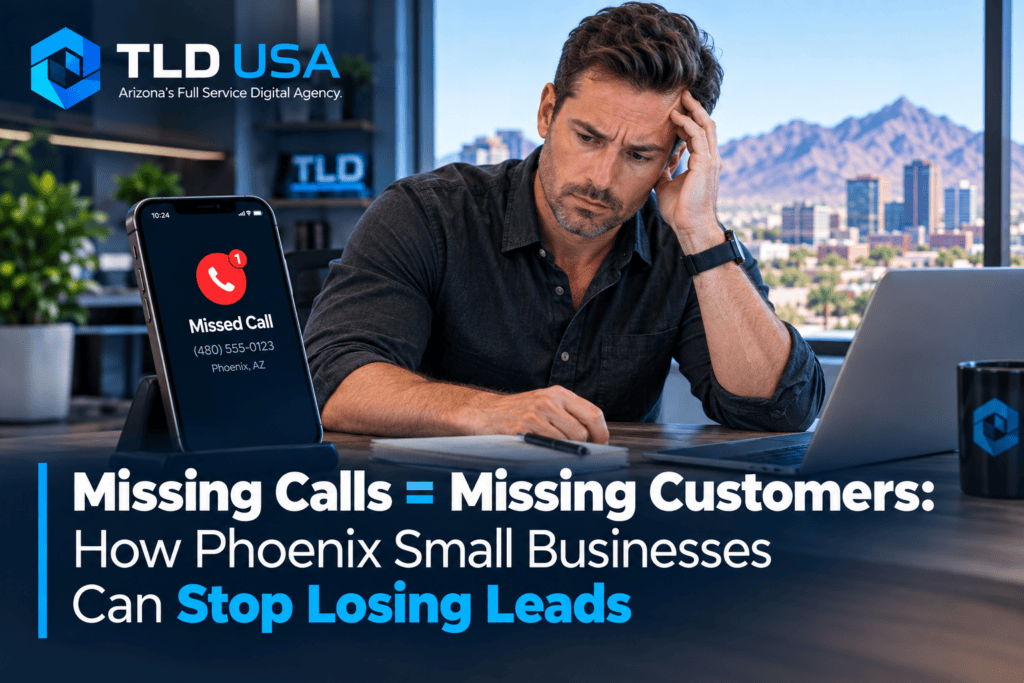
Then a potential customer calls while you’re on a job, helping another customer, driving, in a meeting or simply away from your phone.
They leave a voicemail.
Or they don’t.
You plan to call them back.
Then the day gets away from you.
By the time you call, they’ve already contacted someone else.
For many small businesses, the problem isn’t generating another lead.
The problem is what happens after the lead arrives.
Quick answer: If your business regularly misses calls, takes hours to respond to website inquiries, or relies on memory to follow up with prospects, you may have a lead-management problem rather than a lead-generation problem. A properly connected website, phone system, CRM and automation workflow can help make sure legitimate inquiries are captured, acknowledged and followed up with.
Recent small-business discussions have repeatedly focused on this exact problem: missed calls, slow responses, after-hours inquiries, forgotten follow-ups and owners being too busy serving customers to manage every incoming lead.
For Phoenix and Scottsdale businesses, this matters because the customer who just searched for a service often has several options available to them.
You may only get one opportunity to respond.
Table of Contents
- Why Small Businesses Miss Good Leads
- The Problem With Relying on Voicemail
- What Happens When a Website Lead Comes In
- Why Speed Matters Without Chasing Every Lead
- Missed-Call Text Back: A Simple First Step
- What After-Hours Leads Should Trigger
- How a CRM Prevents Leads From Disappearing
- Where AI Can Actually Help
- Why Your Website and CRM Need to Work Together
- What Your Lead Process Should Look Like
- When Fractional IT Makes Sense
- A Simple Lead-Leak Test
- A Simple Next Step
- Frequently Asked Questions
- Final Thoughts
Why Small Businesses Miss Good Leads
Most small businesses aren’t intentionally ignoring customers.
They’re busy.
A plumber is on a job.
A transmission shop is working on a vehicle.
A contractor is walking a property.
A salon owner is with a client.
A medical office is helping patients.
A law firm is dealing with an existing case.
A real estate professional is showing a property.
The business is doing exactly what it is supposed to do: serving customers.
The problem is that the phone doesn’t care what you’re doing.
Neither does the website.
Nor does the contact form.
Neither does the person who just searched Google for your service.
That creates a dangerous disconnect.
Your marketing can generate the opportunity, but your operational systems have to capture it.
The Problem With Relying on Voicemail
Voicemail isn’t useless.
It is simply not a complete lead-management system.
When someone calls a local business and gets voicemail, several things can happen.
They might leave a message.
Probably might hang up.
They might send a text instead.
Might visit another website.
They might call your competitor.
They might decide to deal with the problem later and forget about it entirely.
The business owner usually has no idea which outcome occurred.
That makes missed calls difficult to measure.
A better system treats an unanswered call as an event that requires action.
For example:
Incoming call → missed → automatic acknowledgment → lead captured → follow-up assigned → customer contacted → outcome recorded
That is very different from:
Incoming call → voicemail → remember to call back
One is a process.
The other depends on memory.
What Happens When a Website Lead Comes In?
The same problem happens with website forms.
A potential customer fills out your contact form.
What happens next?
Does the form go to one employee’s email?
Does someone receive a text?
Is the lead entered into your CRM?
Does the customer receive an immediate acknowledgment?
Does someone know who is responsible for the follow-up?
Can you tell whether that person ever contacted the prospect?
Does the lead remain visible until it is closed?
If the answer to several of those questions is “no,” your website may be generating opportunities that your business isn’t equipped to manage.
That’s an important distinction.
Your website may not need more traffic. It may need a better system behind it.
Why Speed Matters Without Chasing Every Lead
Not every phone call is a customer.
Just like not every form submission is legitimate.
Not every inquiry deserves an immediate sales response.
That doesn’t mean every legitimate lead should be treated casually.
A good lead-management system separates the two.
Instead of trying to personally respond to everything immediately, the system can help identify what needs attention.
For example:
- New website inquiry
- Missed customer call
- Existing customer request
- Spam inquiry
- Quote request
- Appointment request
- Emergency service request
- General question
- Follow-up waiting on customer
The goal isn’t to automate your entire business.
The goal is to make sure important opportunities don’t disappear because everyone was busy.
Missed-Call Text Back: A Simple First Step
One of the simplest ways to improve a missed-call process is an automatic text response.
For example:
“Sorry we missed your call. We’re currently helping another customer. Reply here with what you need and we’ll get back to you.”
That message doesn’t replace your team.
It simply acknowledges the customer.
Tells them their call wasn’t ignored.
It gives them another way to communicate.
And, depending on the system, it can feed that conversation into the same lead-management process used for website inquiries.
However, businesses should not blindly turn on automated texting.
The messaging workflow, consent, opt-out handling and the type of message being sent matter. The FCC has specific rules concerning consent and revocation for certain automated calls and texts, including the ability for consumers to revoke consent through reasonable methods such as reply messages.
The technology should support your process—not create a compliance problem.
What Should Happen to After-Hours Leads?
Your business doesn’t have to be open 24 hours a day.
Your lead capture shouldn’t necessarily stop when you lock the door.
An after-hours system might:
- Capture the customer’s name.
- Capture their phone number.
- Identify what service they need.
- Provide basic information.
- Offer a scheduling option when appropriate.
- Notify your team.
- Create a follow-up task for the next business day.
- Record the interaction.
For some businesses, a simple form and automated acknowledgment are enough.
For others, an AI-assisted system or more advanced phone workflow may make sense.
The important part is matching the technology to the business.
You don’t need an expensive AI system just because AI exists.
How a CRM Prevents Leads From Disappearing
This is where a properly configured CRM becomes useful.
A CRM should not simply be a database containing hundreds of names.
It should show you what needs to happen next.
For example:
| Lead | Source | Status | Next Action |
|---|---|---|---|
| John Smith | Website | New | Call |
| Sarah Jones | Contacted | Send estimate | |
| Mike Brown | Phone | Waiting | Follow up |
| Lisa Davis | Referral | Appointment | Confirm |
| Tom Wilson | Website | Closed | Request review |
Now your team doesn’t have to remember everything.
The system tells them.
A properly configured CRM can also connect the website, email, phone system, scheduling tools and other business applications so information doesn’t have to be manually copied from one place to another.
That becomes particularly valuable as a business grows.
Where AI Can Actually Help
AI can be useful in the lead process, but it shouldn’t be added simply because it is fashionable.
Useful applications can include:
- Summarizing incoming inquiries
- Categorizing leads
- Identifying the service requested
- Drafting an initial response
- Summarizing phone conversations
- Extracting contact information
- Routing inquiries
- Helping answer routine questions
- Creating internal follow-up tasks
- Identifying leads that haven’t received a response
- Organizing information before a salesperson or owner responds
The human still needs to control important customer decisions.
AI can reduce repetitive work.
It should not become an excuse to remove judgment from the process.
Why Your Website and CRM Need to Work Together
A website should not operate as an isolated marketing asset.
If someone fills out a form, that inquiry should have somewhere to go.
A strong setup might look like this:
Google Search
↓
Website
↓
Lead Form
↓
CRM
↓
Instant Acknowledgment
↓
Employee Notification
↓
Follow-Up Task
↓
Estimate / Appointment
↓
Customer
↓
Review / Repeat Business
That is a business system.
It also gives you something extremely valuable:
visibility.
Instead of wondering whether your marketing is working, you can start asking better questions.
How many leads came in?
Where did they come from?
In total how many were contacted?
How quickly?
How many booked?
What is the number that became customers?
How many are still waiting?
Where are leads getting stuck?
Those questions are far more useful than simply asking how many people visited your website.
What Your Lead Process Should Look Like
A practical small-business lead process doesn’t need to be complicated.
Step 1: Capture the lead
Every legitimate inquiry should enter a system.
That might be through:
- Website forms
- Phone calls
- Text messages
- Google Business Profile
- Social media
- Online scheduling
- Referral forms
Step 2: Acknowledge the inquiry
The customer should know their request was received.
This could be human or automated depending on the situation.
Step 3: Assign responsibility
Someone should own the lead.
Not “someone on the team.”
An actual person or clearly defined workflow.
Step 4: Follow up
The next action should be visible.
Call.
Email.
Text.
Schedule.
Send estimate.
Answer question.
Whatever the situation requires.
Step 5: Track the outcome
The lead should eventually have a status.
Booked.
Closed.
Lost.
Not qualified.
Waiting.
Follow-up required.
Without this step, your CRM eventually becomes another messy database.
When Fractional IT Makes Sense
This is where many small businesses run into a wall.
The problem isn’t necessarily that they need an IT department.
They need someone who understands how the pieces fit together.
The website needs to connect to the CRM.
The CRM needs to connect to email.
The phone system needs to work with the lead process.
The business needs secure accounts.
Employees need appropriate access.
Automations need to work.
Backups need to exist.
Someone needs to know what happens when something breaks.
That is where Fractional IT can make sense.
Instead of hiring a full-time IT employee to manage a relatively small technology environment, a business can bring in professional technology support as needed.
For a growing Phoenix or Scottsdale business, that can mean having someone who understands the technology underneath the marketing—not just someone who fixes a computer when it stops working.
A Simple Lead-Leak Test
You can test your own business in about 15 minutes.
Call your business from a number nobody recognizes.
Don’t leave a voicemail immediately.
See what happens.
Then submit your website contact form.
Watch your inbox.
Now ask:
- How long did it take to receive a response?
- Did anyone receive the lead?
- Did the lead enter a CRM?
- Did anyone know who was responsible?
- Did you receive an acknowledgment?
- What happens if the inquiry arrives after hours?
- What happens if the person doesn’t respond?
- Does anyone follow up again?
- Can you tell where the lead came from?
- Can you see whether the lead became a customer?
Now try it after business hours.
That’s where many businesses discover the gap.
The Real Cost Isn’t the Missed Call
A missed call isn’t automatically a lost customer.
That’s important.
Some calls are spam.
Other callers have the wrong number.
Some people will call back.
Some inquiries simply aren’t a fit.
The real problem is having no system for knowing which is which.
If you spend money on SEO, advertising, social media or other marketing to generate demand, then allow legitimate inquiries to disappear because nobody had time to handle them, you’re creating an expensive leak.
Fixing that leak may be more valuable than immediately increasing your advertising budget.
TLD USA Can Help Connect the Pieces
TLD USA works with Phoenix, Scottsdale and Arizona small businesses on the technology and digital systems behind customer acquisition.
That can include:
- Website design and development
- Website maintenance
- Local SEO
- Google Business Profile support
- Lead tracking
- CRM setup
- CRM automation
- Website-to-CRM integration
- Email and business technology
- AI and business automation
- Marketing tracking
- Fractional IT support
- Technology planning
The objective isn’t to add more software.
It’s to determine what your business actually needs, connect the systems that should communicate, and eliminate unnecessary manual work.
A Simple Next Step
If you’re already getting calls, website inquiries or referrals but aren’t confident that every legitimate opportunity is being captured and followed up with, start there.
Don’t automatically buy more advertising.
Audit the path from first contact to customer.
TLD USA can review your website, lead process, CRM, technology and marketing systems and identify where opportunities are getting lost.
Call 623-282-2114 or schedule a 30-minute strategy session at tldtechusa.com.
Frequently Asked Questions
How do I stop missing customer calls?
Start by identifying when and why calls are being missed. Then consider a business phone system, missed-call workflow, automated acknowledgment, call routing, scheduling system or CRM integration based on your actual needs.
What is a missed-call text-back?
A missed-call text-back is an automated message sent after an unanswered call. It can acknowledge the caller and provide another way to continue the conversation. Businesses should configure these systems with applicable messaging and consent requirements in mind.
Do small businesses need a CRM?
Not every business needs a complicated CRM. However, if leads are being tracked through memory, spreadsheets, scattered emails or text messages, a properly configured CRM can make follow-up much easier.
Should I use an AI receptionist?
It depends on the business. An AI receptionist may make sense when call volume, after-hours inquiries or repetitive questions are creating a real operational problem. It should be evaluated based on the customer experience and the actual workflow—not simply because it uses AI.
Can my website automatically send leads to my CRM?
Yes. Many websites and CRM platforms can be connected so that a form submission creates or updates a lead record, notifies the appropriate employee and triggers a defined follow-up process.
What if I already spend money on SEO?
SEO can help generate qualified traffic, but generating traffic is only part of the customer journey. If inquiries aren’t being captured, answered and followed up with consistently, improving the lead-management process may be necessary alongside SEO.
Can Fractional IT help with business automation?
Yes. Fractional IT can provide ongoing technical guidance and support for connected business systems, email, security, websites, automation, CRM infrastructure and other technology needs without requiring a full-time internal IT department.
Final Thoughts
Small businesses don’t lose customers only because competitors have better websites.
Sometimes they lose them because the owner was helping another customer when the phone rang.
Sometimes the form went to an inbox nobody checked.
Often times the quote was sent but never followed up.
Sometimes the customer called after hours and simply moved on.
Those aren’t necessarily marketing failures.
They’re system failures.
And systems can be fixed.
The goal isn’t to automate your business until it feels impersonal.
The goal is to make sure your team has the tools to respond when customers are ready to buy—even when you’re busy doing the work that makes your business successful.
TLD USA – Websites, SEO, IT Support and Fractional IT for Arizona businesses.