
How Much Does Local SEO Cost? A Real Pricing Guide

How much does local SEO cost for Phoenix and Scottsdale businesses

How Much Does Local SEO Cost? A Real Pricing Guide

Every local SEO quote seems to land in a different range.

One agency may quote $300 a month. Another may quote $3,000.

Both companies may call their service “local SEO.” However, the work behind those prices can be very different.

So, how much does local SEO cost?

The answer depends on several factors.

Local SEO can include website optimization, keyword research, Google Business Profile work, content, citations, technical SEO, reporting, and ongoing strategy.

Therefore, two businesses can receive completely different services while both receive a quote labeled “local SEO.”

Understanding the pricing models gives you a better way to compare those offers.

Quick answer: Local SEO pricing commonly ranges from several hundred dollars per month to several thousand dollars. Your actual cost depends on competition, location, website condition, service area, and scope. One-time audits and setup projects can also cost hundreds or several thousand dollars. Most importantly, compare the work behind the price.

Table of Contents

  • Why Local SEO Pricing Varies
  • Typical Local SEO Pricing Models
  • Local SEO Pricing Chart
  • What Actually Affects Your Cost
  • What You Should Get for Your Money
  • Red Flags in Local SEO Pricing
  • What Makes TLD USA Different
  • TLD USA SEO Starts at $750 Per Month
  • What 12 Dedicated SEO Hours Can Cover
  • How to Know If Your SEO Is Working
  • A Simple Next Step
  • Frequently Asked Questions
  • Final Thoughts

Why Local SEO Pricing Varies So Much

Local SEO is not one single task.

Instead, it combines several different services.

Those services may include:

  • Website optimization
  • Keyword research
  • Google Business Profile optimization
  • Local citations
  • Content development
  • Internal linking
  • Technical SEO
  • Local landing pages
  • Review strategy
  • Competitor research
  • Reporting
  • Ongoing strategy

Because the scope can vary, pricing can vary as well.

Your starting point matters, too.

For example, a business with a fast website, strong content, accurate business information, and an established Google Business Profile may need less foundational work.

On the other hand, an older website with technical problems may need significant cleanup first.

The market also matters.

A personal injury law firm competing across Phoenix may face intense competition.

Meanwhile, a specialized home service business targeting one suburb may have a different SEO challenge.

Similarly, a company targeting Phoenix, Scottsdale, Tempe, Mesa, Chandler, and Gilbert needs a broader strategy than a company serving one community.

As a result, a simple price comparison does not tell the entire story.

You need to compare the scope of work behind the price.


Typical Local SEO Pricing Models

Here are common pricing models you may encounter when comparing SEO agencies, consultants, and service providers.

Pricing ModelTypical CostMonthly Support
Monthly SEO Retainer$300 – $2,500/monthYes
One-Time SEO Audit$500 – $1,500No
Project-Based SEO Setup$1,000 – $5,000No
Hourly SEO Consulting$100 – $250/hourNo

These ranges are general market examples.

Actual pricing varies by provider, location, competition, experience, and scope.

Monthly SEO Retainer

A monthly retainer provides ongoing SEO work.

Depending on the provider, that work may include website optimization, local SEO, Google Business Profile management, content, reporting, technical improvements, and strategy.

However, the amount of actual work can differ significantly between providers.

That is why the monthly price alone does not tell you enough.

One-Time SEO Audit

An SEO audit examines your current website and local search presence.

For example, an audit may identify technical problems, keyword opportunities, content gaps, citation issues, Google Business Profile problems, and competitor opportunities.

The audit gives you information.

However, implementation may require a separate project or ongoing service.

Project-Based SEO Setup

A project-based service establishes the foundation for an SEO campaign.

That work may include technical fixes, keyword research, website optimization, Google Business Profile optimization, local landing pages, citations, schema, and other foundational improvements.

Once the project ends, ongoing SEO may require a separate agreement.

Hourly SEO Consulting

Hourly consulting can work well for specific questions, technical problems, strategy sessions, or individual SEO tasks.

For example, a business may need help fixing a technical issue or understanding a sudden ranking change.

However, hourly consulting does not automatically provide ongoing SEO management.


Local SEO Pricing Chart

The chart below gives you a simple visual comparison of common SEO pricing models.

LOCAL SEO PRICING SPECTRUM

$300                 $750                 $1,500                 $2,500+
│---------------------│---------------------│----------------------│
Monthly SEO           Monthly SEO          Expanded SEO           Extensive
Retainer              Retainer             Management              SEO Campaign
│                     │                     │                      │
Ongoing Support       Ongoing Support      Ongoing Support        Ongoing Support


ONE-TIME SERVICES

$500 ───────────── $1,500
One-Time SEO Audit
Monthly Support: NO


$1,000 ───────────────────────────── $5,000
Project-Based SEO Setup
Monthly Support: NO


$100 ─────────────── $250/hour
Hourly SEO Consulting
Monthly Support: NO

The chart represents general pricing examples.

It does not mean every agency uses these exact numbers.

More importantly, price does not tell you how much professional work you receive.

That distinction becomes especially important when comparing monthly SEO services.


What Actually Affects Your Local SEO Cost?

1. Industry and City Competition

Competition plays a major role in local SEO pricing.

For example, a competitive legal market can require substantial ongoing work.

Likewise, popular service categories in Phoenix and Scottsdale can have many businesses competing for the same searches.

In contrast, a specialized business in a smaller market may face fewer competitors.

Therefore, your SEO plan should account for the actual search environment.

2. The Current State of Your Website

Your website provides the foundation for SEO.

If the site has technical problems, slow pages, weak content, broken links, or poor mobile performance, those issues may need attention first.

Once the foundation improves, ongoing SEO can focus more heavily on visibility and growth.

3. Number of Locations and Service Areas

One service area is very different from ten.

For example, a company targeting Scottsdale has a different local SEO scope than a company targeting multiple Phoenix Valley communities.

Each additional market can require more research, content, optimization, and competitive analysis.

As a result, a larger service area can increase the amount of SEO work required.

4. Content Requirements

Content can support local SEO in several ways.

It can target services, locations, customer questions, industry topics, and long-tail searches.

However, useful content takes time to research and produce.

A business with hundreds of strong pages has a different starting point than a business with five basic pages.

5. Citation and Directory Work

Your business information should remain accurate across relevant directories.

That includes your:

  • Business name
  • Address
  • Phone number
  • Website
  • Services
  • Business categories

If that information is inconsistent, additional cleanup may become necessary.

6. Reviews and Reputation

Reviews can also affect the overall local search strategy.

Some SEO providers include review strategy within their services.

Others treat reputation management as a separate service.

Therefore, ask what is included before comparing prices.


What You Should Get for Your Money

Before signing an SEO agreement, ask exactly what the provider will do, and remember we have no contracts here at TLD USA.

Depending on the plan, you may expect services such as:

  • Google Business Profile optimization
  • Google Business Profile posts and updates
  • Local keyword research
  • On-page website optimization
  • Technical SEO
  • Local landing page optimization
  • Internal linking
  • Citation and directory management
  • Competitor research
  • Content strategy
  • Schema markup
  • Local search monitoring
  • SEO reporting
  • Conversion tracking
  • Ongoing strategy

You should also know who performs the work.

Furthermore, you should understand how often that work happens.

A monthly SEO fee should never feel like a mystery charge.

Instead, you should know what work is being completed and why.


Red Flags in Local SEO Pricing

Guaranteed Number-One Rankings

No SEO provider controls the search results.

Search algorithms change.

Competitors also change their strategies.

For that reason, be cautious about anyone who guarantees a specific ranking position.

Extremely Cheap Full-Service Packages

A very low monthly price can sound attractive.

However, ask what actual work the price covers.

If the provider cannot explain the work, reporting, or strategy, you may not be comparing equivalent services.

No Reporting

You should know what is happening with your SEO.

Useful measurements can include:

  • Keyword visibility
  • Local search visibility
  • Organic traffic
  • Website leads
  • Phone calls
  • Google Business Profile activity
  • Direction requests
  • Conversion activity

Without meaningful reporting, it becomes difficult to understand your progress.

Long-Term Contracts With No Clear Explanation

Some businesses prefer month-to-month SEO.

Others choose longer engagements.

Either way, understand the commitment before signing.

Ask about cancellation terms, deliverables, reporting, and ongoing responsibilities.

One-Size-Fits-All SEO

Your business is different from your competitor.

Every website is different.

Your service area is different.

Your customers are different.

Consequently, your SEO strategy should account for those differences.


What Makes TLD USA Different?

This is where TLD USA takes a different approach.

Rather than forcing every business into a large SEO package, TLD USA uses a dedicated-work model.

The concept is straightforward.

You receive dedicated professional SEO time each month.

Then, that time can focus on the priorities your business actually needs.

Those priorities can include:

  • Technical SEO
  • On-page SEO
  • Keyword research
  • Local SEO
  • Google Business Profile optimization
  • Content strategy
  • Internal linking
  • Schema markup
  • Image SEO
  • Citation work
  • Competitor research
  • SEO reporting
  • Website improvements
  • Local landing pages
  • Search visibility strategy

As priorities change, the work can change with them.

For example, one month may require technical cleanup.

The next month may require more content optimization.

Later, the focus may shift toward local pages, Google Business Profile optimization, internal linking, or competitor research.

That flexibility is a major part of the model.


TLD USA SEO Starts at $750 Per Month

TLD USA SEO starts at $750 per month.

The starting plan includes 12 dedicated hours each month specifically for SEO work.

That gives you a straightforward way to understand what the monthly fee provides.

You are not simply paying for access to an SEO dashboard.

Instead, you receive dedicated professional time that can be directed toward your SEO priorities.

Those hours can support work such as:

  • Technical SEO
  • Local SEO
  • Keyword research
  • Google Business Profile optimization
  • Content optimization
  • Internal linking
  • Schema
  • Image SEO
  • Citation work
  • Competitor research
  • SEO reporting
  • Strategy

The exact allocation depends on your website and current priorities.

As a result, the work can evolve as your SEO needs change.


What Does 12 Dedicated SEO Hours Actually Mean?

Twelve hours per month equals approximately three dedicated SEO hours each week.

That gives you a simple way to understand the model.

Instead of purchasing an oversized package, you receive a defined block of professional SEO time.

Then, that time can be applied where it matters most.

For example, a technical problem may require immediate attention.

Later, the same business may need new location content.

Another month may call for internal linking, Google Business Profile optimization, or competitor research.

The available time remains dedicated to SEO.

The priorities can change.


What Can TLD USA Do With 12 Dedicated SEO Hours?

The exact allocation depends on your business.

However, the hours can be used for a wide range of SEO work.

Technical SEO

  • Website technical review
  • Indexing issues
  • Broken links
  • Redirects
  • Metadata
  • Page structure
  • Internal linking
  • Technical cleanup

Local SEO

  • Local keyword research
  • Location targeting
  • Local landing pages
  • Local search strategy
  • Competitive research
  • Citation opportunities

Google Business Profile

  • Profile optimization
  • Category review
  • Services
  • Business description
  • Posts
  • Local keyword strategy
  • Photo optimization
  • Review strategy

Website Content

  • Existing page optimization
  • Service-page optimization
  • Location-page optimization
  • Blog optimization
  • Search-intent improvements
  • Content recommendations

Schema and Structured Data

  • Business schema
  • Service schema
  • Article schema
  • Structured data review
  • Entity information

SEO Reporting

  • Keyword visibility
  • Search traffic
  • Local visibility
  • Website activity
  • Leads
  • Calls
  • Conversion data

The goal is not to create a report simply for the sake of reporting.

Instead, the goal is to understand what is happening and determine what should happen next.


Why TLD USA Uses a Fractional SEO Model

Hiring a full-time SEO professional can be expensive.

Hiring several specialists can cost even more.

For many small businesses, a full internal SEO department does not make financial sense.

That is where fractional professional support can help.

TLD USA provides access to dedicated professional SEO time without requiring you to hire a full-time SEO employee.

You receive a defined amount of professional work each month.

Then, that work can focus on your current priorities.

This model can also work well for businesses that already have employees handling some marketing tasks.

Your team can handle the work they know.

TLD USA can provide additional technical and strategic SEO support where needed.


TLD USA SEO vs. a Traditional Monthly SEO Package

The difference is not simply the monthly price.

Instead, the difference is how the work gets structured.

Traditional Monthly SEO PackageTLD USA SEO
PricingVaries by providerStarts at $750/month
Dedicated SEO HoursVaries12 hours/month
Work AllocationOften package-basedDedicated time based on priorities
Technical SEODepends on packageIncluded within dedicated SEO work
Local SEODepends on packageIncluded within dedicated SEO work
Google Business ProfileDepends on packageIncluded within dedicated SEO work
Content OptimizationDepends on packageIncluded within dedicated SEO work
ReportingDepends on providerIncluded with ongoing SEO management
StrategyDepends on providerOngoing
Contract TermsDepends on providerDiscuss current terms

This comparison does not mean every traditional SEO package is bad.

There are many different SEO providers and service models.

Instead, the important point is simple:

Understand exactly what you are paying for.


How to Know If Your Local SEO Is Working

SEO does not normally produce overnight results.

Instead, meaningful movement can take months.

Competitive markets may take longer.

Your starting point also matters.

Even so, you should see measurable signs of progress.

Look at:

  • Local search visibility
  • Target keyword movement
  • Organic website traffic
  • Google Business Profile activity
  • Phone calls
  • Website inquiries
  • Contact-form submissions
  • Direction requests
  • Conversion activity

Traffic alone does not tell the whole story.

A thousand visitors who never become customers may matter less than a smaller amount of highly qualified local traffic.

Therefore, conversion tracking matters.

Your website, SEO, Google Business Profile, advertising, and lead generation should work together.

If you cannot see where leads come from, it becomes much harder to understand what is working.

For Phoenix and Scottsdale businesses, TLD USA focuses on connecting SEO with the broader digital presence.


A Simple Next Step

If you are researching how much local SEO costs, do not ask only:

“How much do you charge?”

Instead, ask:

“What professional work do I actually receive for that price?”

Then ask:

  • How many hours are dedicated to my business?
  • Who performs the work?
  • What happens each month?
  • What gets optimized?
  • How is progress measured?
  • Is Google Business Profile work included?
  • Is technical SEO included?
  • Is content optimization included?
  • Can the work change when priorities change?
  • Do I have a clear point of contact?

Those questions can tell you much more than the monthly price.

If you want to discuss your website, local search presence, and SEO needs, TLD USA can review your current situation and discuss the next steps.

Call TLD USA at 623-282-2114.

Or book a 30-minute strategy session:

https://calendly.com/tldusa480/30min


Frequently Asked Questions

What’s a reasonable monthly budget for local SEO?

A common range for small and mid-sized businesses is several hundred to several thousand dollars per month.

However, your actual cost depends on competition, location, website condition, service area, and scope.

Therefore, compare the work behind each price.

How much does TLD USA SEO cost?

TLD USA SEO starts at $750 per month.

The starting plan includes 12 dedicated hours each month specifically for SEO work.

Those hours can support technical SEO, local SEO, Google Business Profile optimization, content, keyword research, competitor research, internal linking, schema, reporting, and other SEO priorities.

What makes TLD USA’s SEO model different?

TLD USA uses a dedicated-work approach.

Rather than relying only on a fixed checklist, the available SEO time can focus on the areas that need attention.

As your priorities change, the work can change as well.

Why do some SEO companies charge much less?

SEO pricing varies because the scope varies.

Some providers offer limited services.

Others automate portions of their work.

Meanwhile, some focus on one specific area instead of providing ongoing management.

Therefore, always ask what the monthly fee includes.

How long does local SEO take?

SEO usually takes time.

Some businesses see early movement within a few months.

However, competitive industries and larger service areas can take longer.

Your website’s starting condition also affects the timeline.

Can I do local SEO myself?

Yes.

Business owners can handle basic tasks such as keeping business information accurate and maintaining their Google Business Profile.

However, technical SEO, competitive keyword strategy, content optimization, structured data, and broader local SEO can require substantial time and experience.

Should I pay for a one-time SEO audit?

An audit can make sense when you want to understand your starting point.

For example, it can identify technical problems, content gaps, local SEO opportunities, and other priorities.

Afterward, you can decide which recommendations require implementation.

Do I need a long-term SEO contract?

Not necessarily.

Different providers use different arrangements.

Before signing, understand the contract terms, cancellation policy, deliverables, reporting, and ongoing responsibilities.

Is $750 per month expensive for SEO?

Price alone does not answer that question.

Instead, look at the amount and type of professional work included.

With TLD USA’s starting SEO plan, the $750 monthly price includes 12 dedicated SEO hours.

That gives you a clear way to understand the professional time allocated to your SEO.


Final Thoughts

So, how much does local SEO cost?

There is no single price.

Common pricing models can range from several hundred dollars per month to several thousand dollars.

One-time audits and SEO projects can also cost hundreds or thousands of dollars.

Ultimately, the difference comes down to scope.

You need to know what the provider is actually doing.

You should also know who performs the work.

Most importantly, understand how much dedicated professional time your business receives.

That is why TLD USA uses a different approach.

TLD USA SEO starts at $750 per month with 12 dedicated SEO hours each month.

The goal is straightforward.

Give Phoenix, Scottsdale, and Arizona businesses access to experienced SEO professionals without forcing them into an oversized agency package.

Your business receives dedicated SEO time.

Your priorities determine where that time goes.

You know what you are paying for.

TLD USA – Arizona’s Full Service Digital Agency

Websites. SEO. IT Support. Fractional IT.

623-282-2114

Book a 30-minute strategy session:
https://calendly.com/tldusa480/30min

Social Media Strategy for Small Businesses (2026 Guide): Step-by-Step System That Drives Real Growth

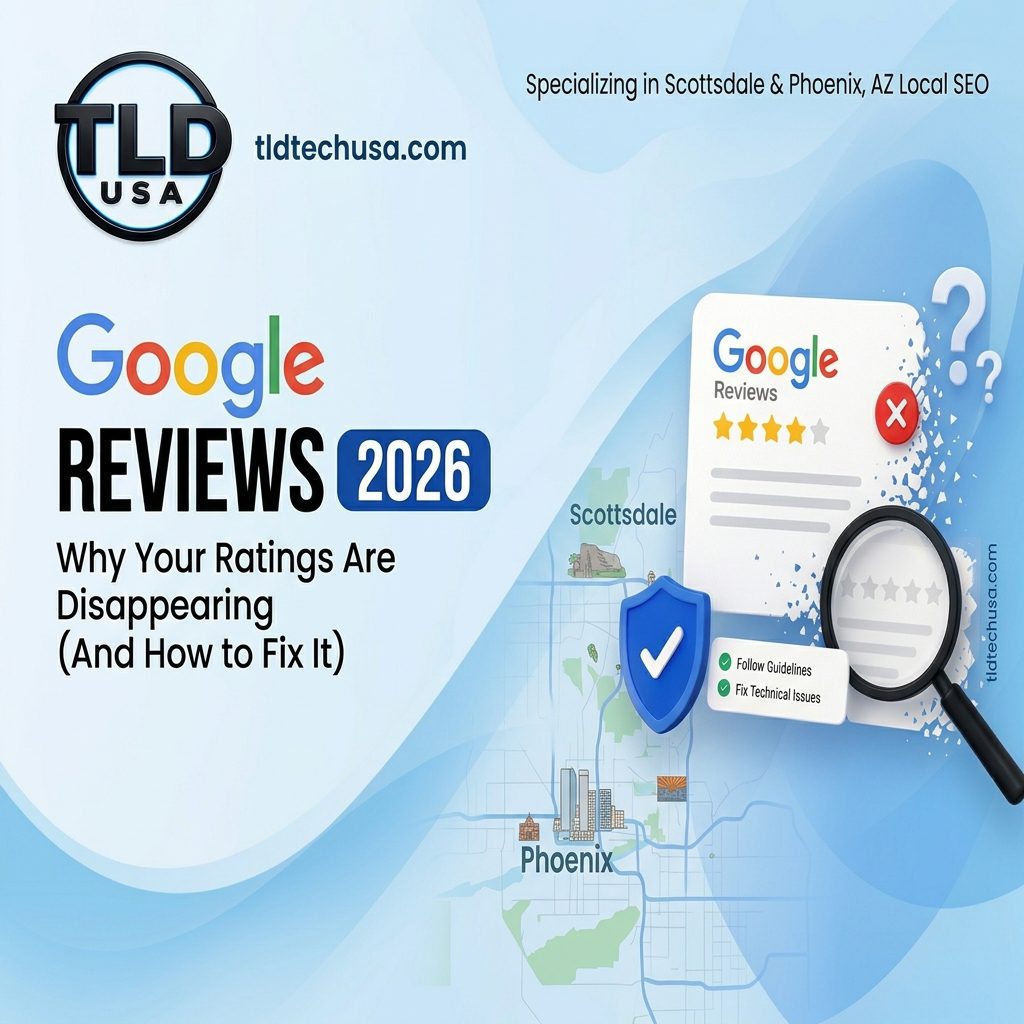
Your Google Reviews Just Vanished. Here’s What’s Actually Going On.

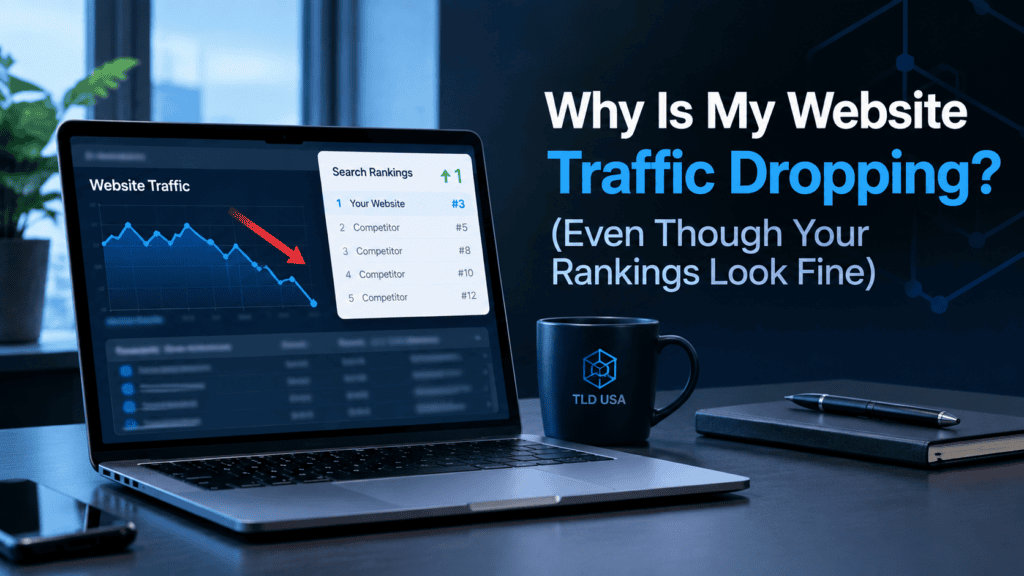
Why is my website traffic dropping even though my search rankings look fine

Your Google Reviews Just Vanished. Here’s What’s Actually Going On.

You open your Google Business Profile and check your review count.

Something looks wrong.

Your review count has dropped. In some cases, businesses have seen hundreds of reviews disappear almost overnight. Some owners have reported losing years of review history with little or no explanation.

If this happened to you, you’re not alone.

Google Business Profile owners reported multiple review problems during 2026. Some incidents affected what owners could see in their dashboards. Other reports involved major drops in public review counts.

Quick Answer

Google reviews can disappear for several reasons.

Sometimes, a technical problem affects how Google displays reviews. Other times, Google’s automated systems may remove reviews that they identify as spam or policy violations. Google also acknowledges that its automated systems can mistakenly remove legitimate reviews.

If your reviews suddenly disappear, don’t panic.

First, check your public profile. Then compare it with your previous records. Finally, document the change and contact Google Business Profile support if the reviews remain missing.

What’s Actually Happening in 2026?

Google Business Profile owners have reported several review-related problems throughout 2026.

Some incidents affected the owner dashboard while customers could still see the reviews publicly. Other reports described much larger drops in review counts.

For example, business owners reported sudden review-count changes in early July. One Google Business Profile Community thread described a profile dropping from more than 160 reviews to zero. The owner later reported that the written reviews also disappeared.

Another July thread reported businesses losing large numbers of reviews. Product Experts discussed the issue with affected business owners and escalated some cases to Google.

That distinction matters.

A missing review in your dashboard does not always mean Google permanently deleted it.

Is It a Bug or Real Enforcement?

This is where things get complicated.

Google uses automated systems to detect spam and policy violations. Those systems can remove reviews that violate Google’s policies. Google also says that its automated systems can sometimes remove legitimate reviews by mistake.

At the same time, technical problems can affect how reviews appear.

That means you need to determine what actually happened before changing your review strategy.

Look for these clues:

  • Did your public review count suddenly change?
  • Can customers still see the missing reviews?
  • Did only the owner dashboard lose access to the reviews?
  • Did Google send a policy notification?
  • Did the disappearance happen immediately after a suspicious review or spam attack?
  • Did several businesses report the same problem at the same time?

A sudden, widespread change can point toward a Google-side issue. A smaller group of missing reviews may require a closer look at Google’s review policies.

How to Check Whether Your Business Was Affected

Step 1: Check Your Previous Review Count

Look for a recent screenshot, report, marketing document, or other record showing your review count.

Don’t have one?

Start keeping monthly records now.

A simple screenshot can give you useful documentation if your review count changes later.

Step 2: Check Your Public Google Business Profile

Don’t rely only on the management dashboard.

Open your public Business Profile and check the reviews from the customer-facing side.

You may find that customers can still see reviews that don’t appear in your owner dashboard.

Google Business Profile owners reported this exact type of dashboard problem in July 2026. In one reported case, customers could see reviews while administrators could not access them through the dashboard. A Google Product Expert identified it as a known bug under investigation.

Step 3: Look for Policy Notifications

Check your Business Profile for notices about suspicious activity, review restrictions, or policy issues.

Google’s automated systems evaluate reviews for policy violations. Reviews that violate Google’s policies may disappear from Search and Maps.

Step 4: Check the Google Business Profile Community

Search the Google Business Profile Community for similar reports.

This step can provide useful context.

If dozens of business owners report the same problem during the same period, you may be dealing with a broader Google issue rather than an isolated problem with your profile.

What Should You Do If Your Reviews Disappeared?

Document Everything

Start with evidence.

Save screenshots of:

  • Your current review count
  • Your previous review count
  • Missing reviews
  • Your public Business Profile
  • Your owner dashboard
  • Any Google notices
  • Support case numbers
  • Relevant customer communications

Documentation gives Google more information to investigate.

Contact Google Business Profile Support

If legitimate reviews remain missing, contact Google Business Profile support.

Google specifically advises businesses to contact support when its automated systems mistakenly remove legitimate reviews.

Explain exactly what happened.

Include the approximate date, your previous review count, your current count, and any screenshots you have.

Don’t Ask Customers to Repost Everything Immediately

This is important.

Don’t immediately launch a campaign asking everyone to repost a missing review.

First determine why the reviews disappeared.

A sudden wave of similar review activity can create additional review-quality concerns. Google considers unusual review patterns and other signals when evaluating reviews.

Give Google time to investigate before creating another unusual spike.

Keep Running Your Business Normally

Don’t let a review-count problem derail your entire marketing strategy.

Continue providing good service.

Always be collecting legitimate customer feedback through normal processes.

Continue monitoring your Business Profile.

The goal is consistency, not panic.

How to Protect Your Review Base Going Forward

Google reviews matter. However, your entire reputation should not depend on one platform.

Diversify Your Online Reputation

Google remains an important source of local trust.

Still, consider building a broader review presence.

Depending on your industry, that could include:

  • Yelp
  • Facebook
  • BBB
  • Industry-specific review sites
  • Professional directories
  • Testimonials on your website

A broader reputation gives your business more than one source of customer trust.

Keep a Regular Record

Make review monitoring part of your normal marketing process.

Take a monthly screenshot.

Record your review count.

Track your average rating.

Monitor unusual changes.

This takes only a few minutes, but it gives you a historical record when something goes wrong.

Build Reviews Consistently

Don’t rely entirely on reviews you collected five years ago.

Create a consistent process for asking satisfied customers for honest feedback.

Don’t buy reviews.

Never offer incentives for positive reviews.

Don’t pressure customers to use specific wording.

Instead, create a simple process that makes it easy for genuine customers to share their experience.

Monitor Your Profile Regularly

Don’t wait until a customer tells you something looks wrong.

Monitor your profile.

Check your review count.

Watch for unusual changes.

Look at new reviews.

Respond appropriately.

That gives you a better chance of catching problems early.

A Simple Next Step

Google’s review system can create real headaches for local businesses.

Technical problems can affect what owners see. Automated systems can also remove reviews that Google identifies as policy violations. In some cases, legitimate reviews may disappear by mistake.

That’s why review monitoring should become part of your broader local SEO strategy.

TLD USA helps Phoenix and Scottsdale businesses monitor their online presence, Google Business Profile, local SEO, reviews, website performance, and overall digital reputation.

If your review count suddenly changed, don’t guess at the problem.

Let’s look at what happened and determine what you should do next.

Call TLD USA: 623-282-2114

Book a strategy session:
https://calendly.com/tldusa480/30min

Frequently Asked Questions

Why did my Google reviews suddenly disappear?

Several things can cause missing reviews. Google may experience a technical issue, or its automated systems may remove reviews that trigger spam or policy filters. Google also acknowledges that legitimate reviews can sometimes disappear by mistake.

Will Google restore my reviews if they were removed by mistake?

Google says legitimate reviews that its systems remove incorrectly can require support assistance. Contact Google Business Profile support and provide evidence showing that the reviews existed.

Should I ask my customers to repost their reviews?

Not immediately.

First, determine why the reviews disappeared. A sudden surge of new reviews can create additional review-quality concerns, so avoid trying to replace hundreds of missing reviews at once.

How can I tell if my reviews are actually gone?

Check your public Business Profile and your owner dashboard separately.

If customers can still see the reviews but you cannot see them in the dashboard, you may be dealing with a display or management issue.

Recent 2026 reports documented this exact type of problem.

Could Google remove old reviews years after customers posted them?

Yes.

Google’s automated systems evaluate reviews for policy violations. A review that once appeared may later trigger a policy filter. Google also acknowledges that automated systems can make mistakes.

Is Google still having review problems in 2026?

Business owners reported multiple review-related problems during 2026, including missing review counts, missing dashboard reviews, and large-scale review disappearances. Some reports later showed reviews returning after support intervention.

Final Thoughts

If your Google reviews suddenly disappeared, don’t assume your business did something wrong.

First, investigate.

Check your public profile. Check your dashboard. Compare your current count with previous records. Look for policy notices. Then document everything.

Google’s automated review systems can catch legitimate problems, but they can also make mistakes. Technical issues can create another layer of confusion.

The best response combines monitoring, documentation, legitimate review practices, and a broader online reputation strategy.

TLD USA helps Phoenix and Scottsdale business owners protect the digital presence they’ve spent years building.

Call 623-282-2114 or book a strategy session:
https://calendly.com/tldusa480/30min

Why Is My Website Traffic Dropping? (Even Though Your Rankings Look Fine)

You’ve checked Google Search Console three times this week.

Impressions are stable.

Rankings haven’t moved.

Yet clicks are down 20, 30, sometimes 40 percent.

You haven’t changed anything. If that sounds familiar, you’re not imagining it, and you’re far from alone. Why is my website traffic dropping has become one of the most common questions business owners ask right now. The answer almost always traces back to the same thing: AI Overviews.

Quick answer: Website traffic is dropping for most businesses in 2026 because Google’s AI Overviews now answer many searches directly on the results page. Users never click through to a website at all. People call this zero-click search, and industry data shows well over half of all Google searches now end without a click. The fix isn’t abandoning SEO. It’s restructuring content so it gets cited inside those AI answers instead of losing visibility to them.

Table of Contents

  • Why This Is Happening to So Many Websites Right Now
  • How to Diagnose Your Specific Traffic Drop
  • The Silver Lining Most Business Owners Miss
  • What Actually Gets Your Content Cited
  • What This Means Specifically for Local Businesses
  • A Simple Next Step
  • Frequently Asked Questions

Why This Is Happening to So Many Websites Right Now

Google’s AI Overviews now appear on a large and growing share of search results. The feature pulls together a direct answer from multiple sources into one paragraph, shown right above the traditional results. When that happens, a meaningful share of searchers get what they need without clicking anywhere at all. Industry research consistently shows organic click-through rates drop sharply whenever an AI Overview appears.

Small and mid-sized business websites take the hardest hit. That’s largely because AI Overviews trigger most often on informational, comparison, and local queries. Small business content lives almost entirely in that territory. So this isn’t a penalty, and it isn’t a sign your content got worse. The rules changed underneath everyone at the same time.

How to Diagnose Your Specific Traffic Drop

Step 1: Check whether your rankings actually moved. Open Google Search Console and compare your average position for key pages over the last six months. If rankings held steady while clicks dropped, that points directly to AI Overviews or another zero-click feature, not a ranking problem.

Step 2: Identify which specific pages lost traffic. Pull organic traffic by landing page. Compare recent months to the same period last year. Pages that lost traffic despite stable rankings are your AI Overview casualties.

Step 3: Search your own target keywords manually. Check whether an AI Overview now appears for the exact questions your top pages answer. If it does, and your site isn’t cited as a source, that page is likely losing clicks directly to that summary.

Step 4: Rule out seasonality and other SERP features first. Compare like periods, not just recent months against older ones. Normal seasonal patterns can look similar to an AI Overview impact at first glance.

Step 5: Check whether a competitor is being cited instead of you. If a competitor’s content appears inside the AI Overview for your target keywords, that traffic and visibility go to them instead of you, even when your ranking position hasn’t changed at all.

The Silver Lining Most Business Owners Miss

Here’s the part most of the panic around this shift misses. AI Overviews don’t pull exclusively from major publications or high-authority domains with years of backlinks behind them. Any page structured clearly enough for the AI to extract a direct answer can earn a citation, regardless of how long the site has existed. A small, well-structured local business page can earn a spot right alongside a national brand for the same query.

That’s a genuine opportunity search hasn’t historically offered smaller sites. Businesses cited inside an AI Overview tend to see meaningfully more organic clicks than businesses ranking on the same page without a citation. Even the impression alone still carries brand value. When your business name appears inside an AI-generated answer, the searcher sees it, even without clicking through.

What Actually Gets Your Content Cited

Answer placement matters more than almost anything else. A direct, clearly written answer near the top of the page, before background information or extended explanation, earns citation far more often.

Structure beats length. Clear headings, short paragraphs, and content organized around specific questions outperform long, unstructured pages, even when the unstructured page contains more total information.

Specificity outperforms generic coverage. Content that answers a precise, specific question earns a citation more reliably than broad content covering a topic at a surface level.

Freshness and accuracy still matter. AI systems trust recent, accurate content more than outdated information or stale statistics.

This connects directly to the broader shift we cover in our guide on AI search visibility for local business, which goes deeper into the signals AI systems look for across Google, ChatGPT, and other platforms.

What This Means Specifically for Local Businesses

Google kept expanding AI Overviews into local, commercial, and comparison searches throughout 2026. That’s exactly the territory most local service business websites depend on. If you run a business relying on searches like “best plumber near me” or “how much does X cost in Phoenix,” this isn’t a future concern. It’s likely already showing up in your analytics right now.

The businesses adapting well aren’t the ones abandoning content and SEO altogether. They’re restructuring their existing content around clear, direct answers, positioning themselves to earn citations rather than get buried. For more on how this fits into the broader 2026 search landscape, our recap of Google’s 2026 algorithm updates covers the platform-wide changes driving this shift.

A Simple Next Step

A confusing traffic drop, with rankings intact but clicks disappearing, almost always has an identifiable cause once you know where to look. Diagnosing the specific affected pages and restructuring them for AI citation works far better than guessing or abandoning your content strategy altogether.

Book a time to diagnose your traffic drop and build an AI citation strategy: calendly.com/tldusa480/30min

Frequently Asked Questions

Why did my website traffic drop even though my rankings stayed the same? This almost always points to AI Overviews or another zero-click search feature answering the query directly on the results page. Your page still ranks well, but users never click through.

Is this a Google penalty? No. This is a structural shift in how search results work, not a penalty against your specific website. Google isn’t ranking your content lower; it’s simply answering more questions directly.

Can small businesses actually get cited inside AI Overviews? Yes. AI Overviews pull from any clearly structured, well-answered page, regardless of domain authority or site size. That creates a real opportunity for smaller, well-optimized local business sites.

Should I stop investing in SEO and content because of AI Overviews? No. Restructure your content for clear, citable answers instead of abandoning SEO altogether. Businesses that adapt their content structure keep seeing strong results despite the overall shift toward zero-click search.

How long does it take to see results after restructuring content for AI citation? Results vary, but content changes generally need a few weeks to a few months to show measurable impact, similar to other SEO and content-driven improvements.

Final Thoughts

If your website traffic is dropping in 2026, you’re dealing with a real, well-documented, industry-wide shift, not a mistake you made or a penalty you triggered. AI Overviews and zero-click search have changed how people find information. Still, the businesses restructuring their content around clear, specific, well-placed answers are finding a genuine opportunity inside a shift most competitors haven’t adapted to yet.

TLD USA helps Phoenix and Scottsdale business owners diagnose traffic loss, restructure content for AI citation, and rebuild visibility in a search landscape that keeps changing.

Call (623) 282-2114 or book a time directly: calendly.com/tldusa480/30min

Why Phoenix Small Businesses Are Frustrated With Web Design, SEO and Marketing Agencies

Phoenix small business owner frustrated with website SEO marketing and IT problems

Why Phoenix Small Businesses Are Frustrated With Web Design, SEO and Marketing Agencies

If you own a small business in Phoenix or Scottsdale, there is a good chance you’ve heard the same promises before.

More traffic.

Better rankings.

A new website.

More leads.

Better marketing.

Then the invoices start arriving.

The monthly reports show charts and numbers you don’t fully understand. Your website looks newer, but the phone isn’t ringing. Your SEO company says the campaign is working, but you still cannot tell where the customers are coming from. You send an email and wait three days for an answer.

Eventually, you start wondering whether the problem is your business or the company you hired.

For many Phoenix small businesses, the frustration isn’t that digital marketing does not work. The bigger problem is that too many businesses are buying disconnected services from companies that never take responsibility for the bigger picture.

Quick answer: Phoenix small businesses should not choose a web design company, SEO agency or digital marketing provider based only on price, appearance or promises. The right provider should explain what needs to be fixed, show you what the work is accomplishing, keep your accounts accessible, communicate clearly, build for search and conversions, and provide ongoing support after the website launches.

That distinction matters because a website, SEO campaign, Google Business Profile, advertising account, CRM and IT environment are not separate islands.

They affect one another.

A beautiful website that nobody finds is a problem.

A highly ranked website that does not convert visitors is a problem.

A marketing campaign that generates leads but loses those leads because nobody follows up is a problem.

And an agency that cannot explain any of it clearly is another problem.

Table of Contents

  • Why Phoenix Business Owners Are Frustrated
  • The Website Looks Good — So Why Isn’t It Working?
  • The SEO Problem: Reports Are Not Customers
  • Why Cheap Web Design Can Become Expensive
  • What Phoenix Businesses Should Expect From an SEO Company
  • Communication Is Part of the Service
  • Who Owns Your Website and Accounts?
  • What About Monthly Website Maintenance?
  • When You Actually Need IT Support
  • Why Fractional IT Makes Sense for Small Business
  • The Phoenix Digital Marketing Checklist
  • Questions to Ask Before Hiring a Phoenix Agency
  • A Simple Next Step
  • Frequently Asked Questions
  • Final Thoughts

Why Phoenix Business Owners Are Frustrated

A recent Phoenix-area discussion from a business owner looking for web design and SEO help highlighted a concern that comes up repeatedly: owners want something between the cheapest freelancer and an expensive agency that charges for everything. The same conversation included warnings about overpromising, unclear SEO results and the importance of transparency.

That is the real issue.

Most small-business owners aren’t digital marketing experts.

They don’t want to become SEO experts.

Don’t want to learn every WordPress setting.

They don’t want to understand every Google Business Profile feature.

They simply want to know:

Is this working?

What are you doing?

Do I need to fix anything on my end?

What am I paying for?

Can I call someone when I have a problem?

Those are reasonable questions.

Unfortunately, some providers make digital marketing more confusing than it needs to be.

The Website Looks Good – So Why Isn’t It Working?

This is one of the biggest mistakes businesses make when evaluating a website.

They judge the website by how it looks.

Customers judge it by whether it helps them make a decision.

A professional Phoenix business website should answer basic questions quickly:

  • What does this business do?
  • Where does it operate?
  • Why should I trust it?
  • What services does it provide?
  • How do I contact it?
  • Can I call from my phone?
  • Can I request an appointment?
  • Can I find pricing or useful information?
  • Does the company appear legitimate and established?

A website can look fantastic and still fail at all of those things.

A recent small-business website discussion made the same point from another angle: owners often discover that the real problem isn’t development itself. It may be unclear contact information, weak service descriptions, poor mobile usability, no obvious inquiry path or nobody maintaining the website after launch.

That is why website design Phoenix should not simply mean making a website prettier.

It should mean building a website that helps the business accomplish something.

Your Website Should Be Built Around Customers

When someone searches for:

“Phoenix plumber”

or

“Scottsdale personal injury lawyer”

or

“website designer Phoenix AZ”

they are not looking for a pretty homepage.

They are looking for an answer.

That means your website needs to connect:

Search → Page → Information → Trust → Action

If one of those steps breaks, the customer can disappear.

For example, you might rank well for a service.

The visitor clicks.

The page takes six seconds to load.

They leave.

Or the page loads quickly, but the service information is buried.

They leave.

Or the information is good, but there is no clear way to call.

They leave.

That is a conversion problem.

The SEO Problem: Reports Are Not Customers

SEO is one of the biggest areas of frustration for small-business owners.

A business owner may receive a monthly report showing:

  • backlinks
  • impressions
  • clicks
  • keyword movement
  • domain authority
  • traffic
  • technical scores

All of those numbers can matter.

But there is another question that matters more:

Did this work help my business?

A Phoenix business owner recently described paying thousands of dollars to an SEO company while organic traffic declined and new Google leads failed to materialize. The owner also complained that the agency’s reports consisted largely of dashboard screenshots that were difficult to understand.

That doesn’t mean every SEO agency operates that way.

It does mean business owners should ask better questions before signing an SEO agreement.

Ask Your SEO Company:

  • What keywords are you targeting?
  • Why did you choose them?
  • What pages are you improving?
  • What local searches are we targeting?
  • What competitors are we trying to beat?
  • What technical problems did you find?
  • What changes did you actually make?
  • How are leads being tracked?
  • What should I realistically expect?
  • What happens if the strategy isn’t working?

If the answers are vague, keep asking.

SEO Should Connect to Business Intent

A ranking by itself is not the goal.

The goal is visibility in searches that matter to your business.

There is a huge difference between ranking for:

“what is SEO?”

and:

“SEO company Phoenix AZ”

The first search may come from someone researching.

The second comes from someone potentially looking for a provider.

That distinction is called search intent.

A strong Phoenix SEO company should build its strategy around the searches that can actually produce business.

That includes service keywords, location-based searches, comparison searches, problem-based searches and decision-stage searches.

Why Cheap Web Design Can Become Expensive

There is nothing wrong with having a small website budget.

The problem happens when the cheapest option creates problems that somebody else has to fix later.

A $500 website can become much more expensive if:

  • nobody knows how it was built
  • the business does not control the hosting
  • the domain is registered under someone else’s account
  • the website has no backup
  • the site is not maintained
  • the design is not mobile-friendly
  • SEO was never considered
  • the site has no conversion strategy
  • nobody can update it
  • security updates are ignored

The same issue applies to cheap SEO.

If someone promises immediate rankings for a tiny monthly fee, ask exactly what work they are doing.

Phoenix business owners searching for web design and SEO are increasingly comparing the middle ground: they want professional help without paying inflated agency prices or accepting bottom-of-the-barrel freelance work.

That is a reasonable expectation.

What Phoenix Businesses Should Expect From an SEO Company

A legitimate SEO strategy should begin with an understanding of the business.

Before changing anything, an agency should understand:

  • your services
  • your customers
  • your service area
  • your competitors
  • your current rankings
  • your website
  • your Google Business Profile
  • your reviews
  • your existing content
  • your technical SEO
  • your conversion process

Then it should establish priorities.

Not every business needs the same strategy.

A Phoenix transmission shop does not need the same SEO strategy as a Scottsdale law firm.

A medical practice does not need the same website as a home contractor.

A real estate company does not need the same content strategy as a restaurant.

One-size-fits-all SEO is usually a warning sign.

Communication Is Part of the Service

This sounds obvious.

It isn’t.

Small-business owners repeatedly complain about agencies that are difficult to reach, slow to respond or impossible to understand.

If you are paying someone to manage an important part of your business, communication should not feel like an additional service.

You should know:

Who is doing the work.

Who do I contact?

How often will we communicate?

What happens when something breaks?

How quickly do you respond?

Can you explain the work without hiding behind technical language?

A good digital marketing agency Phoenix should be able to explain what it is doing in language a business owner can understand.

You should never need a marketing degree to understand your own marketing.

Who Owns Your Website and Accounts?

This is one of the most important questions to ask before hiring anyone.

Your business should maintain control of its:

  • domain
  • website
  • hosting
  • Google Business Profile
  • Google Analytics
  • Search Console
  • advertising accounts
  • social media accounts
  • CRM
  • email systems

If an agency manages those systems, that is fine.

If the agency owns everything and you have no access, that is different.

Before signing anything, ask:

“If we stop working together tomorrow, what happens to my website and accounts?”

A professional provider should be able to answer that clearly.

What About Monthly Website Maintenance?

A website is not finished simply because it launched.

WordPress updates.

Plugin updates.

Security patches.

Backups.

Content changes.

Forms.

Integrations.

DNS.

Email.

Analytics.

Search engines.

Business information.

All of these can change.

That is why website maintenance Phoenix is an important service for small businesses.

The goal isn’t to constantly redesign the website.

The goal is to keep the website functioning, secure and useful.

When You Actually Need IT Support

Sometimes the problem isn’t marketing.

It is technology.

Your website may be fine, but your employees cannot access email.

Microsoft 365 account needs attention.

Google Workspace setup is causing problems.

Your domain records are wrong.

DNS is misconfigured.

Your computers need support.

Your business needs better backups.

CRM isn’t connected to your website.

Those are IT and technology problems.

This is where IT support Phoenix becomes important.

Instead of hiring a full internal IT department, many small businesses can use fractional support when they need experienced help without the overhead of a full-time technology employee.

Why Fractional IT Makes Sense for Small Business

Most small businesses don’t need someone sitting in the office waiting for a computer problem.

They need someone who understands the systems when something happens.

That might include:

  • website support
  • email
  • Microsoft 365
  • Google Workspace
  • DNS
  • domains
  • backups
  • security
  • CRM
  • automation
  • software
  • employee technology
  • vendor coordination

That is the basic idea behind Fractional IT Phoenix.

You get experienced technology support without building an entire internal department.

The Phoenix Digital Marketing Checklist

Before hiring a Phoenix web design company, SEO company or digital marketing agency, make sure you can answer these questions.

Website

  • Is the website mobile-friendly?
  • Does it load quickly?
  • Are services clearly explained?
  • Are phone numbers clickable?
  • Are calls to action obvious?
  • Can customers easily contact you?
  • Is the website secure?
  • Do you control the domain and hosting?

SEO

  • Are you targeting the right services?
  • Are you targeting the right locations?
  • Is your website technically sound?
  • Are your service pages optimized?
  • Is your content answering real customer questions?
  • Are you tracking meaningful searches?
  • Are competitors being monitored?

Local SEO

  • Is your Google Business Profile complete?
  • Are your categories accurate?
  • Are your services listed?
  • Are your hours correct?
  • Are your reviews current?
  • Is your business information consistent?
  • Are local citations accurate?

Marketing

  • Are leads being tracked?
  • Do you know which channels generate customers?
  • Are you measuring calls and forms?
  • Are advertising campaigns tied to actual business goals?
  • Are you building an audience you can reach directly?

Technology

  • Who handles your IT?
  • Are backups verified?
  • Is email secure?
  • Are employee accounts protected?
  • Are your systems connected?
  • Do you have someone to call when something breaks?

Questions to Ask Before Hiring a Phoenix Agency

Before you hire a Phoenix web design company, ask these questions.

1. Will I own my website?

You should know exactly what you own.

2. Will I have access to my accounts?

You should not be locked out of your own business systems.

3. Who actually does the work?

Ask whether the work stays local, gets outsourced or gets handed between departments.

4. What happens after the website launches?

A website without maintenance can quickly become outdated.

5. How does SEO fit into the website?

SEO should not be treated as an afterthought.

6. How will you measure results?

Ask for meaningful business metrics, not just impressive-looking charts.

7. Can I cancel?

Understand the agreement before you sign it.

8. How quickly can I get help?

This matters even more when the same company handles your website and technology.

9. Do you understand Phoenix and Scottsdale?

Local businesses compete in a specific market. Local knowledge matters.

10. Can you explain what you’re doing?

If the answer is buried under jargon, keep asking questions.

A Simple Next Step

You don’t have to fire your current agency tomorrow.

You don’t have to rebuild your entire website next week.

And you don’t need to spend thousands of dollars before you even understand what is wrong.

Start with an honest assessment.

Look at your website.

Search for your own services.

Check your Google Business Profile.

Look at your competitors.

Test your website from a phone.

Call your own business.

Submit your own contact form.

Ask yourself whether the experience is actually good.

Then ask:

“If I were looking for this business today, would I choose it?”

If the answer isn’t an immediate yes, something needs attention.

TLD USA helps Phoenix and Scottsdale businesses evaluate websites, SEO, local search, digital marketing and business technology as one connected system.

You don’t have to know exactly what is wrong before you call.

That’s what the conversation is for.

Call TLD USA at (623) 282-2114 or book a free 30-minute strategy session.

Frequently Asked Questions

How much does website design cost in Phoenix?

Website pricing varies based on the size of the site, functionality, platform, content requirements, SEO needs and ongoing support. A simple business website and a custom eCommerce or CRM-connected website should not cost the same.

What should I look for in a Phoenix web design company?

Look for experience, clear communication, transparent pricing, ownership of your website and accounts, mobile-friendly development, SEO knowledge and ongoing support.

Is SEO worth it for a small business in Phoenix?

SEO can be valuable when it targets searches that match your services, locations and customers. The important question isn’t simply whether an agency does SEO. It is whether the strategy targets the searches that can actually produce business.

Should my website and SEO company be the same company?

They do not have to be. However, having website development and SEO under one team can make communication easier because the people working on the website understand the search strategy from the beginning.

Do small businesses need IT support?

Not every small business needs a full-time IT employee. However, businesses that rely on email, cloud applications, websites, CRM systems and other technology need someone responsible for keeping those systems working.

What is Fractional IT?

Fractional IT provides ongoing access to professional technology support without requiring a business to hire a full-time internal IT department.

How do I know if my SEO company is doing enough?

Ask what work was completed, which pages changed, what technical problems were fixed, what searches are being targeted, how competitors are performing and how the work connects to leads or business outcomes.

Final Thoughts

Phoenix small businesses don’t need more confusing marketing.

They need clarity.

What is wrong?

They need to know what should be fixed first.

And someone who answers the phone.

Control of their own accounts.

A website that does more than look good.

They need SEO that targets real customers.

They need technology that supports the business instead of creating more work.

Most importantly, they need a partner who understands that websites, SEO, marketing and technology are connected.

That’s the approach TLD USA takes.

We help Arizona businesses with website design, website support, SEO, local SEO, digital marketing, CRM, automation, IT support and Fractional IT.

One team. One call. Complete support.

If your business has been dealing with a website that isn’t working, SEO that you don’t understand, marketing that isn’t producing enough leads or technology that has become a constant headache, call TLD USA.

623-282-2114

tldtechusa.com

TLD USA – Arizona’s Full Service Digital Agency.

Book Now: https://calendly.com/tldusa480/30min

How to Choose a Web Design Agency: The Complete Guide

TLD USA Arizona web design agency office showing a modern website design workspace

How to Choose a Web Design Agency: The Complete Guide

Picking the wrong web design agency costs more than money. It costs months of your time, a website that undersells your business, and often a second, more expensive project to fix what the first one got wrong. Learning how to choose a web design agency the right way, before signing anything, is the single best way to avoid that outcome entirely.

Quick answer: To choose a web design agency, evaluate their portfolio for real, live client sites rather than mockups, confirm they build on a platform you can actually control (like WordPress), ask specifically how they handle SEO and mobile performance, and get a clear, itemized quote before starting. Avoid agencies that won’t explain their process, own your website’s login credentials permanently, or quote a price with no scope attached to it.

Table of Contents

  • Why This Decision Matters More Than It Seems
  • Step-by-Step: How to Evaluate a Web Design Agency
  • Web Design Agency Comparison Checklist
  • Red Flags That Should End the Conversation
  • Questions to Ask Before You Sign Anything
  • What a Fair Website Project Actually Costs
  • A Simple Next Step
  • Frequently Asked Questions

Why This Decision Matters More Than It Seems

A website is often the very first impression a potential customer forms of your business, sometimes even before they see your physical location. Because of that, the agency you choose to build it directly shapes how seriously customers take you before they’ve spoken to a single employee.

Beyond first impressions, your website also carries real, ongoing business weight. It needs to load quickly, rank in local search, work well on a phone, and actually convert visitors into calls or bookings. A cheap or rushed build might look fine on launch day, but it often creates expensive problems six months later, once the SEO gaps, security issues, or mobile bugs start showing up.

Step-by-Step: How to Evaluate a Web Design Agency

Step 1: Review their portfolio for real, live websites. Click through to actual client sites, not just polished screenshots or mockups. Check whether those sites still look current and whether they load quickly on your phone.

Step 2: Confirm what platform they build on. Ask directly whether they use WordPress, a proprietary builder, or a page-builder platform like Wix or Squarespace. A platform you don’t own or can’t move away from later limits your options significantly down the road.

Step 3: Ask how they approach SEO from day one. A website built without basic SEO fundamentals, like proper heading structure, page speed optimization, and mobile responsiveness, often needs significant rework later just to become visible in search.

Step 4: Request a clear, itemized quote. A reputable agency can break down exactly what’s included: number of pages, revisions, SEO setup, hosting, and ongoing support. Vague, all-in-one pricing with no scope attached is a common source of scope creep and disputes later.

Step 5: Ask who owns the website once it’s built. You should retain full ownership of your domain, hosting account, and website files. An agency that keeps permanent control over your login credentials creates unnecessary risk if the relationship ever ends.

Step 6: Check how they handle ongoing support. Ask what happens after launch if something breaks, whether updates are included, and what a support request actually costs if you’re not on a maintenance plan.

Step 7: Talk to at least one current client if possible. A quick reference call or review search reveals more about an agency’s actual reliability than any portfolio piece.

Web Design Agency Comparison Checklist

What to CheckGood SignWarning Sign
PortfolioLive, current client websitesOnly mockups or outdated examples
PlatformWordPress or another open platformProprietary builder you can’t export
SEO ApproachExplains structure, speed, and mobile setup clearlyVague answers or “SEO is included” with no detail
PricingItemized quote tied to specific scopeOne flat number with no breakdown
OwnershipYou own the domain, hosting, and filesAgency retains permanent login control
SupportClear post-launch process and pricingNo answer, or “we’ll figure it out later”
CommunicationResponsive during the sales processSlow or vague before you’ve even signed

Red Flags That Should End the Conversation

  • Refusing to show real, live client websites
  • Building exclusively on a closed platform with no export option
  • Quoting a price before understanding your actual scope or goals
  • Being unwilling to explain their SEO process in plain language
  • Requiring full payment upfront with no milestone structure
  • No clear answer about who owns the site after launch
  • Pressuring you to sign quickly with a limited-time discount

Questions to Ask Before You Sign Anything

  • What platform will my website be built on, and can I export it later?
  • Who owns the domain, hosting account, and website files once it’s live?
  • What’s included in the quote, and what counts as an extra cost?
  • How do you handle mobile performance and page speed?
  • What happens if something breaks after launch?
  • Can I see two or three live websites you’ve built for businesses like mine?
  • What’s a realistic timeline from kickoff to launch?

What a Fair Website Project Actually Costs

Website pricing varies widely based on scope, but a few general patterns hold true. A simple, five-to-eight-page business website typically costs less than a custom-built site with e-commerce, booking systems, or advanced integrations. Agencies quoting a flat hourly rate, rather than a mysterious flat package price with no breakdown, tend to offer more transparency about where your budget is actually going.

Be cautious of quotes that seem dramatically lower than everything else you’ve received. In web design, an unusually cheap price often means a template-based build, limited revisions, or corners cut on SEO and mobile optimization, all of which tend to cost more to fix later than they saved upfront.

A Simple Next Step

Choosing the right web design agency sets the foundation for everything else your business does online, from local SEO to lead generation to how customers perceive you before they ever call. Taking the time to evaluate properly upfront saves significant time, money, and frustration down the road.

Book a time to talk through your website project: calendly.com/tldusa480/30min

Frequently Asked Questions

How much does it cost to hire a web design agency? Costs vary significantly based on scope, but a straightforward business website typically costs less than a custom build with e-commerce or advanced integrations. Ask for an itemized quote tied to your specific needs rather than a flat, unexplained number.

Should I choose a local Phoenix or Scottsdale web design agency, or work with someone remote? A local agency often understands the regional market, local SEO landscape, and customer expectations more directly, and makes in-person meetings possible if that matters to you. Remote agencies can still work well if their process, portfolio, and communication meet the same standards.

What platform should my website be built on? WordPress is a common recommendation for small businesses because it offers flexibility, strong SEO capability, and full ownership, without locking you into a single company’s proprietary system.

How long does a typical website project take? Most standard business websites take a few weeks from kickoff to launch, depending on how quickly content and feedback come back during the process. More complex or custom builds take longer.

What’s the biggest mistake businesses make when choosing a web design agency? Choosing based on price alone, without evaluating the agency’s actual process for SEO, ownership, and post-launch support, is one of the most common and costly mistakes.

Do I need to sign a long-term contract to get a website built? Not necessarily. Website projects are often one-time engagements, while ongoing SEO, hosting, or maintenance services may be structured as separate, optional monthly plans.

Can I switch web design agencies later if I’m not happy? Yes, as long as you retain ownership of your domain, hosting, and website files. This is exactly why confirming ownership upfront, before signing anything, matters so much.

Final Thoughts

Learning how to choose a web design agency properly protects you from one of the more expensive mistakes a growing business can make. A clear evaluation process, honest questions about ownership and pricing, and a look at real, live client work go a long way toward finding a partner who builds something that actually works for your business, not just something that looks good on launch day.

TLD USA is a full-service digital agency in Scottsdale, Arizona, building custom WordPress websites for business owners across Phoenix, Scottsdale, Tempe, Mesa, Chandler, Gilbert, Glendale, and Peoria, with full transparency on ownership, pricing, and process from the very first conversation.

Call (623) 282-2114 or book a time directly: calendly.com/tldusa480/30min

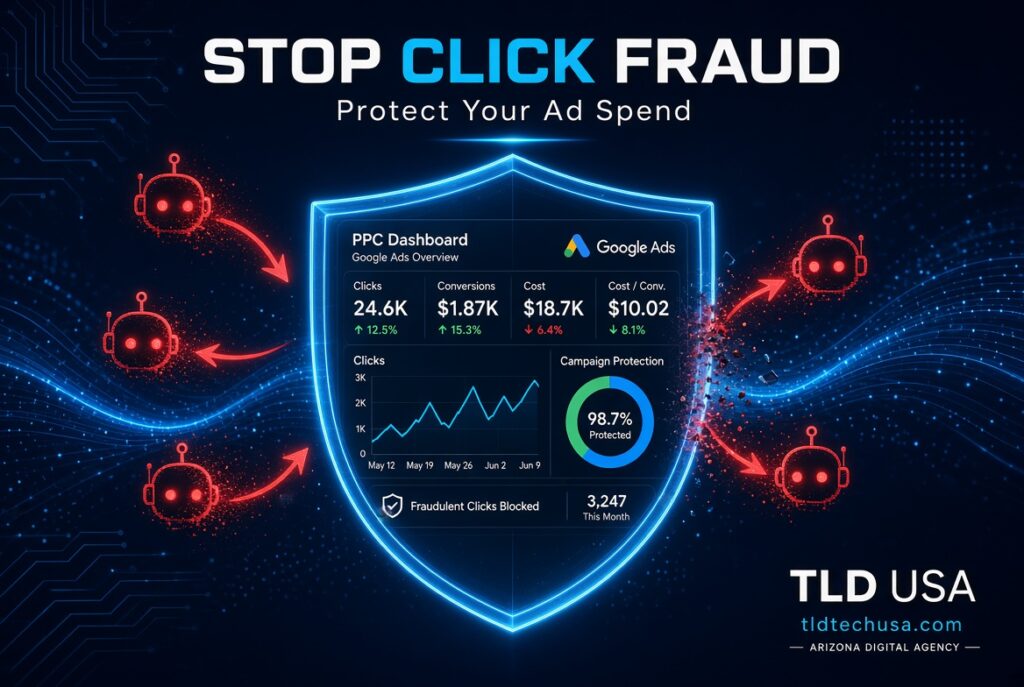
Someone Might Be Clicking Your Ads on Purpose. Here’s How to Tell.

Click fraud on Google Ads affecting Scottsdale and Phoenix businesses by TLD USA

Your Google Ads budget disappears every day, right on schedule, but the phone isn’t ringing to match it.

Before assuming your ads just aren’t working, consider a less obvious possibility: click fraud Google Ads campaigns quietly drain real budget every single day, and it happens far more often than most business owners realize.

Quick answer: Click fraud on Google Ads happens when bots, competitors, or click farms repeatedly click your ads with no real intent to buy, wasting your budget and corrupting your performance data. Industry data consistently shows double-digit invalid click rates across Google Ads, with local service industries like plumbing, HVAC, and legal services hit especially hard. Monitoring your click patterns and setting up IP exclusions are the most effective first steps to fight back.

Table of Contents

  • Why This Costs More Than Just Wasted Spend
  • Who’s Actually Doing This
  • How to Spot Click Fraud in Your Own Account
  • What to Do About It
  • Why Local Service Businesses Get Hit Hardest
  • A Simple Next Step
  • Frequently Asked Questions

Why This Costs More Than Just Wasted Spend

The direct financial hit is obvious.

Every fraudulent click burns real budget on someone who was never going to become a customer.

Still, the bigger problem often runs deeper than that. Google’s Smart Bidding and other automated bidding tools learn from your conversion data. So if fraudulent clicks or fake conversions slip through, the algorithm can start optimizing toward more of that same low-quality traffic, quietly making your entire account worse over time.

Because of that second-order effect, click fraud doesn’t just cost you today’s budget. It can actively steer your campaigns in the wrong direction going forward.

Who’s Actually Doing This

Competitors trying to exhaust your daily budget.

By repeatedly clicking your ads early in the day, a competitor can push your budget to zero fast, then enjoy cheaper, less competitive placement for the rest of the day.

Automated bot networks.

Large-scale bot traffic, sometimes running through infected devices, generates clicks that look like real human traffic to most basic fraud detection.

Low-quality ad placements.

Certain Display Network placements attract disproportionate amounts of accidental or fraudulent clicks, particularly on mobile apps designed to generate accidental taps.

How to Spot Click Fraud in Your Own Account

Watch for unusual click patterns from the same location.

Repeated clicks from a single IP address, especially at the same time of day on the same keywords, is a strong signal.

Compare your click-through rate to your conversion rate over time.

A sudden spike in clicks with no corresponding increase in leads or conversions deserves a closer look.

Check your Display Network placements regularly.

A small number of placements are often responsible for a disproportionate share of low-quality clicks.

Review your geographic and device performance data.

Fraud often concentrates in specific locations or device types that don’t match your typical customer base.

What to Do About It

Set up IP exclusions for repeat offenders. Once you identify a suspicious IP address, excluding it prevents further wasted spend from that specific source.

Use Google’s own invalid click reporting. Google does track and sometimes refund invalid clicks, though its detection generally catches less than independent, dedicated fraud monitoring tools.

Consider a dedicated click fraud protection service for high-spend accounts. For businesses spending significant monthly budget, a real-time monitoring tool can catch and block fraud far faster than manual review.

Keep your conversion tracking clean and accurate. This matters for more than just fraud detection. Our guide on local marketing tracking for Phoenix and Scottsdale businesses covers why accurate tracking is foundational to every marketing decision you make.

Why Local Service Businesses Get Hit Hardest

Industries with high cost-per-click, including plumbing, HVAC, legal services, and other local service categories, are disproportionately targeted. That’s because each fraudulent click costs more in these industries, making them a more attractive target for competitors trying to drain a rival’s budget quickly and cheaply.

If your business operates in one of these categories, click fraud monitoring isn’t an optional add-on. It’s a meaningful part of protecting your actual marketing return.

A Simple Next Step

Wasted ad spend from click fraud is one of the more invisible drains on a marketing budget, precisely because it looks like normal traffic on the surface. A closer look at your account’s click patterns often reveals more waste than expected.

Book a time to review your Google Ads account for click fraud: calendly.com/tldusa480/30min

Frequently Asked Questions

How much of my ad budget is typically lost to click fraud?

Industry data commonly shows double-digit invalid click rates on Google Ads, though this varies significantly by industry and how aggressively you monitor for it.

Does Google Ads automatically filter out fraudulent clicks?

Google does some filtering, but independent research consistently shows its detection catches meaningfully less than dedicated third-party fraud monitoring tools.

Can I get a refund for fraudulent clicks?

Yes, in some cases, if you can provide clear evidence. Google does offer refunds for confirmed invalid clicks when properly documented.

Is click fraud protection worth it for a smaller ad budget?

It depends on your spend level and industry, but even a modest monthly budget in a high-CPC category can justify basic monitoring, since the wasted spend adds up quickly.

Final Thoughts

Click fraud is a quiet, ongoing drain on Google Ads budgets, and it’s easy to mistake for simply “ads that aren’t working.” For Scottsdale and Phoenix businesses running paid search campaigns, a closer look at click patterns often uncovers real, recoverable waste hiding in plain sight.

TLD USA helps local business owners audit and protect their Google Ads campaigns so budget actually reaches real, qualified customers.

Call (623) 282-2114 or book a time directly: calendly.com/tldusa480/30min

One Text Message, $1,500 in Damages. Welcome to TCPA Law.

TCPA text message lawsuit risk for Scottsdale and Phoenix businesses with TLD USA.
A TCPA text message lawsuit can cost $500 to $1,500 per message sent. Learn what triggers these claims and how to keep your SMS marketing compliant.

Text message marketing works. Open rates crush email, and customers respond fast. Unfortunately, that same effectiveness has turned SMS marketing into one of the fastest-growing sources of legal exposure for small businesses. A single improperly sent promotional text can trigger a TCPA text message lawsuit, and the penalties add up per message, not per campaign.

Quick answer: A TCPA text message lawsuit arises when a business sends marketing texts without proper prior written consent, continues texting after someone opts out, or sends messages outside allowed hours. Penalties run from $500 to $1,500 per violation, and since each individual text can count as a separate violation, a single flawed campaign to a modest list can create six or seven figures of potential liability.

Table of Contents

  • Why TCPA Lawsuits Are Rising So Fast
  • What Actually Triggers a Violation
  • The Consent Mistake Almost Everyone Makes
  • Building Compliant SMS Marketing
  • What to Do If You Receive a Demand Letter
  • A Simple Next Step
  • Frequently Asked Questions

Why TCPA Lawsuits Are Rising So Fast

TCPA lawsuit filings have climbed sharply so far this year compared to last. A few factors are driving this. First, SMS marketing has exploded in popularity, giving plaintiffs’ attorneys far more potential violations to pursue. Second, the statutory damages are large enough per message that even a modest list creates meaningful financial exposure. Finally, courts have shown a willingness to certify class actions in these cases, which multiplies the potential payout dramatically.

Because of all this, what used to feel like a low-risk marketing channel has become one that genuinely requires careful compliance.

What Actually Triggers a Violation

Sending marketing texts without proper prior written consent.

Simply having someone’s phone number from a purchase or appointment is not consent to send them promotional messages.

Continuing to text after someone opts out.

Once a customer replies STOP, every message sent afterward is a separate violation, even if it happens by accident through an automated system.

Texting outside allowed hours.

Marketing texts generally cannot be sent before 8 a.m. or after 9 p.m. in the recipient’s local time zone.

Using a purchased or scraped contact list.

Lists acquired from a third party rarely come with valid, documented consent, which makes them a common and serious source of liability.

The Consent Mistake Almost Everyone Makes

Here’s where most businesses get tripped up. A customer gives their phone number for an appointment reminder or a receipt. The business assumes that’s enough to also send promotional offers later. It isn’t. Courts require clear, documented consent specifically for marketing messages, separate from transactional or account-related texts. Without that specific documentation, even a well-intentioned promotional campaign can create real legal exposure.

Building Compliant SMS Marketing

Get explicit, documented consent for marketing texts specifically.

A simple checkbox or opt-in confirmation, separate from transactional consent, closes most of this gap.

Include clear opt-out instructions in every message.

A simple “Reply STOP to unsubscribe” line needs to actually work, immediately and completely.

Keep detailed records of every opt-in and opt-out.

Timestamps, consent language shown at the time, and the method of consent all matter if a claim is ever made.

Respect quiet hours without exception.

Automate your sending schedule so messages simply cannot go out before 8 a.m. or after 9 p.m. local time.

Review your CRM or marketing platform’s compliance features.

A properly configured system can automate consent tracking and opt-out enforcement so compliance doesn’t depend on manual diligence every time. This connects directly to the setup we cover in our guide on CRM for small business.

What to Do If You Receive a Demand Letter

Don’t respond directly without legal counsel.

Anything you say can affect your position, so involve an attorney familiar with TCPA claims before replying.

Pull your consent records immediately.

Documentation showing proper consent and opt-out handling is your strongest defense.

Audit your current SMS practices right away.

Even if the specific claim gets resolved, fixing the underlying process prevents a repeat issue.

A Simple Next Step

SMS marketing remains genuinely effective when it’s done correctly. The businesses running into trouble aren’t the ones using text marketing. They’re the ones running it without proper consent tracking and compliance safeguards in place.

Book a time to review your SMS marketing compliance: calendly.com/tldusa480/30min

Frequently Asked Questions

Can I text customers who gave me their phone number for an appointment?

Not for marketing purposes, unless they separately consented to promotional messages. Transactional consent and marketing consent are treated differently under the law.

How much can a TCPA violation actually cost?

Penalties range from $500 to $1,500 per message. Since each text can count separately, even a modest campaign without proper consent can create significant liability quickly.

What counts as proper consent for marketing texts?

Generally, prior express written consent that clearly explains the type of messages a customer will receive and confirms consent isn’t a condition of purchase.

Is it too late to fix compliance if I’ve already been sending marketing texts?

Auditing your current list, confirming proper consent, and correcting any gaps now significantly reduces ongoing risk, even if past practices weren’t fully compliant.

Final Thoughts

TCPA text message lawsuits are a real and growing risk for any business using SMS marketing, but the fix isn’t abandoning a channel that works. It’s building proper consent tracking and compliance into how that marketing already runs. For Scottsdale and Phoenix business owners relying on text marketing to drive bookings, getting this right protects both revenue and the business itself.

TLD USA helps local business owners set up compliant, properly documented SMS marketing as part of a broader CRM and automation strategy.

Call (623) 282-2114 or book a time directly: calendly.com/tldusa480/30min