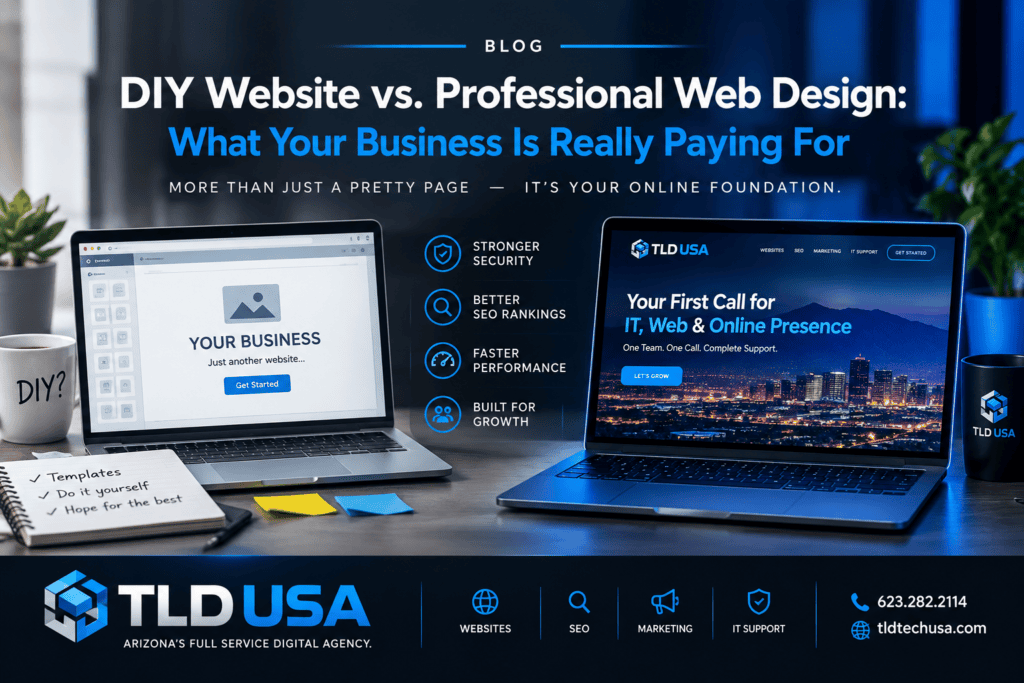
You built your website yourself, and it looks clean. It cost only a few hundred dollars a year. Even so, your phone stays quiet. So why is that happening?
Many Scottsdale and Phoenix business owners ask this exact question. In most cases, the platform is not the problem. Instead, the answer sits behind the design. This guide breaks down the real difference in a DIY website vs. professional web design decision. Along with that, you will see how to tell if your site is working or just sitting there.
Why So Many Scottsdale and Phoenix Businesses Start With a DIY Website
DIY builders solve a real problem. They are fast, cheap, and easy to start. For example, Wix, Squarespace, and GoDaddy let you launch in a weekend. That is a smart move when you are opening a new business.
However, launching a site and winning customers are two different jobs. A DIY site handles the first job. On its own, it does not handle the second one.
DIY Builders Are Not the Problem
Let’s be clear. A site built on Wix or Squarespace can work well. In fact, plenty do. Still, the real problem is the missing strategy. Most DIY sites are built once and never tuned. Meanwhile, your competitors keep improving theirs.
7 Gaps That Cost DIY Websites Customers
Most owner-built sites share the same weak spots. As you read, check your own site against this list.
1. No Local SEO Foundation
Scottsdale and Phoenix are crowded markets. Every service category has dozens of competitors. Therefore, Google needs clear signals to know where you work and what you do.
DIY sites often skip these signals. Common misses include:
- Generic page titles like “Home” or “Services”
- A lack of city or neighborhood terms in your content
- Missing local business schema
- One “Services” page instead of a page for each service
As a result, you do not show up when someone searches for a Phoenix plumber or a Scottsdale accountant.
2. An Unclaimed or Neglected Google Business Profile
Your website and your Google Business Profile work as a team. In fact, many local customers find you on the map before they ever see your site. Consequently, old photos, missing posts, or incomplete categories on your profile cost you those customers.
Ideally, your site should also match your profile exactly. Your name, address, and phone number must be identical in both places.
3. Slow Page Speed
Phones dominate local search. Because of that, a visitor standing in a parking lot will not wait for a heavy page. Large uncompressed images are the most common cause, while too many apps and plugins come second. Slow pages hurt you twice, since visitors leave and Google notices.
4. Weak Mobile Experience
Your site may look great on your laptop. However, the view on your phone can tell a different story. Tiny buttons, hard-to-read text, and forms that are painful to fill out all push people away.
5. No Clear Path to Contact You
Ask yourself one question. What should a visitor do in the first five seconds? If the answer is unclear, they will leave. By contrast, a working site includes:
- A visible, tap-to-call phone number on mobile
- Booking or contact buttons on every page
- A short form that asks for only what you need
- Trust signals like reviews, licenses, and real photos
6. Thin or Copied Content
Many DIY sites use template text. Some pages hold only two or three sentences. As a result, Google has little to work with, and customers learn nothing about why they should pick you.
Strong content answers real questions. For instance, it names your city, explains your process, and shows proof that you know your trade.
7. Security and Email Gaps
Here is the gap most owners never see. A site with no security setup is a risk. In addition, email sent from your domain without proper authentication can land in spam or be spoofed by scammers. Your business email is part of your brand, so if clients do not receive your quotes, you lose sales without knowing it.
DIY Website vs. Professional Web Design: A Side-by-Side Look
| Factor | Typical DIY Site | Professionally Built Site |
|---|---|---|
| Upfront cost | Low | Higher |
| Local SEO setup | Basic or missing | Built in from day one |
| Page speed tuning | Default settings | Optimized and tested |
| Lead capture | Simple contact form | Forms tied to a CRM and follow-up |
| Security and email | Rarely addressed | Configured and monitored |
| Ongoing support | You handle it | Someone watches it for you |
| Strategy | None | Matched to your customers and market |
Notice the pattern. DIY saves money on day one. In contrast, professional design pays off over the following months and years.
The Hidden Cost of “Free” Time
Your time has a price. For example, every hour spent fixing a broken page is an hour not spent serving customers. To see the impact, consider what you earn per hour in your business. Then, count the hours you spend on your website each month.
In addition, weigh the cost of lost leads. If your site misses even a few customers a month, that revenue adds up fast. Because those visitors leave without a trace, you never see them.
When a DIY Website Is Still the Right Choice
We believe in honest advice. Therefore, we will say plainly that DIY may fit you if:
- You are pre-revenue and testing an idea
- Referrals bring in all of your customers
- Learning the tools sounds like a good use of your time
If that sounds like you, keep going. Later on, plan an upgrade for when growth becomes the goal.
When It Is Time to Bring in a Professional
Consider help if any of these are true:
- Google is your main source of new customers, yet you rarely appear in results
- Your site gets visits, but few calls or form fills
- Site speed, rankings, and lead sources are a mystery to you
- Fixing the site has been on your to-do list for months
- Security or email problems worry you
Quick Self-Check: Is Your Website Working for You?
Answer yes or no to each item:
- Does my site load in under three seconds on my phone?
- Can a visitor call or book in one tap?
- Does each service have its own page with local terms?
- Is my Google Business Profile an exact match for my site?
- Are recent reviews displayed on the site?
- Is my domain email set up so messages reach inboxes?
- Do I know how many leads my site produced last month?
Scoring: If you answered no to three or more items, your site is likely leaving money on the table.
What a Professional Website Setup Includes
At TLD USA, we build sites for owner-operated businesses across Scottsdale, Phoenix, and the greater Valley. Our approach covers the full picture:
- Web design and development built for speed and mobile
- Local SEO and Google Business Profile management
- CRM setup and automation so no lead slips away
- Cybersecurity and email security that protect your brand
- Fractional IT support, starting at $250 per month
Furthermore, we work with the platform you already have. You do not always need a rebuild. Instead, a focused fix on your current Wix, Squarespace, or GoDaddy site sometimes delivers the biggest win.
Get a Straight Answer About Your Website
Not sure where your site stands? Let’s look at it together. Afterward, we will point out the gaps and tell you plainly what is worth fixing.
Call us at (623) 282-2114, or book a free 30-minute call at a time that suits you.