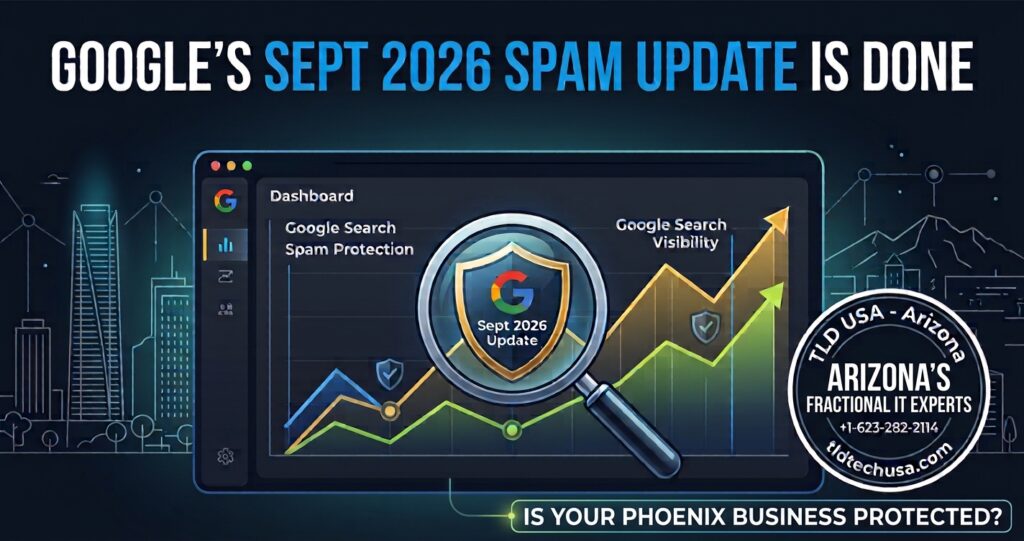
Google just finished a two-week update.
Two.
Weeks.
Spam updates usually wrap up in a couple of days, so this one took the scenic route and made everyone’s rank tracker sweat along the way.
Here’s the plot twist.
It wasn’t a core update.
Google called it a normal spam update. Plenty of us SEO guys and gals say it felt like a core update.
Both can be true, and that’s exactly why your Monday morning traffic report looked like a rollercoaster.
So what happened?
What does it mean for a small business in Phoenix or Scottsdale? And what should you actually do about it?
Grab your coffee.
We’ll keep it short and only a little dramatic.
The Quick Facts
Here’s the timeline, based on reporting from Search Engine Roundtable and Search Engine Watch:
- Name: Google September 2026 Spam Update
- Started: Thursday, September 24, 2026, around 12:00 p.m. ET
- Finished: October 8, 2026, at 4:37 a.m. ET
- Where it applied: Globally and in all languages
- Who it targets: Sites that violate Google’s spam policies
- The unusual part: It took almost two weeks. Previous spam updates took about two days.
- Reported volatility: September 25 to 27, September 30, and October 4 to 6
Google announced the rollout on its Search Status Dashboard and confirmed it was complete on October 8.
Wait, So When Was the Last Core Update?
Great question, because the internet keeps mixing these up.
A core update and a spam update are two different things.
- Core updates are broad adjustments to how Google ranks content. The most recent one ran from May 21 to June 2, 2026, according to Search Engine Land. The one before that ran from March 27 to April 8.
- Spam updates improve Google’s ability to catch sites that break its spam rules. Google’s AI-based system for this is called SpamBrain.
As of this writing, Google hasn’t announced a new core update.
However, plenty of people expect one.
Search Engine Roundtable’s Barry Schwartz said he wouldn’t be surprised if one lands soon, and Coalition Technologies argues the timing makes another one unsurprising.
Nobody knows the date, though.
Anyone who tells you otherwise is either guessing, a bold face liar, selling something, or both.
What Does a Spam Update Actually Target?
Google’s spam policies cover the usual suspects: keyword stuffing, cloaking, sneaky redirects, hacked content, and mass-produced low-value pages.
Google didn’t announce any specific policy changes with this update, so we can’t tell you exactly what it targeted. Instead, Google’s advice is simple: review the spam policies and make sure your site complies.
Here’s the part most small business owners miss. You don’t have to be a bad actor to get caught in spam territory. A few common ways it happens:
- Your website got hacked. Hackers love injecting sketchy pages and links into old, unpatched sites. You’d never know, because the page isn’t on your menu.
- An old agency or freelancer left behind junk. Hidden text, keyword-stuffed pages, and mystery redirects don’t age well.
- Your site is a pile of thin pages. Fifty near-identical “plumber near me” pages aren’t a strategy.
- A plugin or theme went rogue. Abandoned plugins are the open window of the internet.
In short, a website that nobody looks after is a website that can get weird.
And Google doesn’t send you a polite text about it.
Why Small Business Owners Should Care
Let’s be real.
You didn’t start a business to read algorithm updates.
You started it to serve customers.
So here’s why this matters anyway.
1. Rankings can drop quietly – and QUICKLY!
No alarm goes off. Your calls just slow down, and you blame the weather. Or maybe the economy, maybe Mercury is in Retrograde – but usually you just yell at your SEO guy.
2. Recovery isn’t instant – NOT EVEN CLOSE!
According to Google’s own spam update documentation, sites that violate its policies may rank lower or not appear at all.
Improvements can take months, because Google’s automated systems have to learn over time that you’re following the rules.
And if you had policy violations in the past, you remain flagged throughout the process.
Google also says spam updates get periodic refreshes.
3. Prevention is much cheaper than a rescue mission – BY ALOT!
A clean, secure, well-maintained website costs far less than a recovery project.
That’s not a scare tactic.
It’s math + fact.
“My Traffic Dipped. Now What?”
Deep breath.
Here’s a calm, five-step plan:
- Compare the right dates. Open Google Search Console and compare your performance before and after September 24. This is the same approach Search Engine Watch recommends.
- Check for red flags. In Search Console, look for security issues and manual actions. If something’s listed, call us.
- Scan your site for things you didn’t create. Strange pages, odd redirects, and unfamiliar links are all warning signs.
- Review Google’s spam policies. Be honest about what’s on your site.
- Fix, then keep going. Update software, remove junk, improve thin pages, and keep publishing real, helpful content. Don’t panic-rewrite your whole site. Wait for the dust to settle and measure again, then do page by page if needed.
Also, one caution.
Not every dip is a penalty.
Rankings move for lots of reasons, including competitors, seasonality, and AI changes.
We covered some of that in Why AI Overviews Are Killing Your Business.
The Spam-Proof Checklist
Be honest.
We won’t tell anyone.
- Is your website platform, theme, and every plugin up to date?
- Do you know who has admin access to your website?
- Are your passwords strong, unique, and not on a sticky note?
- Have you checked Google Search Console for security issues in the last 30 days?
- Do you have a recent backup you’ve actually tested?
- Can you name every page on your site and why it exists?
- Did anyone outside your company ever “help” with your SEO? Do you know what they did?
- Is your email protected against phishing? (Someone will click the “your package is delayed” email. Someone always does.)
If you answered “no” or “uh…” to two or more, a quick check-up is overdue.
How TLD USA Helps (Without the Panic)
Here’s the good news.
You don’t need a full-time IT team to stay out of trouble.
Our fractional plans give you real help in affordable blocks. $250 buys a 4-hour block. Most small businesses benefit from one or two.
Here’s what a block can cover:
- Website health check: We look for outdated software, suspicious pages, and anything that makes Google (or visitors) nervous. See our website design and development services.
- Search Console review: We check for security issues, manual actions, and ranking changes around key dates like September 24.
- Security and email protection: Backups, updates, and phishing defense. Learn more about email security and cloud migration, and read why it matters in our post on the Arizona court system cyber attack.
- Local SEO cleanup: Better pages, cleaner structure, and clearer signals. Explore our local SEO services.
- Google Business Profile support: Keep your listing accurate and active. See Google Business Profile management. For more on the September changes, read our earlier post on Google’s September updates and your GBP dashboard.
- Ongoing help: Our fractional IT support plans start at $250 per month for 4 hours. No full-time hire. No 3-to-5 business day replies from your cousin.
Not sure whether social or Google deserves more attention? We break it down in Google Traffic vs Social Media.
We proudly serve businesses across Phoenix and Scottsdale and Nationwide.
Frequently Asked Questions
Was the September 2026 update a core update?
It was not. Google labeled it a spam update. Some SEOs say it felt as impactful as a core update, but Google hasn’t called it one.
When did the update start and finish?
It started September 24, 2026, and finished October 8, 2026. That’s almost two weeks.
How long does it take to recover from a spam update?
It depends. Google says its systems may need months to learn that a site is following its spam policies. Fix the issues, keep your site clean, and stay consistent.
Does this update affect my Google Business Profile?
Google described this as a search spam update tied to its spam policies, not a Business Profile update. Your listing still has its own guidelines, so keep both your site and your profile clean and accurate.
Is another core update coming?
Nobody outside Google knows. Many SEOs expect one, but Google hasn’t announced a date. The best plan is to keep your site healthy so you’re ready whenever it happens.
Don’t Wait for the Next Update to Find Out
Google updates its systems constantly.
Your website shouldn’t wait for a crisis to get attention.
Book a free 15-minute digital checkup, and we’ll tell you what’s helping, what’s hurting, and what to fix first.
No jargon. No pressure. Just a plan.
- Call: (623) 282-2114
- Book online: calendly.com/tldusa480/30min
- Web: tldtechusa.com
Your customers are searching right now.
Let’s make sure Google likes what it finds.