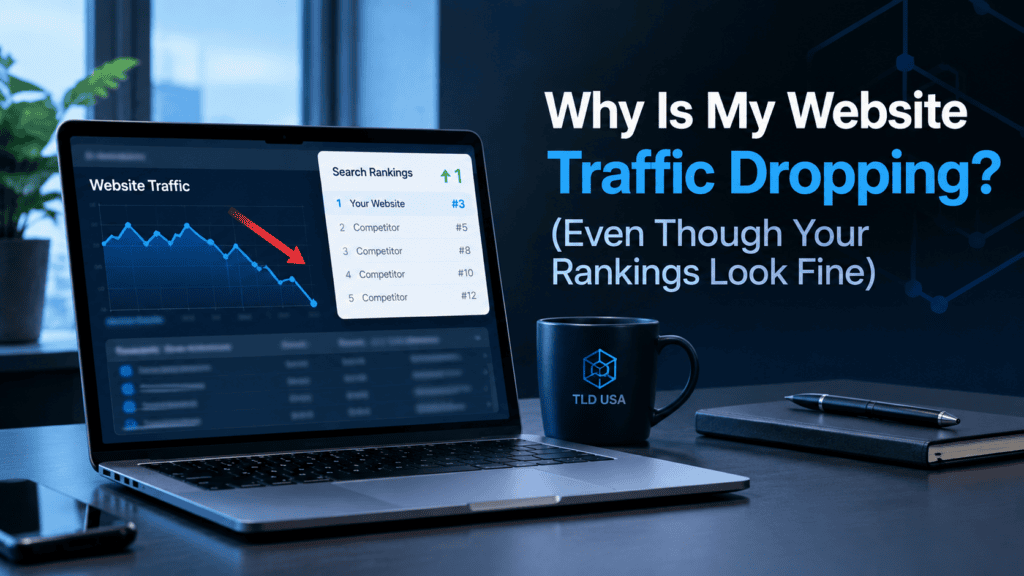
You’ve checked Google Search Console three times this week.
Impressions are stable.
Rankings haven’t moved.
Yet clicks are down 20, 30, sometimes 40 percent.
You haven’t changed anything. If that sounds familiar, you’re not imagining it, and you’re far from alone. Why is my website traffic dropping has become one of the most common questions business owners ask right now. The answer almost always traces back to the same thing: AI Overviews.
Quick answer: Website traffic is dropping for most businesses in 2026 because Google’s AI Overviews now answer many searches directly on the results page. Users never click through to a website at all. People call this zero-click search, and industry data shows well over half of all Google searches now end without a click. The fix isn’t abandoning SEO. It’s restructuring content so it gets cited inside those AI answers instead of losing visibility to them.
Table of Contents
- Why This Is Happening to So Many Websites Right Now
- How to Diagnose Your Specific Traffic Drop
- The Silver Lining Most Business Owners Miss
- What Actually Gets Your Content Cited
- What This Means Specifically for Local Businesses
- A Simple Next Step
- Frequently Asked Questions
Why This Is Happening to So Many Websites Right Now
Google’s AI Overviews now appear on a large and growing share of search results. The feature pulls together a direct answer from multiple sources into one paragraph, shown right above the traditional results. When that happens, a meaningful share of searchers get what they need without clicking anywhere at all. Industry research consistently shows organic click-through rates drop sharply whenever an AI Overview appears.
Small and mid-sized business websites take the hardest hit. That’s largely because AI Overviews trigger most often on informational, comparison, and local queries. Small business content lives almost entirely in that territory. So this isn’t a penalty, and it isn’t a sign your content got worse. The rules changed underneath everyone at the same time.
How to Diagnose Your Specific Traffic Drop
Step 1: Check whether your rankings actually moved. Open Google Search Console and compare your average position for key pages over the last six months. If rankings held steady while clicks dropped, that points directly to AI Overviews or another zero-click feature, not a ranking problem.
Step 2: Identify which specific pages lost traffic. Pull organic traffic by landing page. Compare recent months to the same period last year. Pages that lost traffic despite stable rankings are your AI Overview casualties.
Step 3: Search your own target keywords manually. Check whether an AI Overview now appears for the exact questions your top pages answer. If it does, and your site isn’t cited as a source, that page is likely losing clicks directly to that summary.
Step 4: Rule out seasonality and other SERP features first. Compare like periods, not just recent months against older ones. Normal seasonal patterns can look similar to an AI Overview impact at first glance.
Step 5: Check whether a competitor is being cited instead of you. If a competitor’s content appears inside the AI Overview for your target keywords, that traffic and visibility go to them instead of you, even when your ranking position hasn’t changed at all.
The Silver Lining Most Business Owners Miss
Here’s the part most of the panic around this shift misses. AI Overviews don’t pull exclusively from major publications or high-authority domains with years of backlinks behind them. Any page structured clearly enough for the AI to extract a direct answer can earn a citation, regardless of how long the site has existed. A small, well-structured local business page can earn a spot right alongside a national brand for the same query.
That’s a genuine opportunity search hasn’t historically offered smaller sites. Businesses cited inside an AI Overview tend to see meaningfully more organic clicks than businesses ranking on the same page without a citation. Even the impression alone still carries brand value. When your business name appears inside an AI-generated answer, the searcher sees it, even without clicking through.
What Actually Gets Your Content Cited
Answer placement matters more than almost anything else. A direct, clearly written answer near the top of the page, before background information or extended explanation, earns citation far more often.
Structure beats length. Clear headings, short paragraphs, and content organized around specific questions outperform long, unstructured pages, even when the unstructured page contains more total information.
Specificity outperforms generic coverage. Content that answers a precise, specific question earns a citation more reliably than broad content covering a topic at a surface level.
Freshness and accuracy still matter. AI systems trust recent, accurate content more than outdated information or stale statistics.
This connects directly to the broader shift we cover in our guide on AI search visibility for local business, which goes deeper into the signals AI systems look for across Google, ChatGPT, and other platforms.
What This Means Specifically for Local Businesses
Google kept expanding AI Overviews into local, commercial, and comparison searches throughout 2026. That’s exactly the territory most local service business websites depend on. If you run a business relying on searches like “best plumber near me” or “how much does X cost in Phoenix,” this isn’t a future concern. It’s likely already showing up in your analytics right now.
The businesses adapting well aren’t the ones abandoning content and SEO altogether. They’re restructuring their existing content around clear, direct answers, positioning themselves to earn citations rather than get buried. For more on how this fits into the broader 2026 search landscape, our recap of Google’s 2026 algorithm updates covers the platform-wide changes driving this shift.
A Simple Next Step
A confusing traffic drop, with rankings intact but clicks disappearing, almost always has an identifiable cause once you know where to look. Diagnosing the specific affected pages and restructuring them for AI citation works far better than guessing or abandoning your content strategy altogether.
Book a time to diagnose your traffic drop and build an AI citation strategy: calendly.com/tldusa480/30min
Frequently Asked Questions
Why did my website traffic drop even though my rankings stayed the same? This almost always points to AI Overviews or another zero-click search feature answering the query directly on the results page. Your page still ranks well, but users never click through.
Is this a Google penalty? No. This is a structural shift in how search results work, not a penalty against your specific website. Google isn’t ranking your content lower; it’s simply answering more questions directly.
Can small businesses actually get cited inside AI Overviews? Yes. AI Overviews pull from any clearly structured, well-answered page, regardless of domain authority or site size. That creates a real opportunity for smaller, well-optimized local business sites.
Should I stop investing in SEO and content because of AI Overviews? No. Restructure your content for clear, citable answers instead of abandoning SEO altogether. Businesses that adapt their content structure keep seeing strong results despite the overall shift toward zero-click search.
How long does it take to see results after restructuring content for AI citation? Results vary, but content changes generally need a few weeks to a few months to show measurable impact, similar to other SEO and content-driven improvements.
Final Thoughts
If your website traffic is dropping in 2026, you’re dealing with a real, well-documented, industry-wide shift, not a mistake you made or a penalty you triggered. AI Overviews and zero-click search have changed how people find information. Still, the businesses restructuring their content around clear, specific, well-placed answers are finding a genuine opportunity inside a shift most competitors haven’t adapted to yet.
TLD USA helps Phoenix and Scottsdale business owners diagnose traffic loss, restructure content for AI citation, and rebuild visibility in a search landscape that keeps changing.
Call (623) 282-2114 or book a time directly: calendly.com/tldusa480/30min