Google’s November 2026 Core Update Just Wrapped Up (And Yes, It Picked Thanksgiving Week on Purpose)
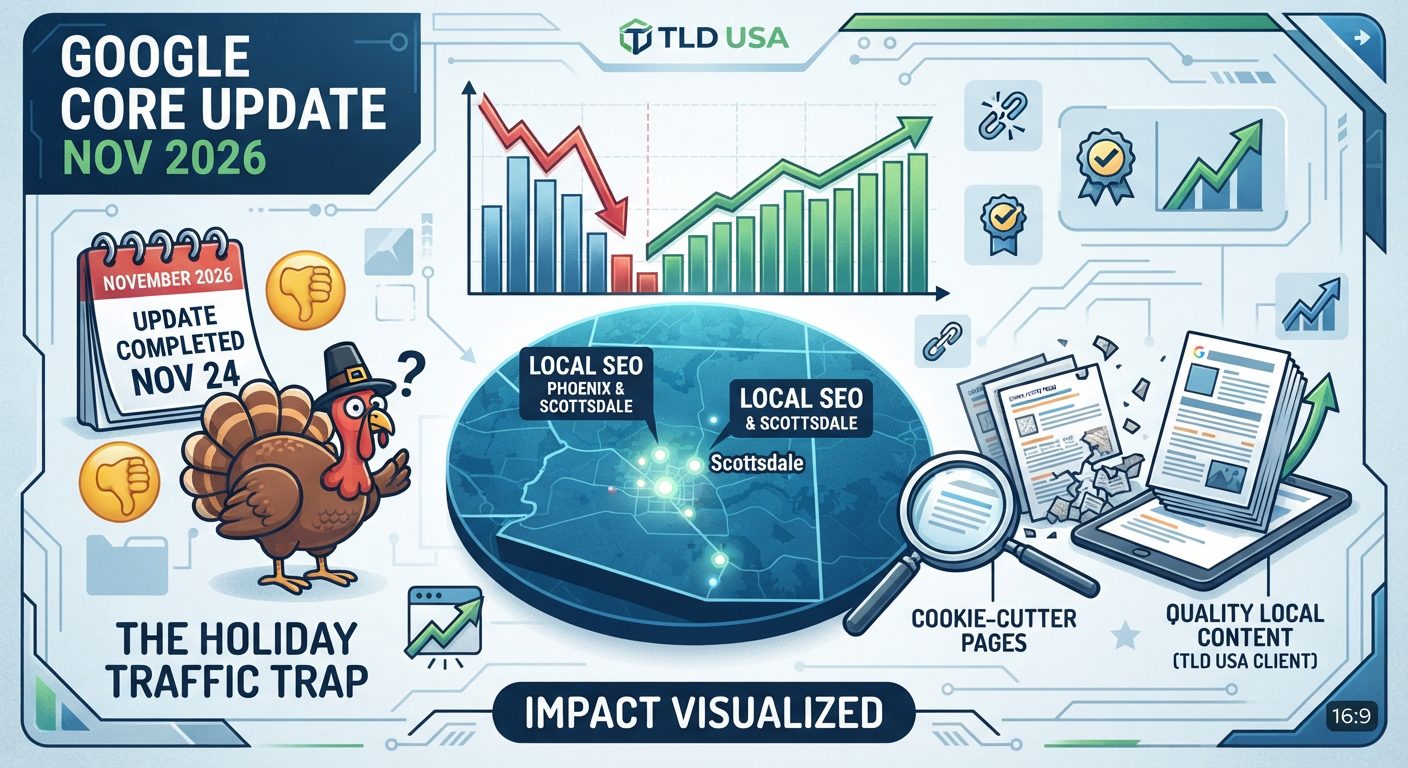
Nothing says “Happy Holidays” quite like Google reshuffling the entire internet right before turkey, Black Friday, and Cyber Monday. After a roughly five-and-a-half-month quiet stretch since the May 2026 update, Google officially rolled out the November 2026 Core Update from November 10 through November 24, 2026—completing its 14-day global rollout just in time for business owners across Phoenix and Scottsdale to stare at their analytics over leftover stuffing.
And because Google clearly thought one holiday plot twist wasn’t enough, it also took the rare step of pre-announcing that a December 2026 Core Update is already queued up next. If your website traffic looked like a rollercoaster this month, take a breath before rewriting your entire site. Here is what actually happened, what the data is showing in our visualization above, and how to separate real SEO changes from normal holiday noise.
The Hard Facts: What We Know About the November 2026 Core Update
When Google releases a broad core update, the internet immediately fills up with wild theories from people who swear they “cracked the code” twenty minutes after launch. Skip the rumor mill—here are the verified facts from Google’s Search Status Dashboard and early industry tracking:
- Exact Rollout Window: Started November 10, 2026, and officially finished November 24, 2026 (right on schedule inside the two-week window).
- Third Core Update of 2026: Following the March and May core updates, this marked the first broad core reshuffle in roughly 173 days.
- AI Search Changes Landed at the Same Time: During the exact same week, Google rolled out major model upgrades inside AI Mode in Search, meaning shifts in your clicks or impressions could come from traditional organic rankings, AI answer citations, or both.
- Global & All Languages: No industry or region was excluded—whether you run a law firm in central Phoenix, a home service company in Scottsdale, or an e-commerce brand nationwide, your pages were re-evaluated.
Who Got Hit—And Why Some Sites Actually Won
Core updates do not issue “penalties” the way spam updates do. Instead, Google re-measures which pages genuinely solve a searcher’s problem versus which pages were built strictly to game a keyword list. As illustrated in the “Impact Visualized” section of our graphic, the divergence is clear:
1. Mass-Produced “Cookie-Cutter” Pages Took a Beating
Sites carrying huge folders of repetitive, templated pages—think hundreds of near-identical “Service X in Neighborhood Y” pages or automated “Product A vs. Product B” filler posts—saw sharp drops in both organic rankings and AI Overview citations. If ten pages on your site say the exact same thing with only the city name swapped out, Google noticed.
2. Real Core Service & Brand Pages Held Strong
While bloated, low-value blog archives slipped, clean core service pages, authentic local businesses, and sites with clear expertise held steady or climbed. In plain English: one thorough, genuinely helpful page written for an actual human beats twenty thin pages written to appease an algorithm.
The Holiday Data Trap: Don’t Panic-Edit Your Website This Week
Google’s standard advice after any core update is to wait at least a full week after completion—putting us around December 1, 2026—before comparing your Search Console performance against a pre-update baseline like November 3–9.
There is just one hilarious catch with comparing November 3–9 to November 25–December 1: Thanksgiving, Black Friday, and Cyber Monday sit squarely in the middle of the “after” week.
- If you sell retail or gifts: A massive traffic spike this week might just be holiday shoppers, not sudden SEO enlightenment.
- If you run a B2B company, medical practice, or local service business: A dip in calls or form fills over Thanksgiving weekend does not mean Google blacklisted you—it means your customers were eating pie and watching football instead of requesting quotes.
To get an honest read, compare your late-November 2026 numbers against the same Thanksgiving week in 2025, and filter your Google Search Console data page-by-page rather than looking at one giant sitewide graph.
Your Action Plan Before the December 2026 Core Update Hits
With Google already confirming another core update for December, tearing up pages that are still ranking well is the fastest way to break something that isn’t broken. Instead, focus on durable fundamentals:
- Audit Your Weakest Content Folders: Look in Google Search Console for old blog posts or location pages that get zero clicks and consolidate or upgrade them with real, specific local value.
- Show Real-World Proof: Make sure your service pages clearly reflect who you are, where you operate, your actual process, and real client outcomes—not generic stock-text fluff.
- Keep Your Technical House Clean: Fast load times, clean mobile layouts, accurate schema markup, and an active Google Business Profile give your site stability no matter how often Google tweaks the dials.
Want a Straight-Talking Checkup on Your November Search Data?
If your rankings shifted this month—or you want your website tightened up before Google’s December core update rolls out—TLD USA builds custom, high-performing websites and local SEO strategies without long-term lock-in contracts.
Stop guessing at your analytics. Reach out to TLD USA at , or call (480) 493-2228 for an honest look at where your site stands.